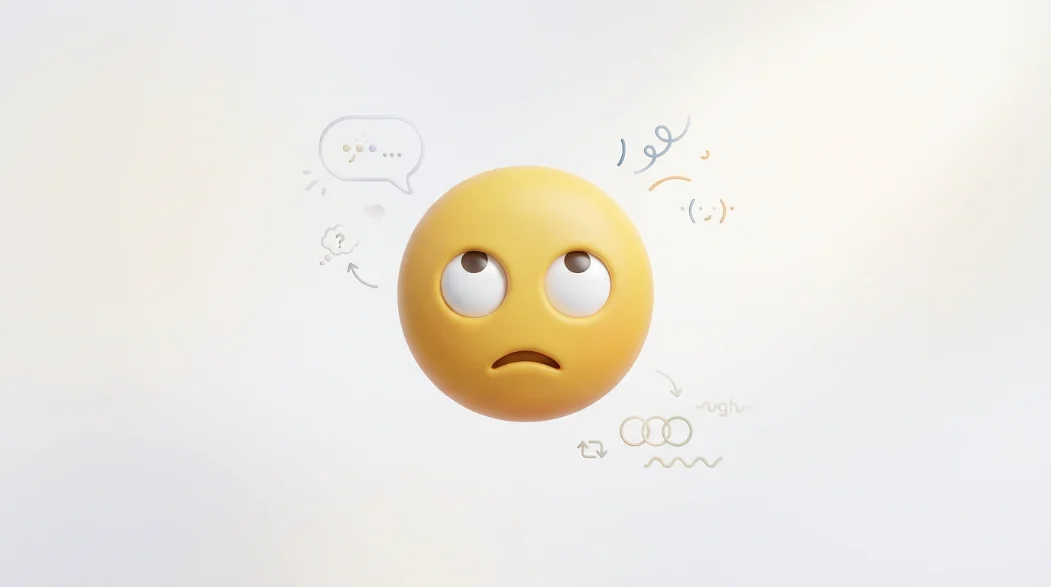
Quick Answer:
The rolling eyes emoji 🙄 usually expresses annoyance, disbelief, impatience, sarcasm, or an unimpressed reaction.
Its exact tone depends on the message and can range from playful teasing to genuine irritation.
The rolling eyes emoji 🙄, officially called Face with Rolling Eyes, is commonly used when someone feels annoyed, unimpressed, skeptical, or tired of what is being said. The upward-looking eyes create the visual impression of an eye roll, a reaction people often use when something seems ridiculous, frustrating, repetitive, or hard to believe. Unicode identifies 🙄 as U+1F644, and the character was included in Unicode 8.0.
In texting, 🙄 can be serious, sarcastic, or completely playful. Someone might use it to react to an annoying comment, exaggerate a joke, or show that they are not impressed. The words around the emoji matter. A message like “Sure, whatever 🙄” feels dismissive, while “You are so dramatic 🙄😂” may simply be friendly teasing. Context is what gives the emoji its final tone.
What Does the Rolling Eyes Emoji 🙄 Mean?
The rolling eyes emoji usually represents an eye roll.
An eye roll can communicate several related reactions:
- Annoyance
- Disbelief
- Impatience
- Exasperation
- Skepticism
- Disapproval
- Sarcasm
- Being unimpressed
- “Here we go again”
- “Seriously?”
The emoji is often used as a reaction rather than as the main subject of a message.
For example:
“He told the same story again 🙄”
Here, 🙄 suggests that the sender is tired of hearing the story.
Another example:
“You forgot your keys again 🙄”
This may express mild frustration or playful teasing.
The emoji does not automatically mean anger. The intensity depends on the surrounding words and the relationship between the people communicating.
🙄 Meaning in Text Messages
In texting, 🙄 often works like a visual version of saying:
“Seriously?”
“Oh, please.”
“Here we go again.”
“I can’t believe this.”
“That’s ridiculous.”
“I’m not impressed.”
“Whatever.”
For example:
“You said you were going to be five minutes late 🙄”
This can suggest that the sender is frustrated because the other person is late again.
Or:
“He thinks he’s the best cook 🙄😂”
The added 😂 makes the eye roll feel more humorous than hostile.
This is why you should not interpret 🙄 in isolation. The rest of the message can completely change how it feels.
The Emotional Tone of 🙄
The rolling eyes emoji has a stronger negative tone than many neutral reaction emojis, but it is still flexible.
Annoyed
“You keep doing that 🙄”
The sender is showing genuine irritation.
Sarcastic
“Yeah, because that worked so well last time 🙄”
The emoji strengthens the sarcasm.
Unimpressed
“That’s your excuse? 🙄”
The sender does not find the explanation convincing.
Playful
“You are impossible 🙄😂”
Here, the emoji may be teasing rather than genuinely angry.
Exasperated
“Not this again 🙄”
The sender feels tired of dealing with the same situation.
Does 🙄 Mean Sarcasm?
It can, but sarcasm is not the only meaning.
The rolling eyes emoji is often paired with sarcastic statements because an eye roll naturally adds an exaggerated sense of disbelief or mock annoyance.
For example:
“Wow, what an amazing excuse 🙄”
The wording and emoji together strongly suggest sarcasm.
But:
“I have explained this three times already 🙄”
may be genuine frustration rather than sarcasm.
So, 🙄 can signal or strengthen sarcasm, but the emoji itself does not guarantee that a message is sarcastic.
Is the Rolling Eyes Emoji Rude?
It can feel rude or dismissive, especially when used in a serious conversation.
For example:
“I was trying to explain what happened.”
“🙄”
A response like this may make the other person feel that their explanation is being ignored or mocked.
However, between close friends, the same emoji can be harmless teasing:
“You really bought another pair of sneakers? 🙄😂”
The relationship and context make a major difference.
If the conversation is sensitive, using 🙄 may come across more negatively than intended.
Is 🙄 Flirty?
The rolling eyes emoji is not normally a flirting emoji.
It can appear in playful or flirty conversations, but its basic meaning is still an eye roll, annoyance, teasing, or disbelief.
For example:
“You know you missed me 🙄”
This could be playful flirting if the surrounding conversation already has that tone.
But:
“You seriously forgot our plans 🙄”
is more likely to express frustration.
The emoji alone does not prove romantic interest.
What Does 🙄 Mean From Someone?
When someone sends you 🙄, they may be communicating:
- “I’m annoyed.”
- “I don’t believe you.”
- “That’s ridiculous.”
- “You’re being dramatic.”
- “I’ve heard this before.”
- “I’m not impressed.”
- “Seriously?”
- “I’m teasing you.”
The exact interpretation depends heavily on the message.
Example
“You really think you’re going to finish that in five minutes? 🙄”
This likely expresses skepticism.
“You and your obsession with coffee 🙄😂”
This is more likely playful teasing.
“Fine, do whatever you want 🙄”
This sounds more dismissive and potentially irritated.
🙄 Meaning in Relationships
In relationships, 🙄 can have several different meanings.
A partner might use it during playful teasing:
“You always steal the blankets 🙄😂”
That can be affectionate teasing.
But the same emoji can also appear during an argument:
“You never listen to me 🙄”
In that situation, the emoji may reinforce frustration or dismissal.
It is therefore risky to assume that 🙄 always means anger or always means playful affection. Look at the complete conversation.
Rolling Eyes Emoji and Sarcasm
🙄 is especially useful when someone wants to give a sentence an ironic or sarcastic edge.
Compare:
“Sure, that sounds like a great idea.”
This could be sincere.
“Sure, that sounds like a great idea 🙄”
Now the speaker may be signaling that they actually think the idea is questionable or ridiculous.
The emoji gives the reader an additional clue about tone.
However, sarcasm can still be misunderstood in text. If the subject is serious, clear wording is safer than relying entirely on an emoji.
Emojis Similar to the Rolling Eyes Emoji
| Emoji | Official Name | Common Meaning | Tone | Where or When It Is Used |
|---|---|---|---|---|
| 🙄 | Face with Rolling Eyes | Annoyance, disbelief, sarcasm, or exasperation | Sarcastic, irritated, playful | Reactions to frustrating or ridiculous comments |
| 😒 | Unamused Face | Displeasure, irritation, skepticism, or boredom | Unimpressed, negative | When something is disappointing or irritating |
| 😑 | Expressionless Face | Lack of reaction, awkwardness, or emotional exhaustion | Flat, dry | When words do not seem worth a reaction |
| 😏 | Smirking Face | Smugness, slyness, flirtation, or suggestiveness | Sly, playful | Teasing, confidence, or suggestive comments |
| 🤨 | Face with Raised Eyebrow | Doubt, questioning, suspicion, or skepticism | Skeptical | When something seems questionable |
| 😤 | Face with Steam From Nose | Frustration, anger, determination, or triumph | Intense | Strong reactions and heated situations |
| 😬 | Grimacing Face | Awkwardness, discomfort, or nervousness | Awkward, uneasy | Uncomfortable situations or difficult reactions |
| 🤦 | Person Facepalming | Frustration, embarrassment, disbelief, or “I can’t believe this” | Exasperated | Mistakes, bad decisions, or ridiculous situations |
The closest alternatives are 😒 Unamused Face and 🤨 Face with Raised Eyebrow.
The difference is subtle but useful. 🙄 focuses on eye-rolling and exasperation, while 😒 tends to communicate a more steady feeling of being unimpressed or displeased. 🤨 is more about questioning or suspicion than annoyance. Emojipedia describes 😒 as conveying irritation, displeasure, grumpiness, and skepticism, while Unicode’s CLDR annotations associate 🙄 with terms such as “eyeroll,” “shade,” “ugh,” and “whatever.”
🙄 vs. 😒
These two emojis are easy to confuse.
🙄 Rolling Eyes suggests:
“Oh, come on.”
😒 Unamused Face suggests:
“I’m not impressed.”
For example:
“You forgot again 🙄”
This emphasizes frustration with repeated behavior.
“That’s your best answer? 😒”
This emphasizes displeasure or lack of enthusiasm.
🙄 vs. 🤨
The difference is mainly annoyance versus questioning.
🙄 says:
“Seriously?”
🤨 says:
“Are you sure?”
Use 🤨 when you are questioning whether something is true or makes sense.
Use 🙄 when you are more focused on being unimpressed, annoyed, or exasperated.
🙄 vs. 😏
These emojis can sometimes appear in playful conversations, but they have very different meanings.
🙄 is generally about irritation, sarcasm, or an eye roll.
😏 Smirking Face can communicate smugness, slyness, flirtation, or suggestiveness.
So:
“You think you’re funny 🙄”
sounds like teasing or annoyance.
While:
“I know you liked that 😏”
can have a more suggestive or flirtatious tone.
Text Message Examples
1. Genuine annoyance
“You forgot to send it again 🙄”
Likely meaning: The sender is frustrated because the same thing happened again.
2. Playful teasing
“You really watched that movie three times? 🙄😂”
Likely meaning: The sender is teasing rather than seriously criticizing.
3. Sarcasm
“Oh yes, because that will definitely solve everything 🙄”
Likely meaning: The sender does not actually believe the idea will solve the problem.
4. Disbelief
“You paid that much for it? 🙄”
Likely meaning: The sender is surprised and unimpressed by the price.
5. Exasperation
“Here we go again 🙄”
Likely meaning: The sender is tired of a repeated situation.
Common Misunderstandings About 🙄
It does not always mean anger
Someone can use 🙄 to show mild annoyance, playful teasing, sarcasm, or simple disbelief.
It does not automatically mean someone dislikes you
A friend or partner may use it jokingly without having negative feelings toward you.
It is not automatically sarcastic
The surrounding sentence determines whether the eye roll is sarcastic, serious, or playful.
It does not prove someone is being rude
The emoji can feel dismissive in certain situations, but its tone depends on the relationship and conversation.
It does not prove flirting
Even when used in a playful conversation, 🙄 should not be treated as evidence of romantic interest.
How to Respond to 🙄
The best response depends on why the person used it.
- If they are joking
“😂 What did I do now?”
- If they seem annoyed
“Okay, fair point.”
- If they disagree with you
“What part do you disagree with?”
- If you’re unsure
“Are you serious or are you joking? 😂”
- If the conversation is becoming tense
“I’m not trying to argue. I just wanted to explain.”
You do not need to respond with another reaction emoji. A short, clear reply is often better when the tone is uncertain.
Copy and Paste the Rolling Eyes Emoji
🙄
You can copy and paste it into texts, comments, captions, or social posts.
Some combinations include:
- 🙄😂 for playful annoyance
- 🙄🤦 for exasperation
- 🙄😒 for stronger displeasure
- 🙄🤨 for skepticism
- 🙄💀 for exaggerated disbelief
- 🙄😭 for dramatic frustration
The combination can change the overall tone, so use it based on the message you want to convey.
Official Name and Technical Details
The official Unicode name of 🙄 is FACE WITH ROLLING EYES.
- Emoji: 🙄
- Unicode code point: U+1F644
- Official name: Face with Rolling Eyes
- Unicode version: 8.0
- Emoji version: 1.0
Unicode lists U+1F644 as FACE WITH ROLLING EYES. The emoji was included in Unicode 8.0, released in 2015.
The emoji’s visual design can differ between platforms. Earlier Samsung artwork, for example, displayed 🙄 differently from the intended rolling-eyes expression, which could create confusion about its meaning. Samsung later adjusted the design to better match other vendors.
Frequently Asked Questions
What does 🙄 mean?
🙄 usually means eye-rolling, annoyance, disbelief, sarcasm, impatience, or being unimpressed.
What does 🙄 mean in texting?
In texting, 🙄 can mean “seriously?”, “whatever,” “that’s ridiculous,” or “I’m not impressed.” The exact meaning depends on the surrounding message.
Is 🙄 a rude emoji?
It can be. In a serious conversation, 🙄 may come across as dismissive or disrespectful. Among friends, it may simply be playful teasing.
Does 🙄 mean sarcasm?
It can signal sarcasm, especially when paired with an exaggerated or obviously ironic statement. However, it does not automatically mean sarcasm.
Is 🙄 a flirty emoji?
Not usually. 🙄 is primarily associated with eye-rolling, annoyance, disbelief, or playful exasperation.
What is the difference between 🙄 and 😒?
🙄 emphasizes an eye roll and often carries exasperation or sarcasm. 😒 generally expresses being unamused, displeased, irritated, or skeptical.
What is the difference between 🙄 and 🤨?
🙄 usually communicates annoyance or disbelief, while 🤨 is more strongly associated with questioning, suspicion, or doubt.
What is the official name of 🙄?
The official Unicode name is Face with Rolling Eyes. Its Unicode code point is U+1F644.
Conclusion
The rolling eyes emoji 🙄 is mainly used to express annoyance, disbelief, sarcasm, impatience, or an unimpressed reaction. It can also be playful when friends use it to tease each other.
The most important thing to remember is that 🙄 does not have one fixed emotional intensity. The words, relationship, and situation determine whether it feels funny, sarcastic, dismissive, or genuinely irritated. If you’re unsure how someone intended it, focus on the complete message rather than interpreting the emoji by itself.
Discover More Post:
- Music Emoji | Meaning, Uses, and Creative Ways to Express …
- Celebration Emoji | Meaning, Uses, Symbolism, and How to …
- Praying Hands Emoji Meaning, Symbolism, Uses & Emotional …