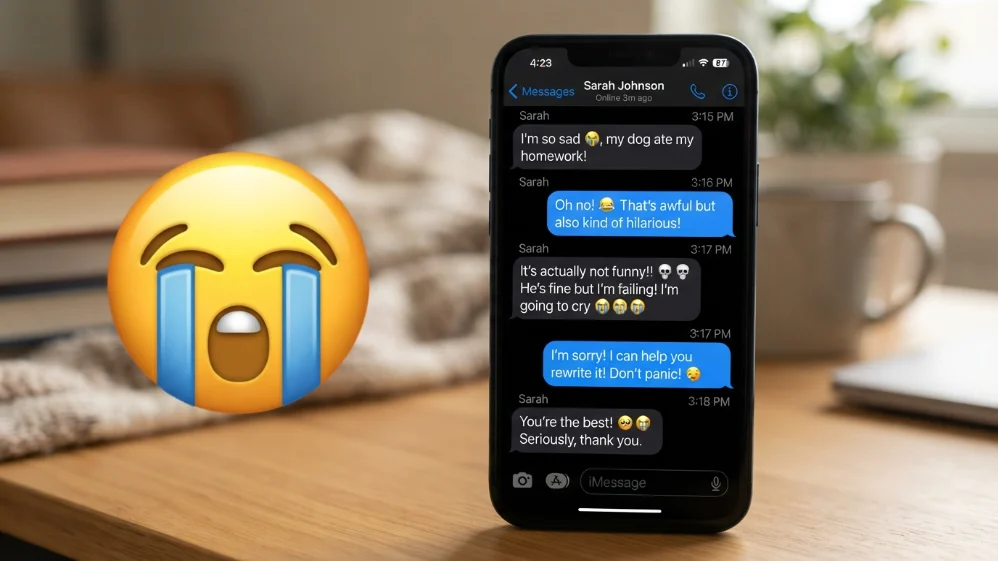
The sobbing emoji 😭 officially called Loudly Crying Face usually expresses intense emotion, especially sadness, grief, disappointment, or feeling overwhelmed. However, its meaning is not limited to genuine crying. In texts and social media, people also use 😭 dramatically to show that something is extremely funny, adorable, embarrassing, frustrating, or emotionally powerful. The same emoji can therefore carry very different tones depending on the message around it.
If someone sends 😭, look at the words, conversation, and situation before deciding what they mean. “I miss you so much 😭” sounds genuinely emotional, while “That video is so funny 😭” usually signals exaggerated laughter. Understanding that difference is the key to reading the sobbing emoji naturally.
Quick Answer:
😭 usually means intense crying or overwhelming emotion, but it can also be used playfully to show extreme laughter, embarrassment, frustration, or affection.
Its official Unicode name is Loudly Crying Face, and context determines whether the emotion is serious, dramatic, or humorous.
What Does the Sobbing Emoji 😭 Mean?
The sobbing emoji 😭 represents a face crying intensely, with tears streaming down both sides of the face. Unicode officially calls it Loudly Crying Face, with the code point U+1F62D. Unicode’s emoji data also associates it with words such as crying, sad, sob, tear, and unhappy.
In everyday texting, 😭 can communicate several forms of strong emotion:
- Deep sadness
- Grief or heartbreak
- Disappointment
- Feeling overwhelmed
- Extreme laughter
- Dramatic frustration
- Emotional affection
- Embarrassment
- Being touched by something sweet or meaningful
The important point is that 😭 communicates intensity more than one specific emotion. It tells the reader that the sender is having a strong reaction, while the surrounding message usually reveals what caused it.
For example:
“I can’t believe you’re leaving 😭”
This likely expresses genuine sadness.
But:
“You really wore that to the party 😭”
could be playful teasing or exaggerated disbelief rather than actual crying.
Why Is 😭 Called the Sobbing Emoji?
People commonly call 😭 the sobbing emoji, crying emoji, or loud crying emoji because its visual design clearly shows intense tears.
Its official Unicode name is not “Sobbing Emoji.” It is Loudly Crying Face. The term “sobbing emoji” is an informal description that matches how many people use and describe the character. Unicode lists 😭 as U+1F62D.
This distinction matters because an emoji’s official name does not necessarily describe every way people use it. Emojipedia notes that 😭 has been used for both serious emotional situations and highly exaggerated reactions, including humor and joy.
😭 Meaning in Text Messages
In texting, 😭 often adds emotional force to a sentence.
Genuine sadness
“I really miss my old friends 😭”
Here, 😭 reinforces a sincere feeling of sadness or longing.
Emotional overwhelm
“I finally got the job I’ve wanted for years 😭”
The sender may be happy, relieved, and overwhelmed rather than sad.
Extreme laughter
“Why did he actually say that 😭”
In casual conversation, the emoji can mean something like “I’m dying laughing.” The sender is not necessarily crying at all.
Frustration
“My laptop crashed right before I finished the assignment 😭”
The emoji emphasizes how frustrating or upsetting the situation feels.
Affection
“You remembered my favorite snack 😭”
Here, 😭 can communicate being touched, grateful, or emotionally overwhelmed.
Is 😭 a Sad Emoji or a Funny Emoji?
It can be either.
The official meaning points toward intense crying, but common usage gives 😭 a much wider emotional range. Emojipedia describes Loudly Crying Face as capable of expressing overwhelming feelings ranging from grief and disappointment to hilarity and joy, often in a deliberately exaggerated way.
A useful way to interpret it is to ask:
What emotion is the surrounding message already expressing?
Compare these:
“I can’t stop thinking about what happened 😭”
- Likely serious sadness.
“That cat really tried to fight the vacuum 😭”
- Likely laughter.
“You are seriously too sweet 😭”
- Likely affection or being emotionally touched.
So 😭 does not automatically mean that the sender is literally crying.
Does 😭 Mean Someone Is Actually Crying?
Not necessarily.
Someone can use 😭 to describe a real emotional reaction, but they can also use it as an exaggeration. In casual online communication, the emoji often functions more like an emotional reaction marker than a literal report of tears.
For instance:
“This movie ending destroyed me 😭”
could mean the person was genuinely moved.
Meanwhile:
“I forgot my password again 😭”
may simply dramatize a minor annoyance.
The words surrounding 😭 are usually more informative than the emoji alone.
😭 Meaning From Someone
If someone sends you 😭 by itself, the meaning is difficult to determine without context.
It might mean:
- “I’m really upset.”
- “That is so funny.”
- “I can’t believe this.”
- “I’m overwhelmed.”
- “That is painfully relatable.”
- “You’re making me emotional.”
- “This is so embarrassing.”
- “I love this so much.”
If the conversation is serious, interpret it more seriously. If you’re joking around, 😭 is more likely to be playful or exaggerated.
The sender’s usual texting style also matters. Someone who regularly uses dramatic emojis may use 😭 casually, while another person might reserve it for stronger emotions.
Is 😭 Flirting?
😭 can appear in flirty conversations, but it is not inherently a flirting emoji.
Someone might use it after receiving a compliment:
“Stop, you’re making me blush 😭”
Or after a sweet message:
“Why are you so cute 😭”
In those examples, 😭 can make the response sound emotionally overwhelmed or playfully affectionate.
But the emoji itself does not prove romantic interest. The relationship between the people, the rest of the conversation, and the sender’s communication style provide much stronger context.
What Does 😭 Mean in a Relationship?
In a romantic relationship, 😭 can express genuine sadness, affection, missing someone, excitement, frustration, or playful exaggeration.
For example:
“I wish you were here 😭”
This may communicate genuine longing.
“You actually remembered our anniversary 😭”
This may express happiness and appreciation.
“You watched the next episode without me 😭”
This is more likely playful disappointment.
The emoji becomes meaningful because of the sentence around it, not because 😭 has one fixed relationship meaning.
Can 😭 Be Used Sarcastically?
Yes. 😭 can be sarcastic or intentionally dramatic.
For example:
“Oh no, I have to eat the last slice of pizza 😭”
The sender is probably pretending to be devastated for comedic effect.
Likewise:
“You got there five minutes before me 😭”
could be genuine disappointment or playful exaggeration.
Sarcasm is especially dependent on shared humor and conversational context, so the emoji alone cannot establish that a message is sarcastic.
When 😭 Means “I’m Dying Laughing”
One of the most common informal uses of 😭 is to exaggerate a funny reaction.
“That was the funniest thing I’ve seen all week 😭”
Here, 😭 can function almost like:
- “I’m crying.”
- “I’m dead.”
- “That’s hilarious.”
- “I can’t handle this.”
- “I’m laughing so hard.”
This is one reason 😭 can be confused with 😂. The difference is that 😂 explicitly depicts tears of joy, while 😭 depicts intense crying and is often repurposed for dramatic reactions. Unicode officially names 😂 Face with Tears of Joy and 😭 Loudly Crying Face.
Emojis Similar to the Sobbing Emoji 😭
| Emoji | Official Name | Common Meaning | Tone | Where or When It Is Used |
|---|---|---|---|---|
| 😭 | Loudly Crying Face | Intense crying or overwhelming emotion | Dramatic, emotional, sometimes playful | Sad messages, jokes, frustration, emotional reactions |
| 😢 | Crying Face | Sadness or a single tearful reaction | Sad, sincere, softer | Disappointment, missing someone, emotional messages |
| 🥹 | Face Holding Back Tears | Trying not to cry, gratitude, tenderness | Emotional, affectionate | Sweet moments, appreciation, proud reactions |
| 😥 | Sad but Relieved Face | Sadness mixed with relief | Worried, relieved, emotional | Close calls, stressful situations that end well |
| 😞 | Disappointed Face | Disappointment or feeling let down | Downcast, subdued | Bad news, failed plans, regret |
| 😓 | Downcast Face with Sweat | Stress, worry, or an uncomfortable situation | Nervous, strained | Difficult moments, awkward situations, pressure |
| 😂 | Face with Tears of Joy | Strong laughter | Joyful, humorous | Jokes, funny stories, hilarious reactions |
| 😩 | Weary Face | Exhaustion, frustration, or feeling worn out | Dramatic, tired | Stressful tasks, complaints, relatable frustrations |
The biggest distinction is emotional intensity. 😭 is usually more dramatic than 😢, while 🥹 is more about holding back tears or feeling deeply touched. 😂 points much more clearly toward laughter, whereas 😭 can move between sadness and humor depending on context. Unicode’s official list identifies these emojis by their distinct names and code points.
😭 vs. 😢: What’s the Difference?
Both emojis can express sadness, but their visual and conversational intensity is different.
😢 Crying Face usually feels quieter and more restrained. It can communicate sadness, disappointment, or missing someone without making the reaction feel extremely dramatic.
😭 Loudly Crying Face generally feels stronger and more expressive. It can suggest intense sadness, emotional overwhelm, or dramatic humor.
Compare:
“I miss you 😢”
with:
“I miss you so much 😭”
The second message usually carries a stronger emotional punch.
😭 vs. 🥹: What’s the Difference?
🥹 Face Holding Back Tears often suggests that someone is trying not to cry. Unicode lists keywords associated with admiration, gratitude, pride, joy, and tears for this emoji.
😭, by contrast, shows the emotional reaction as already overflowing.
For example:
“You remembered my birthday 🥹”
can suggest being touched.
“You remembered my birthday 😭”
can suggest a more dramatic emotional reaction.
Neither is automatically better. The choice depends on how strongly the sender wants to express the feeling.
😭 vs. 😂: Why Do People Confuse Them?
These two emojis can both appear after something funny.
😂 Face with Tears of Joy has a clearer literal connection to laughing. Its official Unicode name specifically refers to tears caused by joy.
😭 Loudly Crying Face is more ambiguous. It can mean actual crying, but people also use it as an exaggerated reaction to something hilarious.
For a straightforward laughing reaction:
“That joke was hilarious 😂”
For a more dramatic reaction:
“I cannot believe he actually did that 😭”
Both can communicate humor, but 😭 often adds a stronger sense of dramatic disbelief.
How to Use 😭 Without Being Misunderstood
If you’re talking about something genuinely serious, surrounding words can make your meaning clearer.
Instead of:
“I’m fine 😭”
you could write:
“I’m trying to be okay, but I’m really upset 😭”
If you’re using 😭 to show laughter, make the humorous context obvious:
“That video was ridiculous 😭”
This is especially helpful when the message could otherwise be interpreted as sadness.
You should also be careful with serious situations. Because 😭 is frequently used humorously, it may not always communicate grief or distress as clearly as words do.
How to Respond to 😭
Your response should match the apparent context.
- If they’re genuinely upset
“I’m sorry. Do you want to talk about it?”
- If they’re laughing
“I know 😭 That part got me too.”
- If they’re frustrated
“Oh no 😭 What happened?”
- If they’re being playful
“You are so dramatic 😂”
- If you’re unsure
“Wait, are you actually upset or are you laughing? 😭”
That last option can be useful when the message could reasonably have either meaning.
Sobbing Emoji Examples in Text
Here are a few realistic examples showing how the same emoji can change meaning:
“I have to say goodbye to my dog today 😭”
Likely expresses genuine sadness or grief.
“He really thought nobody would notice 😭”
Likely communicates amusement or disbelief.
“You made that for me? 😭”
Could express gratitude, affection, or being emotionally touched.
“I studied the wrong chapter 😭”
Usually expresses frustration in an exaggerated way.
“You look amazing in that photo 😭”
Could express strong admiration or playful affection.
These examples show why reading 😭 in isolation can be misleading.
What Does One 😭 Mean vs. Multiple 😭 Emojis?
The number of emojis can change the perceived intensity, but there is no universal scale.
For example:
“Nooo 😭”
can sound dramatic or playful.
“Noooo 😭😭😭”
may feel even more exaggerated or emotionally intense.
However, multiple emojis do not automatically mean the sender is genuinely more upset. People often repeat emojis for emphasis, humor, or dramatic effect.
Can 😭 Be Rude?
The emoji itself is not inherently rude.
However, context can make it feel dismissive or mocking.
For example:
“You really failed that test 😭”
could be playful teasing between close friends, but it could also feel insensitive if the other person is genuinely upset.
When someone is sharing serious news, using 😭 as a joke may be misunderstood. The safest interpretation depends on your relationship, the subject, and the tone of the conversation.
Frequently Asked Questions
What is the official name of 😭?
The official Unicode name is Loudly Crying Face. Its code point is U+1F62D.
What does 😭 mean from a girl or guy?
There is no fixed meaning based on the sender’s gender. 😭 can express sadness, laughter, frustration, affection, or another intense reaction regardless of who sends it.
Does 😭 mean crying from laughter?
Sometimes. In casual texting, 😭 is often used as an exaggerated reaction to something funny. However, it can also represent genuine sadness or other strong emotions.
Is 😭 a sad emoji?
Yes, sadness is one of its common meanings, but it is not limited to sadness. Its informal use can include humor, joy, frustration, affection, and emotional overwhelm.
Is 😭 stronger than 😢?
Usually, yes. 😭 tends to feel more intense or dramatic, while 😢 generally communicates a quieter form of sadness.
What is the difference between 😭 and 🥹?
😭 is Loudly Crying Face, while 🥹 is Face Holding Back Tears. The first generally suggests an overflowing emotional reaction, while the second often suggests trying not to cry, gratitude, tenderness, or being deeply touched.
Can 😭 mean “I love this”?
Yes. Someone may use 😭 to show that something is extremely sweet, adorable, touching, or emotionally satisfying. The surrounding message determines whether that is the intended meaning.
Is 😭 a flirting emoji?
Not by itself. It can appear in playful or affectionate flirting, but 😭 does not automatically signal romantic interest.
Final Takeaway
The sobbing emoji 😭, officially Loudly Crying Face, is one of the more flexible emotional emojis. It can express genuine sadness and intense crying, but it can also signal laughter, frustration, affection, embarrassment, or dramatic disbelief.
When you see 😭 in a text, don’t interpret it alone. Read the surrounding words, consider the situation, and think about the sender’s usual communication style. That context usually reveals whether the person is actually upset, laughing dramatically, or simply reacting strongly.
Read More Related Articles:
- Robot Emoji Meaning | What It Really Says in Texts, Chats …
- Pleading Emoji Meaning | What Does It Mean?
- Thank You Emoji Meaning | Best Emojis to Say Thanks