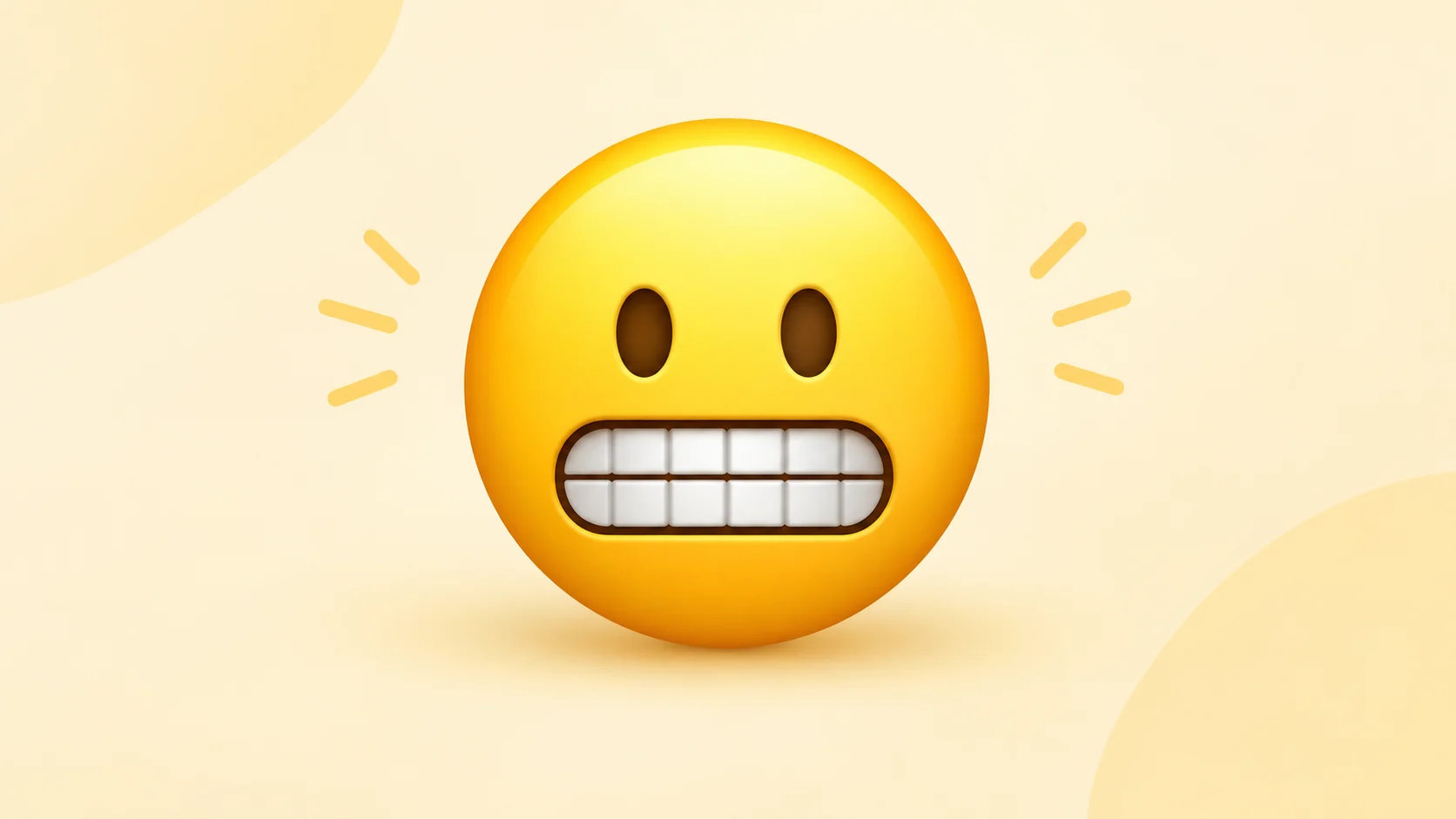
The Yikes emoji 😬 usually refers to the Grimacing Face emoji, which shows a face with tightly clenched teeth. It commonly expresses awkwardness, nervousness, embarrassment, discomfort, or a reaction to something unpleasant. People often use it when they want to say “yikes,” “uh-oh,” “that was awkward,” or “I’m not sure about this” without spelling everything out. Its exact meaning depends on the message and situation.
In texting and social media, 😬 can soften an uncomfortable comment, react to a mistake, or show mixed feelings about something. It may also be used playfully when a situation is embarrassing but not truly serious. Because its toothy expression can sometimes look like a smile, it can be misunderstood as happiness or excitement. The surrounding words are usually the best clue.
Quick Answer
😬 usually means awkwardness, nervousness, embarrassment, discomfort, or a tense “yikes” reaction.
It can also express mixed feelings when something is both exciting and stressful.
What Does the Yikes Emoji 😬 Mean?
The emoji commonly called the Yikes emoji is officially named Grimacing Face. It depicts a yellow face with open eyes and clenched teeth. Its appearance is strongly associated with tension, discomfort, nervousness, and awkward situations.
The word “yikes” is not the emoji’s official name. Instead, it is a common way people interpret or use the expression.
For example:
“That meeting was painful 😬”
Here, 😬 reinforces the uncomfortable feeling.
Or:
“I accidentally sent that to the wrong person 😬”
In this case, the emoji communicates embarrassment and nervousness.
It can also react to something unpleasant:
“That food looks questionable 😬”
The meaning is closer to “Yikes,” “No thanks,” or “That doesn’t look good.”
Emojipedia describes 😬 as covering a range of tense or moderately negative emotions, including nervousness, embarrassment, awkwardness, discomfort, disapproval, and disgust.
Why Is 😬 Called the Yikes Emoji?
People often call 😬 the Yikes emoji because its clenched-teeth expression works well as a visual reaction to something uncomfortable, surprising, unpleasant, or awkward.
Think of situations where you might naturally say:
- “Yikes.”
- “Uh-oh.”
- “Oof.”
- “That’s awkward.”
- “Oh no.”
- “I’m not sure about that.”
The emoji can stand in for any of these reactions depending on context.
However, “Yikes emoji” is an informal description. The official Unicode name is Grimacing Face.
😬 Meaning in Text Messages
In a text, 😬 often signals that the sender feels uncomfortable about what they just said or what is happening.
Common interpretations include:
- That is awkward.
- Yikes, that’s not good.
- I’m nervous.
- I’m embarrassed.
- I’m uncomfortable with this.
- That was a close call.
- I’m not sure how I feel about this.
- Oops.
- This situation is tense.
For example:
“I think I just offended my boss 😬”
The emoji adds nervousness and embarrassment.
Another example:
“He forgot her name during the introduction 😬”
Here, it can represent an awkward reaction to someone else’s mistake.
The Emotional Tone of 😬
The Yikes emoji does not represent one single emotion. Its clenched teeth create a general feeling of tension or discomfort, while the surrounding message determines the exact emotion.
Nervous
“My interview starts in five minutes 😬”
This suggests nervous anticipation.
Embarrassed
“I just realized I had my microphone on the whole time 😬”
Here, the emoji expresses embarrassment.
Awkward
“They both showed up with the same gift 😬”
The emoji captures the uncomfortable situation.
Disapproving
“They canceled the event five minutes before it started 😬”
The reaction can suggest mild disapproval.
Disgusted
“That smell is coming from the fridge 😬”
The emoji can work as a mild “yikes” reaction to something unpleasant.
Mixed feelings
“I got the job, but I have to move next week 😬”
Here, the emoji can express excitement mixed with stress.
Emojipedia notes that 😬 can communicate mixed feelings, including situations where nervousness and excitement appear together.
Does 😬 Mean “Yikes”?
Yes, it can.
When someone reacts to an unpleasant, awkward, or questionable situation with 😬, the intended feeling may be very close to saying “Yikes.”
For example:
“They charged me $200 for a simple repair 😬”
The emoji can mean:
“Yikes, that’s expensive.”
Another example:
“I just looked at the deadline 😬”
This suggests:
“Yikes, I’m in trouble.”
The important point is that 😬 does not literally translate to “yikes” every time. The context determines whether that interpretation makes sense.
Does 😬 Mean Something Is Awkward?
Very often, yes.
The emoji is especially useful when something feels socially uncomfortable, embarrassing, or difficult to respond to.
For example:
“He told the joke and nobody laughed 😬”
The emoji highlights the awkwardness.
Or:
“I accidentally called my teacher ‘Mom’ 😬”
Here, the expression clearly represents embarrassment.
If the situation is mildly awkward rather than deeply upsetting, 😬 can communicate that distinction well.
Can 😬 Mean Nervousness?
Yes.
The clenched teeth can visually suggest someone who is tense or unsure.
For example:
“Waiting for my test results 😬”
The sender may be nervous about what will happen.
Another example:
“First day at my new job tomorrow 😬”
This can communicate a mixture of anticipation and anxiety.
The emoji does not prove that the person is seriously anxious. It can simply show everyday nervousness.
Is 😬 a Negative Emoji?
It is generally associated with tense or mildly negative feelings, but it is not necessarily strongly negative.
The emoji can communicate:
- Mild discomfort
- Nervousness
- Embarrassment
- Awkwardness
- Disapproval
- Disgust
- Stress
- Mixed emotions
It can also be playful.
For example:
“I may have eaten the entire pizza 😬”
The situation is not necessarily serious. The emoji adds a humorous sense of “Oops.”
Emojipedia describes the emoji as having a broad emotional range rather than one fixed negative meaning.
Is the Yikes Emoji Flirty?
Usually not.
😬 is not primarily a flirting emoji. Its usual meanings are connected to tension, awkwardness, embarrassment, or discomfort.
That said, someone can use it during a flirtatious conversation.
For example:
“You really said that to me 😬”
Depending on the conversation, this could be playful teasing.
But the emoji alone does not prove attraction or romantic interest.
If you’re trying to understand whether a message is flirtatious, consider the complete message, previous conversation, and relationship between the people involved rather than interpreting 😬 by itself.
What Does 😬 Mean From Someone?
If someone sends you 😬, they may be reacting to something awkward, uncomfortable, embarrassing, or uncertain.
For example:
“I forgot to submit the form 😬”
Likely meaning:
They are embarrassed or worried about the mistake.
“So… I might have told them your secret 😬”
Likely meaning:
They know they created an uncomfortable situation.
“The bill was way higher than I expected 😬”
Likely meaning:
They are uncomfortable or surprised by the cost.
“I have to give a speech tomorrow 😬”
Likely meaning:
They are nervous about the upcoming event.
The sender’s communication style also matters. Someone who frequently uses expressive emojis may use 😬 casually, while another person may use it only when genuinely uncomfortable.
Can 😬 Be Sarcastic?
Yes, but the sarcasm usually comes from the words and situation, not from the emoji itself.
For example:
“Wow, another meeting that could have been an email 😬”
This may be sarcastic because of the wording.
Another example:
“Love getting charged extra for everything 😬”
The statement can be sarcastic, while 😬 reinforces the uncomfortable frustration.
Without the surrounding message, it is difficult to know whether the emoji is meant seriously or sarcastically.
Yikes Emoji in Different Situations
After a Mistake
“I sent the unfinished version to everyone 😬”
Meaning: embarrassment or regret.
After Bad News
“The flight was canceled again 😬”
Meaning: disappointment or discomfort.
Before Something Nerve-Racking
“Presenting to the entire department tomorrow 😬”
Meaning: nervous anticipation.
After an Awkward Moment
“Nobody knew what to say after that comment 😬”
Meaning: social awkwardness.
During a Funny Situation
“I may have accidentally eaten your leftovers 😬😂”
Meaning: playful guilt rather than serious distress.
Text Message Examples
1. “I forgot the deadline was today 😬”
Likely meaning: The sender is stressed, embarrassed, or worried about the mistake.
2. “That was definitely not how I expected the conversation to go 😬”
Likely meaning: The conversation became awkward or uncomfortable.
3. “I have to meet my new manager tomorrow 😬”
Likely meaning: Nervous anticipation.
4. “They raised the price again 😬”
Likely meaning: Disappointment or mild disapproval.
5. “I think I accidentally spoiled the movie 😬”
Likely meaning: Embarrassment and regret.
6. “You actually sent that message? 😬”
Likely meaning: The sender may be surprised, concerned, or playfully judging the decision.
Emojis Similar to the Yikes Emoji
| Emoji | Official Name | Common Meaning | Tone | Where or When It Is Used |
|---|---|---|---|---|
| 😬 | Grimacing Face | Awkwardness, nervousness, discomfort, “yikes” | Tense, awkward, mildly negative | Mistakes, uncomfortable moments, nervous situations |
| 😅 | Grinning Face with Sweat | Relief, nervous laughter, awkward humor | Nervous, lighthearted | Close calls, mistakes, embarrassing moments |
| 😳 | Flushed Face | Shock, embarrassment, surprise | Embarrassed, startled | Awkward compliments, surprises, uncomfortable attention |
| 😰 | Anxious Face with Sweat | Worry, anxiety, nervousness | Worried, tense | Stressful situations and concerns |
| 😓 | Downcast Face with Sweat | Stress, disappointment, tired relief | Weary, uneasy | Difficult situations and stressful moments |
| 😖 | Confounded Face | Frustration, distress, confusion | Intense, troubled | Problems, difficult situations, emotional frustration |
| 😕 | Confused Face | Confusion, uncertainty, hesitation | Uncertain, puzzled | Mixed signals, unclear situations, questions |
| 🙈 | See-No-Evil Monkey | Embarrassment, avoidance, playful shame | Playful, embarrassed | Awkward moments, mistakes, things someone does not want to see |
| 🫣 | Face with Peeking Eye | Nervous curiosity, embarrassment, wanting to look away | Shy, tense, playful | Awkward reveals, scary moments, embarrassing situations |
The closest match to 😬 is often 😅 Grinning Face with Sweat because both can appear after awkward or stressful moments. The key difference is that 😅 often adds a sense of nervous relief or “that was close,” while 😬 tends to emphasize tension or discomfort.
😳 Flushed Face is more focused on embarrassment, surprise, or being caught off guard. 😰 Anxious Face with Sweat communicates stronger worry. 🙈 See-No-Evil Monkey makes an awkward moment more playful.
😬 vs. 😅: What’s the Difference?
These two emojis are easy to confuse.
😬 Grimacing Face usually emphasizes tension, awkwardness, discomfort, or a nervous reaction.
😅 Grinning Face with Sweat often suggests nervous laughter, relief, or an awkward situation that the sender is trying to take lightly.
Compare:
“I accidentally called my boss by the wrong name 😬”
This focuses on embarrassment.
“I accidentally called my boss by the wrong name 😅”
This can feel more like nervous laughter and relief after an embarrassing mistake.
😬 vs. 😳: What’s the Difference?
😳 Flushed Face is strongly associated with embarrassment, surprise, or feeling exposed.
😬 Grimacing Face is broader and can represent awkwardness, nervousness, discomfort, or a general “yikes” reaction.
For example:
“Everyone heard me singing 😳”
This focuses on embarrassment.
“Everyone heard me singing 😬”
This can emphasize awkwardness or discomfort.
😬 vs. 🫣: What’s the Difference?
🫣 Face with Peeking Eye often suggests wanting to look while also feeling nervous, embarrassed, or shy.
😬 is more direct. It shows a tense facial reaction.
For example:
“I’m about to see the final score 🫣”
This suggests nervous curiosity.
“I just saw the final score 😬”
This suggests the result is uncomfortable or disappointing.
Common Misunderstandings About 😬
It does not always mean disgust
Although 😬 can react to something unpleasant, it is also commonly used for nervousness, embarrassment, and awkwardness.
It does not always mean anger
The clenched teeth can look tense, but the emoji does not automatically communicate anger.
It does not always mean fear
Someone may use it for ordinary nervousness or social awkwardness without being genuinely afraid.
It is not the same as a happy smile
Because 😬 shows teeth, it can sometimes be mistaken for a smile. Emojipedia specifically notes that its toothy appearance can lead to confusion with more positive expressions.
It does not prove a serious emotional reaction
Someone may use 😬 jokingly for a minor mistake or funny awkward moment.
How to Respond to 😬
The best response depends on why the person used it.
If they’re nervous
“You’ve got this!”
If they made a mistake
“It happens. Don’t worry.”
If they’re embarrassed
“😂 You’re fine.”
If they’re reacting to bad news
“Yeah, that’s rough.”
If you’re not sure what they mean
“Wait, what happened? 😬”
Matching the tone of the original message usually works better than treating the emoji as a standalone statement.
Copy and Paste the Yikes Emoji
😬
You can copy and paste 😬 into texts, comments, captions, messages, and social media posts.
Some combinations include:
- 😬😅 for nervous laughter
- 😬😂 for an awkward but funny situation
- 😬🙈 for embarrassment
- 😬😳 for awkward surprise
- 😬🫣 for nervous curiosity
- 😬💀 for an extremely awkward or funny reaction
Official Name and Technical Details
The official Unicode name of 😬 is GRIMACING FACE.
- Emoji: 😬
- Official Unicode name: GRIMACING FACE
- Unicode code point: U+1F62C
- Unicode version: 6.1
- Emoji version: 1.0
Grimacing Face was approved in Unicode 6.1 in 2012 and added to Emoji 1.0 in 2015.
Its appearance has changed across platforms and over time. Different vendors have used somewhat different facial designs, although the modern versions generally show the characteristic clenched teeth.
This variation is one reason 😬 can sometimes be interpreted differently depending on the device or service displaying it.
Frequently Asked Questions
What does the Yikes emoji 😬 mean?
The Yikes emoji 😬 usually represents awkwardness, nervousness, embarrassment, discomfort, or a tense reaction. It is officially called Grimacing Face.
Is 😬 the official Yikes emoji?
No. “Yikes emoji” is an informal description. The official Unicode name is Grimacing Face.
What does 😬 mean in texting?
In texting, 😬 can mean “yikes,” “uh-oh,” “that’s awkward,” “I’m nervous,” or “I’m uncomfortable,” depending on the surrounding message.
Does 😬 mean awkward?
It often can. The emoji is commonly used when someone feels socially awkward, embarrassed, or uncomfortable.
Does 😬 mean nervous?
Yes. Nervousness is one of the common interpretations of Grimacing Face, especially before an uncertain or stressful event.
Is 😬 a bad emoji?
Not necessarily. It usually communicates some form of tension or discomfort, but it can be playful and does not automatically indicate something serious.
Is 😬 a flirting emoji?
Not usually. It is primarily associated with nervousness, awkwardness, and discomfort. A flirtatious meaning depends on the surrounding conversation rather than the emoji itself.
What is the difference between 😬 and 😅?
😬 generally emphasizes tension or awkwardness, while 😅 often suggests nervous laughter, relief, or an awkward situation being taken lightly.
What is the difference between 😬 and 😳?
😬 is broader and often signals discomfort or awkwardness. 😳 more directly emphasizes embarrassment, surprise, or feeling exposed.
What does 😬 mean from a girl or guy?
The emoji does not have a different built-in meaning based on the sender’s gender. The surrounding words, relationship, conversation history, and communication style provide better clues.
Conclusion
The Yikes emoji 😬, officially called Grimacing Face, is a useful reaction for awkwardness, nervousness, embarrassment, discomfort, and mildly unpleasant situations. It can say “yikes,” “uh-oh,” or “that was awkward” without requiring a long explanation.
Its meaning depends heavily on context. 😬 can be serious, nervous, playful, embarrassed, or mildly disapproving. If you’re choosing between similar reactions, remember that 😬 emphasizes tension, 😅 adds nervous relief, 😳 highlights embarrassment, and 🫣 adds shy or nervous curiosity.
Discover More Post:
- Music Emoji | Meaning, Uses, and Creative Ways to Express …
- Hot Emoji Meaning | What Really Says in Texts, Chats, and …
- Warning Emoji Meaning | Hidden Messages, Real World Uses …