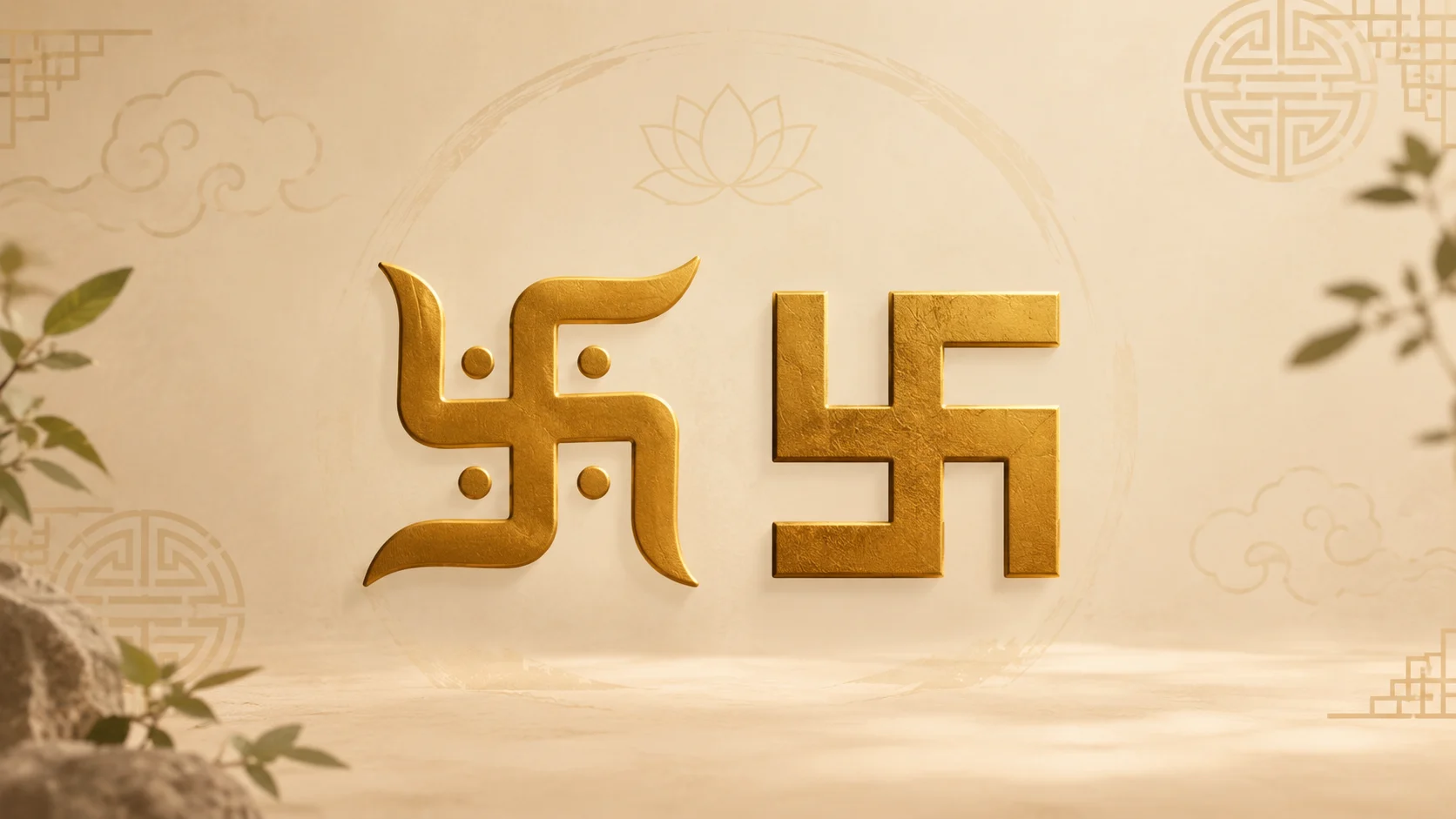
The swastika emoji search term can refer to symbols such as 卍 and 卐, but there is an important distinction: these are Unicode characters rather than standard emoji in the same sense as symbols such as ☯️ or 🕉️. The swastika is an ancient symbol with religious and cultural significance in Hinduism, Buddhism, Jainism, and other traditions. Unicode records swastika characters in the CJK Unified Ideographs block, including U+534D and U+5350.
In the United States and much of the Western world, however, the symbol is also strongly associated with Nazi Germany because the Nazi regime appropriated a particular form of the swastika as its emblem. This creates an important context difference. A swastika used in a religious, historical, or cultural setting can have a very different meaning from one used to express Nazi ideology or hate. The surrounding text and purpose are essential when interpreting it.
Quick Answer
The swastika symbols 卍 and 卐 are ancient religious and cultural symbols, especially associated with Hinduism, Buddhism, and Jainism.
In the U.S., the symbol can also evoke Nazi Germany, so its meaning depends heavily on context, orientation, surrounding imagery, and the reason it was shared.
What Does the Swastika Emoji Mean?
When people search for the swastika emoji, they may be looking for a copyable symbol such as 卍 or 卐.
These characters represent forms of the swastika, an ancient symbol that predates its 20th-century use by Nazi Germany by thousands of years. Unicode documentation describes the svastika as a sacred symbol used in Hinduism, Buddhism, and Jainism, including in religious decorations and Buddhist contexts.
The symbol can therefore carry several very different meanings:
- Religious or spiritual symbolism
- Good fortune or auspiciousness in some cultural traditions
- Buddhist or Hindu cultural identity
- Historical or archaeological reference
- Discussion of Asian art or traditions
- Nazi symbolism when used in an explicitly Nazi context
- Shock, provocation, or hate when intentionally used to promote extremist ideology
The last meanings should not be treated as the default meaning of the ancient symbol itself. Context is critical.
Is the Swastika an Emoji?
Not exactly.
卍 and 卐 are Unicode characters, but they are not standard emoji characters with an official emoji presentation.
The two commonly encountered Chinese characters are:
- 卍: U+534D
- 卐: U+5350
Unicode identifies both within the CJK Unified Ideographs block. U+534D was added to Unicode 1.1, while U+5350 is also a CJK unified ideograph.
This distinction matters because searching for a “swastika emoji” may lead people to assume there is an official Unicode emoji named Swastika. There is not a standard emoji with that official name.
Unicode also explains that not every pictographic or symbolic character has an emoji meaning, and that Unicode character names are identifiers rather than complete definitions of how a character may be interpreted.
What Does 卍 Mean?
卍 is a left-facing form of the swastika and is encoded as U+534D.
In East Asian contexts, it can represent the swastika as a Buddhist or auspicious symbol. The Unicode Unihan definition describes it as an auspicious sign associated with Buddhism, including representations connected with Buddha.
Depending on context, 卍 may therefore appear in:
- Buddhist imagery
- Religious art
- Cultural discussions
- Historical references
- Traditional Asian designs
- Maps or references to Buddhist temples in some contexts
It should not automatically be interpreted as a Nazi symbol simply because the shape resembles the symbol used by Nazi Germany.
What Does 卐 Mean?
卐 is another form of the swastika and is encoded as U+5350.
Like 卍, it has historical and religious meanings that existed long before the 20th century. Unicode’s Unihan data describes U+5350 as an auspicious swastika associated with Chinese Buddhism.
The two characters are visually related but differ in the direction of their hooked arms.
In an Asian religious or cultural context, 卐 can therefore represent a traditional symbol rather than a political statement.
Swastika Meaning in Hinduism, Buddhism, and Jainism
The swastika has longstanding religious and cultural significance across parts of Asia.
In Hindu traditions, it can be associated with auspiciousness, prosperity, well-being, and sacred occasions. In Buddhism, variations of the symbol have been used in religious art and representations connected with Buddhist teachings and temples. Jain traditions also use the swastika as an important religious symbol.
The exact interpretation and visual conventions can vary between traditions and regions, so it is better to describe the symbol as having multiple historical and religious meanings rather than assigning one universal definition.
Unicode documentation specifically notes its use in Hinduism, Buddhism, and Jainism and describes it as a sacred symbol.
Why Is the Swastika Controversial in the United States?
In the United States, the swastika is widely recognized through its association with Nazi Germany and the Holocaust.
The Nazi regime adopted a rotated version of the swastika as a central political symbol. Because of this history, many American readers will initially interpret an isolated swastika as Nazi symbolism rather than as an ancient religious symbol.
That does not erase the symbol’s much older history.
A Buddhist temple, Hindu religious decoration, historical artifact, or educational discussion can use the symbol for entirely different reasons. The surrounding context helps distinguish these meanings.
For example:
“This Buddhist temple uses the traditional swastika symbol.”
This clearly establishes a religious and cultural context.
Compare that with:
“Support this Nazi movement.”
If a swastika appears alongside an explicitly Nazi political message, the context changes its meaning completely.
Swastika Emoji Meaning in Text Messages
If someone sends 卍 or 卐 in a text, do not assume its meaning immediately.
Possible interpretations include:
- Referring to Buddhism or Hinduism
- Discussing Asian culture
- Talking about history or archaeology
- Sharing a religious symbol
- Referring to Japanese or Chinese cultural terminology
- Discussing Nazi history
- Using the symbol provocatively
The surrounding message is especially important.
For example:
“I saw this symbol at a Buddhist temple: 卍”
This is clearly a cultural or religious reference.
But:
“This is the symbol used by the Nazis.”
Here, the character is being discussed historically.
An isolated 卍 with no explanation can be ambiguous, especially for an American recipient.
Can the Swastika Symbol Mean Good Luck?
In some traditional cultural contexts, yes.
The swastika has historically been connected with concepts such as well-being, auspiciousness, prosperity, and good fortune.
The Sanskrit term svastika is related to svasti, a word associated with well-being or auspiciousness. Unicode documentation also describes the symbol as a sacred sign and notes its religious use.
However, saying that the swastika always means good luck would be misleading.
Its interpretation depends on the cultural setting, design, orientation, surrounding symbols, and historical context.
Does the Swastika Always Mean Nazism?
No.
The Nazi use of the swastika is historically significant, but the symbol itself is much older than Nazi Germany.
This is one of the most important distinctions when discussing the symbol.
A swastika appearing in:
- Hindu religious art
- Buddhist artwork
- Jain religious material
- Ancient archaeological objects
- Asian cultural settings
- Historical discussions
does not automatically indicate Nazi ideology.
At the same time, a swastika used with Nazi slogans, extremist imagery, or explicit praise of Nazi ideology should be understood within that political and extremist context.
Swastika vs. Nazi Symbol
The ancient religious symbol and the Nazi emblem should not be treated as interchangeable in every context.
The Nazi emblem used a specific rotated swastika design, generally displayed at an angle and incorporated into the visual identity of the Nazi regime.
Traditional swastikas can have different orientations, proportions, decorative elements, and cultural contexts.
The visual difference can sometimes help, but context remains more important than orientation alone.
A particular direction does not automatically make a symbol religious or Nazi.
Related Symbols and Their Meanings
| Emoji | Official Name | Common Meaning | Tone | Where or When It Is Used |
|---|---|---|---|---|
| 卍 | CJK Unified Ideograph U+534D | Swastika, traditional religious or cultural symbol | Sacred, cultural, historical | Buddhist contexts, Asian culture, historical references |
| 卐 | CJK Unified Ideograph U+5350 | Swastika, traditional religious or cultural symbol | Sacred, cultural, historical | Religious and cultural discussions |
| ☸️ | Wheel of Dharma | Buddhist teachings and the Buddhist path | Spiritual, peaceful | Buddhism, meditation, religious content |
| 🕉️ | Om | Sacred Hindu and Indian spiritual symbol | Spiritual, peaceful | Hinduism, meditation, yoga, religious contexts |
| ☯️ | Yin Yang | Balance and complementary opposites | Philosophical, peaceful | Eastern philosophy, balance, harmony |
| ✡️ | Star of David | Jewish identity and Judaism | Religious, cultural | Jewish culture, religious contexts |
| ☪️ | Star and Crescent | Islam and Muslim identity | Religious, cultural | Islamic culture and religious contexts |
| ☮️ | Peace Symbol | Peace and anti-war ideas | Peaceful, political | Peace messages, activism, historical discussions |
The closest comparisons are ☸️ and 🕉️ because they are also commonly used as religious or cultural symbols. ☯️ is related through broader associations with Asian philosophy, but it represents a different concept.
Most importantly, these symbols should not be treated as interchangeable. A person choosing 🕉️, ☸️, or ☯️ is communicating something different from someone using 卍 or 卐.
卍 vs. 卐: What’s the Difference?
Both characters represent swastika forms, but their hooked arms face in different directions.
卍 is commonly described as the left-facing form.
卐 is commonly described as the right-facing form.
Unicode separately encodes them as U+534D and U+5350.
Their exact cultural use can vary by tradition, region, and historical setting. It is therefore better not to assume that one orientation has one universal meaning everywhere.
Is the Swastika Offensive?
It can be, depending on how and why it is used.
In the United States, an isolated swastika may be perceived as offensive because of its connection with Nazi Germany and the Holocaust.
However, the same basic symbol can appear in legitimate religious and cultural contexts that have nothing to do with Nazism.
For example:
“This ancient temple contains swastika designs.”
This is a historical or cultural statement.
By contrast:
“The swastika represents our Nazi ideology.”
That is an explicitly extremist political use.
When the context is unclear, especially in a casual text or social media post, explaining the intended meaning can prevent serious misunderstanding.
Swastika Text Message Examples
1. Religious context
“卍 is found in traditional Buddhist artwork.”
Likely meaning: The symbol is being discussed in a religious or cultural context.
2. Historical context
“We learned about the Nazi use of the swastika today.”
Likely meaning: The symbol is being referenced as part of history.
3. Cultural context
“I saw 卍 on an old temple map.”
Likely meaning: The sender is discussing a cultural or Buddhist reference.
4. Unclear context
“卐”
Likely meaning: Impossible to determine confidently without additional context.
An isolated symbol can be interpreted differently by different readers, especially when they come from different cultural backgrounds.
Common Misunderstandings About the Swastika
The swastika did not originate with Nazi Germany
The symbol has a much older history and has been used in several religious and cultural traditions. Unicode documentation explicitly records its longstanding use in Hinduism, Buddhism, and Jainism.
Every swastika is not automatically a Nazi symbol
Context matters. Religious, archaeological, and cultural uses can have meanings unrelated to Nazism.
卍 and 卐 are not standard emoji
They are Unicode characters in the CJK Unified Ideographs block rather than official emoji characters with an emoji name such as “Swastika.”
Orientation does not tell the entire story
The direction of the arms can distinguish different traditional forms, but it does not provide enough information by itself to determine the intended meaning.
An isolated symbol can be ambiguous
If someone sends only 卍 or 卐, the safest approach is to consider the conversation and ask what they mean if the context is unclear.
How to Respond to the Swastika Symbol
Your response should depend on the context.
- If it is clearly religious or cultural
“Are you referring to its traditional Buddhist meaning?”
- If it appears in a historical discussion
“Yes, the symbol has a much older history than its Nazi-era use.”
- If the intention is unclear
“What context do you mean by this symbol?”
- If it appears alongside extremist content
A neutral clarification may not be enough. In that situation, focus on the explicit message surrounding the symbol rather than treating it as a harmless decorative emoji.
You do not need to accuse someone based on the symbol alone, but you also should not ignore clear accompanying evidence of extremist intent.
Copy and Paste Swastika Symbols
You can copy these Unicode characters:
卍
卐
Remember that these are Unicode characters rather than standard emoji.
Because the symbols can be misunderstood, especially in U.S. conversations, it is often helpful to include explanatory text when using them for religious, cultural, or historical purposes.
For example:
卍 Traditional Buddhist symbol
This provides much clearer context than sending the character alone.
Official Names and Technical Details
There is an important technical distinction between the commonly searched term “swastika emoji” and the actual Unicode characters.
卍
- Character: 卍
- Code point: U+534D
- Unicode block: CJK Unified Ideographs
- Unicode status: CJK unified ideograph
- Meaning in Unihan data: Swastika associated with auspicious Buddhist symbolism
卐
- Character: 卐
- Code point: U+5350
- Unicode block: CJK Unified Ideographs
- Unicode status: CJK unified ideograph
- Meaning in Unihan data: Swastika associated with auspicious Buddhist symbolism
Unicode also contains swastika-related characters in the Tibetan block, including traditional Tibetan symbols. A Unicode proposal explains that swastika forms have been used in religious traditions and notes their importance in Hinduism, Buddhism, and Jainism.
These technical details are useful because they explain why you may be able to copy and paste 卍 or 卐 even though you cannot find a standard emoji named “Swastika.”
Frequently Asked Questions
Is there a swastika emoji?
There is no standard emoji officially named “Swastika.” Symbols such as 卍 and 卐 are Unicode characters that represent swastika forms.
What does 卍 mean?
卍 is a Unicode character representing a swastika form. It can have religious, cultural, historical, or other contextual meanings. In Buddhist contexts, it can represent an auspicious symbol.
What does 卐 mean?
卐 is another Unicode swastika character. Like 卍, it can have traditional religious and cultural meanings, while its interpretation depends heavily on context.
Is the swastika a Hindu symbol?
The swastika has longstanding use in Hindu traditions and is associated with auspiciousness and well-being. It is also used in Buddhism and Jainism.
Why is the swastika associated with Nazis?
The Nazi regime adopted a particular form of the swastika as its political emblem. That 20th-century use created a powerful association with Nazism, especially in Europe and the United States.
Does a swastika always represent hate?
No. The symbol has ancient religious and cultural meanings that existed long before Nazi Germany. However, it can represent hate or extremist ideology when intentionally used in an explicit Nazi or extremist context.
Is 卍 the same as the Nazi swastika?
They are related swastika forms, but context, orientation, design, and historical use matter. 卍 is also used in Asian religious and cultural contexts unrelated to Nazism.
Can I use 卍 in a text?
You can copy and paste the Unicode character, but consider your audience and provide context when necessary. In the U.S., an unexplained swastika can easily be interpreted as Nazi symbolism.
What is the difference between 卍 and ☸️?
卍 is a swastika character with ancient religious and cultural uses. ☸️ is the Wheel of Dharma, a Buddhist symbol associated with Buddhist teachings. They are both connected with Buddhist traditions but represent different symbols.
Conclusion
The swastika emoji is a common search term for Unicode characters such as 卍 and 卐, but these are not standard emoji in the same way as many familiar colorful symbols. They are ancient swastika forms with important religious and cultural meanings, particularly in Hinduism, Buddhism, and Jainism.
At the same time, the symbol has a serious and very different association with Nazi Germany. In American communication, that history makes context especially important. If you use 卍 or 卐 for a religious, cultural, or historical purpose, adding a short explanation can help readers understand the intended meaning.
Discover More Post:
- Music Emoji | Meaning, Uses, and Creative Ways to Express …
- Hot Emoji Meaning | What Really Says in Texts, Chats, and …
- Warning Emoji Meaning | Hidden Messages, Real World Uses …