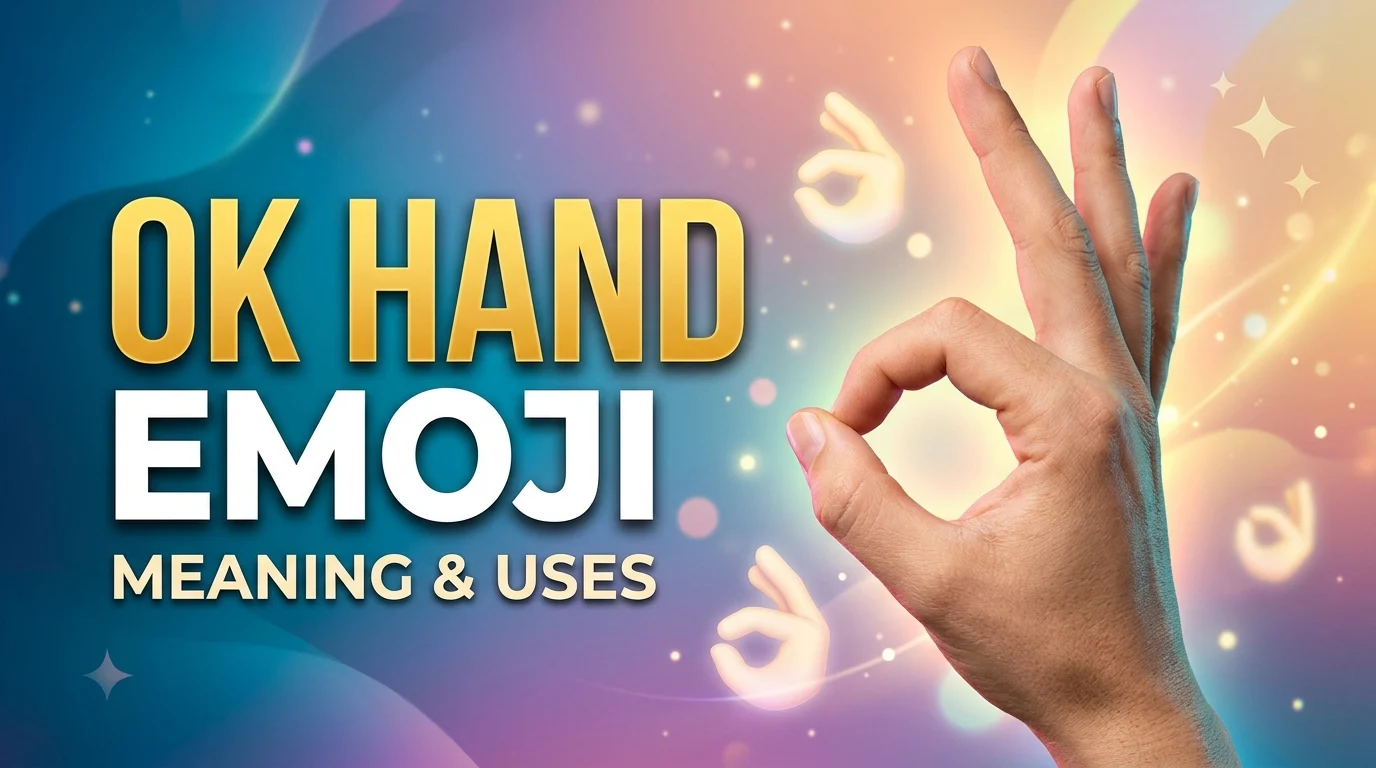
The OK hand emoji means “okay,” “all right,” or “everything is fine.” It shows a hand with the thumb and index finger touching to form a circle, while the other three fingers point upward. People often use it to confirm plans, show agreement, express approval, or let someone know that everything is under control.
However, the meaning of the OK hand emoji can change depending on the conversation. In a friendly message, it may communicate reassurance or approval. In a short reply, it can feel neutral or dismissive, especially when someone expects a more detailed response. Its interpretation can also vary across cultures and social settings, so the surrounding words matter.
Quick Answer
The OK hand emoji 👌 usually means “okay,” “perfect,” “good,” or “everything is fine.”
Its tone depends on context. It can express agreement, approval, reassurance, or sarcasm in everyday messages.
What Does the OK Hand Emoji 👌 Mean?
The OK hand emoji 👌 represents a familiar hand gesture in which the thumb and index finger form a circle. The other three fingers extend upward. In many everyday conversations, this gesture communicates that something is acceptable, correct, or going well.
People commonly use it to confirm that they understand a message or agree with a plan. It can also suggest that something is excellent, well done, or exactly right.
For example, if someone asks whether you will arrive at 6 p.m., replying with 👌 can mean that the time works for you. If a friend sends you a picture of a meal they prepared, the same emoji may communicate approval or appreciation.
The emoji does not always mean the same thing in every situation. A quick response to a simple question may feel natural, while the same symbol during a serious conversation may seem too casual. Its meaning depends on the message, relationship, and tone of the interaction.
👌 Meaning in Text Messages
In text messages, the OK hand emoji is often a quick way to say that something is understood, accepted, or approved. It can replace a short written response without requiring a full sentence.
Here are some common uses:
- Agreement: You accept a suggestion or plan.
- Confirmation: You have received the information and understand it.
- Approval: You think something looks good or has been done correctly.
- Reassurance: You want someone to know that everything is fine.
- Satisfaction: You think something is excellent or just right.
For example, if a friend texts, “I’ll meet you outside the restaurant,” you can reply with 👌 to show that you understand.
If someone asks, “Does this outfit look good?” the emoji can mean that you approve of their choice.
A short emoji reply may sometimes appear less enthusiastic than words such as “That sounds great!” This does not automatically mean the sender is annoyed. Some people simply prefer brief responses, especially during casual conversations.
What Does 👌 Mean From Someone?
When someone sends you the OK hand emoji, the most likely meaning depends on what you said immediately before it.
If you shared a plan, the sender may be confirming that they agree. If you asked whether a task was completed, the emoji may indicate that everything is handled. If you shared an idea or asked for an opinion, it may mean that the person approves.
The message before the emoji is often the best clue to its meaning.
For example:
- You: “I’ll send you the details tonight.”
- Them: “👌”
This usually means they understand and are fine with your plan.
Another example:
- You: “I finally finished the project!”
- Them: “👌”
Here, the emoji may show approval, although a more enthusiastic reply would make their excitement clearer.
If someone sends only 👌 after you explain something important, avoid assuming they are upset. They may simply be acknowledging your message. Look at their usual texting style and the rest of the conversation before deciding how they feel.
Is the OK Hand Emoji Positive?
Yes, the OK hand emoji is generally positive or neutral in many everyday contexts. It commonly communicates agreement, approval, satisfaction, or reassurance.
Someone may use it to show that a plan works, a task is complete, or a suggestion sounds good. It can also communicate that a result meets expectations.
For example:
- “The meeting is at 10 a.m.” 👌
- “Your booking is confirmed.” 👌
- “I fixed the problem.” 👌
In these situations, the emoji generally suggests that everything is acceptable or under control.
However, positive does not always mean enthusiastic. The OK hand emoji can be less expressive than a smiling face, a heart, or an excited written reply. It may simply communicate that the sender has no problem with what you said.
The surrounding message determines whether the emoji feels warm, practical, casual, or emotionally neutral.
Can 👌 Be Sarcastic?
Yes, the OK hand emoji can be used sarcastically, particularly when the conversation suggests that the sender is not genuinely satisfied.
For example, imagine that someone cancels plans at the last minute. You might reply with 👌 to show that you have received the message while also expressing disappointment or frustration.
The sarcasm comes from the situation rather than the emoji alone. In another conversation, the exact same response could be completely sincere.
Consider these examples:
- “You forgot again? 👌” may suggest frustration or disbelief.
- “Sure, that’s totally fine 👌” may sound sarcastic if the surrounding conversation shows the opposite.
- “You changed the schedule without telling me 👌” may communicate annoyance.
However, these interpretations are not guaranteed. Some people use the emoji simply because they prefer short replies.
If you are unsure whether someone is being sarcastic, consider their previous messages, the subject of the conversation, and whether their response matches what they would normally say.
The OK Hand Emoji as a Sign of Approval
One of the most common uses of 👌 is to show that something is good, acceptable, or well done.
People often use it as a quick reaction when they like a result or want to confirm that something meets their expectations. It can be more expressive than a plain “OK” because it visually reinforces the idea of approval.
For example, someone might send the emoji after receiving a finished design, reviewing a meal, or hearing that a task has been completed.
It can also be used to describe something as excellent or perfectly executed. In this context, the intended meaning is closer to “perfect” or “just right” than simply “I understand.”
The distinction depends on the conversation. If the message concerns a plan, 👌 usually indicates agreement. If it concerns the quality of something, it may express praise.
Does 👌 Mean “Okay” or “Perfect”?
The OK hand emoji can mean both, but the difference depends on what the sender is responding to.
“Okay” usually communicates acceptance, understanding, or confirmation. It suggests that the information or plan is acceptable.
“Perfect” communicates stronger approval. It suggests that something is especially good, exactly right, or meets expectations.
For example:
- “I’ll pick you up at 7.” 👌
This usually means the time is acceptable. - “I found the exact dress you wanted.” 👌
This may express approval or excitement about the result.
The emoji does not have a fixed level of enthusiasm. Some people use it for ordinary confirmation, while others use it when they genuinely like something.
If the distinction matters, words such as “okay,” “great,” or “perfect” provide more clarity than the emoji alone.
Does 👌 Mean Thank You?
Not usually. The OK hand emoji is primarily associated with approval, agreement, or confirmation rather than gratitude.
However, someone might use it after receiving help to acknowledge that they have seen the message or that everything is sorted.
For example:
- Person A: “I’ve sent you the document.”
- Person B: “👌”
The response most likely means that the document arrived or that the sender understands.
Compare this with a message such as “Thank you so much!” followed by a smiling face or a heart. Those expressions communicate gratitude more directly.
If you want to thank someone clearly, writing “Thanks,” “Thank you,” or “I appreciate it” is usually better than relying on 👌 alone.
Does 👌 Mean Agreement or Just Acknowledgment?
It can communicate either one.
Agreement means that you accept an idea, suggestion, or plan. Acknowledgment means that you have received or understood the information, without necessarily expressing a strong opinion about it.
For example:
- “Let’s meet at the coffee shop.” 👌
This likely communicates agreement. - “The address is 25 Main Street.” 👌
This may simply acknowledge the information.
The difference is important because receiving a message does not always mean someone agrees with every detail. In everyday texting, however, people often use the same emoji for both purposes.
When a decision is important, it is better to ask for a clear written confirmation rather than assume the emoji answers every question.
Related Hand Emojis and Their Meanings
The OK hand emoji belongs to a wider group of hand gestures that people use to express agreement, appreciation, encouragement, and emotion. Although some gestures may appear similar, their meanings are different.
| Emoji | Official Name | Common Meaning | Tone | Where or When It Is Used |
|---|---|---|---|---|
| 👌 | OK Hand | Okay, approval, perfect | Positive or neutral | Confirming plans or showing that something is acceptable |
| 👍 | Thumbs Up | Agreement, approval, good job | Positive or neutral | Responding to suggestions and confirming information |
| 🙌 | Raising Hands | Celebration, excitement, praise | Enthusiastic | Celebrating success or sharing good news |
| 👏 | Clapping Hands | Applause, praise, appreciation | Supportive or enthusiastic | Congratulating someone or recognizing an achievement |
| 🤝 | Handshake | Agreement, cooperation, partnership | Professional or friendly | Confirming a deal or showing mutual understanding |
| 🙏 | Folded Hands | Gratitude, prayer, or a request | Respectful or emotional | Expressing thanks or asking for help |
| ✌️ | Victory Hand | Peace, victory, or a casual goodbye | Friendly or playful | Celebrating, greeting, or ending a conversation |
| 🤞 | Crossed Fingers | Hope, luck, or wishing for a good outcome | Hopeful | Waiting for good news or expressing optimism |
👌 vs. 👍: What’s the Difference?
The OK hand emoji and thumbs-up emoji both communicate approval, but they can carry slightly different tones.
The OK hand emoji often suggests that something is acceptable, correct, or exactly right. The thumbs-up emoji more directly communicates agreement, approval, or a positive reaction.
For example, 👌 may be a natural response when someone asks whether a time works for you. 👍 may be more suitable when someone shares an idea and you want to show that you support it.
In many casual conversations, the two emojis are interchangeable. The difference is subtle, and personal texting habits can matter more than the symbols themselves.
👌 vs. 👏: What’s the Difference?
The OK hand emoji generally communicates agreement or approval. The clapping hands emoji is more closely associated with applause, praise, and recognition.
If a friend asks whether you understand their instructions, 👌 may be enough. If that friend wins an award or completes a difficult project, 👏 may better express congratulations.
The main distinction is that 👌 often means something is fine or correct, while 👏 highlights an achievement or performance.
👌 vs. 🙏: What’s the Difference?
The OK hand emoji usually indicates that something is acceptable or understood. The folded hands emoji can communicate gratitude, a request, prayer, or a respectful gesture, depending on the context.
For example, if someone confirms your appointment, 👌 can show that you understand. If someone helps you with a difficult task, 🙏 may be a more natural way to express thanks.
Although both can appear in polite conversations, their usual purposes are different.
Is the OK Hand Emoji Flirty?
The OK hand emoji is not generally a romantic or flirty symbol on its own. Its most common uses involve agreement, approval, or confirmation.
However, it can appear in a flirtatious conversation when the surrounding messages already have a playful or romantic tone.
For example, if someone sends you a picture of an outfit and you respond with 👌, they may interpret it as approval or a compliment. If you are already joking or flirting, the same response might feel playful.
Still, the emoji does not automatically mean attraction. A person may use it with friends, relatives, colleagues, or romantic interests without intending anything beyond acknowledgment.
If you want to understand whether a conversation is flirtatious, consider the words, the ongoing interaction, and the person’s behavior rather than interpreting one emoji as proof of romantic interest.
Is the OK Hand Emoji Rude?
The OK hand emoji is not inherently rude. In many conversations, it is a normal way to confirm information or show approval.
However, a short emoji-only response can sometimes feel dismissive, especially when the other person has shared something emotional or expects a thoughtful answer.
For example, replying with 👌 to “I had a really difficult day and need someone to talk to” might seem insensitive because the message calls for empathy rather than simple acknowledgment.
The same emoji could be perfectly appropriate in a practical exchange, such as confirming a meeting time.
Its tone also depends on personal communication styles. Someone who frequently uses brief replies may not intend to sound cold or annoyed.
If you are concerned that your response might seem rude, add a few words to explain what you mean. A message such as “Okay, that works for me” is clearer than the emoji alone.
OK Hand Emoji on Social Media
On social media, the OK hand emoji can be used in comments, captions, and direct messages to show approval or react to something impressive.
Someone might add 👌 to a picture of a well-prepared meal, a stylish outfit, a creative project, or a successful result. In these situations, it can mean that something looks good or has been done well.
It may also appear in comments to acknowledge a suggestion or confirm that someone understands a post.
Its meaning can shift depending on the community and the surrounding content. Some people use it sincerely, while others use it humorously or sarcastically.
The emoji can also carry different cultural or political associations in certain contexts. The hand gesture has been controversial because it has been used in different ways by different groups. That does not mean every use of the emoji communicates a political message.
When interpreting 👌 on social media, consider the post, the account’s context, and the accompanying words instead of assuming that every appearance has the same intention.
Text Message Examples
Here are five realistic examples showing how the OK hand emoji can work in different conversations.
1. Confirming a Plan
- Person A: “I’ll meet you at the station at 5.”
- Person B: “👌”
Meaning: Person B is confirming that the plan works.
2. Approving a Choice
- Person A: “What do you think of this design?”
- Person B: “👌 Looks great!”
Meaning: The emoji communicates approval, while the words make the positive reaction clearer.
3. Acknowledging Information
- Person A: “I’ve emailed you the updated file.”
- Person B: “Got it 👌”
Meaning: Person B has received the information and acknowledges the update.
4. Responding Sarcastically
- Person A: “I forgot to tell you that the meeting was moved again.”
- Person B: “👌”
Meaning: Depending on the relationship and earlier messages, the response may suggest annoyance or reluctant acceptance.
5. Reassuring a Friend
- Person A: “Sorry, is it okay if I’m ten minutes late?”
- Person B: “👌 No worries.”
Meaning: Person B is saying that the delay is acceptable.
These examples show why context matters. The same emoji can communicate agreement, approval, reassurance, or sarcasm depending on the words around it.
Common Misunderstandings About 👌
1. Thinking It Always Means “Perfect”
The emoji can mean “perfect,” but it can also simply mean “okay” or “I understand.” Its strength depends on the conversation.
2. Assuming It Is Always Friendly
Although it is often neutral or positive, the emoji can sound dismissive or sarcastic in certain situations. A short reply does not always communicate warmth.
3. Believing It Always Means Agreement
Sometimes the emoji acknowledges a message without clearly agreeing with every detail. For important decisions, written confirmation can prevent misunderstandings.
4. Treating It as a Romantic Signal
The OK hand emoji is not inherently flirty. It may appear in a romantic conversation, but the symbol alone does not establish romantic interest.
5. Assuming Everyone Interprets It the Same Way
Emoji interpretations can vary by culture, generation, community, and individual habits. A meaning that feels obvious to one person may be unfamiliar to another.
6. Ignoring the Conversation’s Tone
The words, subject, and relationship between the people communicating all help determine the intended meaning. Looking at the emoji alone may lead to the wrong conclusion.
How to Respond to 👌
The best response depends on what the other person is acknowledging.
- If they agree with your plan: Continue with the next step.
- If they approve of your work: You can say “Thanks!” or move forward with the task.
- If they confirm information: No reply may be necessary unless the conversation requires one.
- If you are unsure what they mean: Ask a simple follow-up question.
- If the conversation is serious: Respond with words that show you understand their feelings rather than relying only on another emoji.
For example, if someone replies with 👌 after you suggest a meeting time, you can assume the time is acceptable in an ordinary casual exchange. If you need a firm commitment, ask them to confirm the date and time in words.
You do not need to analyze every emoji response. Most of the time, a straightforward interpretation is enough unless the broader conversation gives you a reason to think otherwise.
Frequently Asked Questions
1. What does the OK hand emoji 👌 mean from a girl?
It usually means “okay,” “good,” “perfect,” or “I agree.” It does not automatically indicate romantic interest. The meaning depends on the conversation and the person’s usual texting style.
2. What does the OK hand emoji 👌 mean from a guy?
It generally communicates acknowledgment, approval, agreement, or reassurance. The emoji alone does not reveal whether he is flirting, annoyed, or simply confirming a message.
3. Does 👌 mean everything is fine?
Often, yes. It can reassure someone that a plan or situation is acceptable. However, context determines whether the sender is being sincere, neutral, or sarcastic.
4. Is 👌 a positive emoji?
It is generally positive or neutral. People commonly use it to show agreement, approval, or satisfaction, although it can sound dismissive in certain conversations.
5. Does 👌 mean yes?
It can function as an informal “yes” when someone asks a question or suggests a plan. However, it may also mean “I understand” or “that’s acceptable” rather than a strong agreement.
6. What is the difference between 👌 and 👍?
The OK hand emoji often suggests that something is acceptable or exactly right. The thumbs-up emoji more directly communicates approval or support. In many situations, both can be used interchangeably.
7. Can 👌 be sarcastic?
Yes. It can communicate reluctant acceptance, frustration, or disbelief when the surrounding conversation suggests sarcasm. The emoji alone does not prove that the sender is annoyed.
8. Does 👌 mean thank you?
Not usually. It more commonly communicates approval or acknowledgment. If you want to express gratitude clearly, words such as “thanks” or “I appreciate it” are more direct.
9. Is the OK hand emoji offensive?
The gesture is understood positively in many settings, but its interpretation can vary across cultures and social contexts. In some situations, it has acquired controversial associations. Consider the context before assuming what a particular use means.
Conclusion
The OK hand emoji 👌 is a simple way to communicate agreement, approval, confirmation, or reassurance. In everyday texts, it often means “okay,” “perfect,” or “everything is fine.” It can also sound sarcastic or dismissive when the surrounding conversation suggests a different tone.
The key is to consider the message, the relationship between the people communicating, and their usual texting habits. The emoji is not automatically rude, flirty, or sarcastic. Most of the time, it is simply a quick way to show that something is understood or acceptable.
Read More Related Articles:
- Sandwich Emoji Meaning | The Tasty Symbol for Food, Fun …
- Alarm Emoji Meaning | Wake-Up Alerts, Urgency & Hidden …
- Question Emoji Meaning | Decode Every ? Symbol and Its …