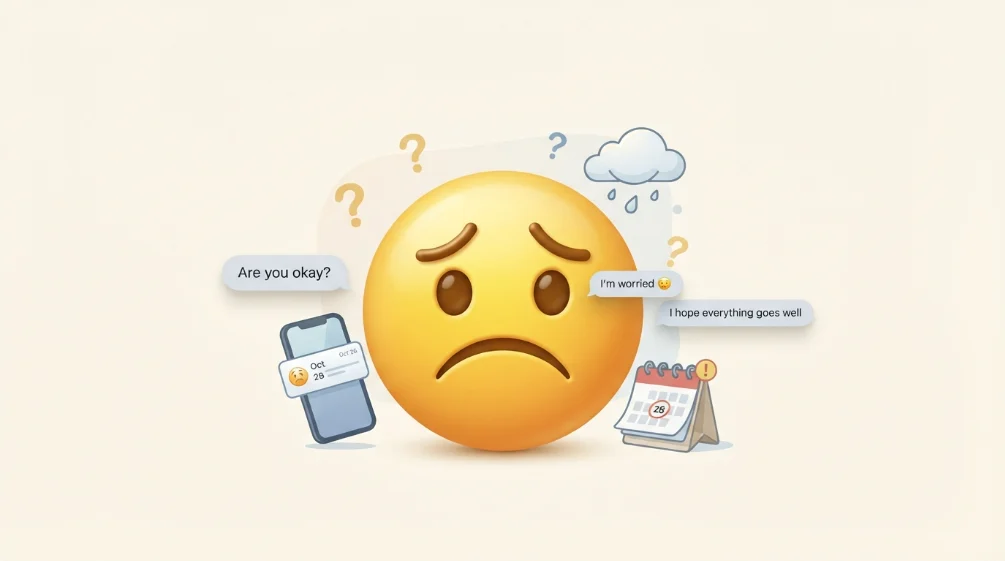
The worried emoji 😟 usually expresses concern, anxiety, uneasiness, disappointment, or mild sadness. Its official Unicode name is Worried Face, and its expression shows raised or furrowed eyebrows with a broad frown. In everyday texting, 😟 can signal that someone feels concerned about a situation, uncomfortable about what happened, or emotionally down.
However, 😟 does not always mean something serious. A person might use it after hearing bad news, when they are uncertain about a decision, or when they want to show concern for someone else. The exact meaning depends on the words around it, the situation, and the sender’s usual communication style.
Quick Answer:
😟 usually means worry, concern, anxiety, disappointment, or feeling uneasy about something.
It has a mildly negative and concerned tone, but the exact emotion can range from simple uncertainty to genuine distress depending on the conversation.
What Does the Worried Emoji 😟 Mean?
The 😟 emoji is officially called Worried Face. It shows a yellow face with open eyes, raised or furrowed eyebrows, and a broad frown. Unicode identifies it as U+1F61F, and it was approved in Unicode 6.1 in 2012 before being added to Emoji 1.0 in 2015.
Its central idea is concern.
People may use 😟 when they want to communicate:
- Worry
- Anxiety
- Concern
- Uneasiness
- Disappointment
- Mild sadness
- Alarm
- Uncertainty
- Emotional discomfort
The emoji usually feels less extreme than 😱 or 😰. It can be appropriate when something is bothering someone without necessarily suggesting panic or fear.
For example:
“I haven’t heard from her all day 😟”
This likely expresses genuine concern.
But:
“I think I left my phone at home 😟”
could simply communicate mild worry or frustration.
Why Do People Use 😟 in Texts?
Text messages do not include facial expressions or vocal tone, so an emoji can help show how a sentence is intended to feel.
Adding 😟 can make a statement sound more concerned:
“Are you okay? 😟”
Without the emoji, the question could sound neutral. With 😟, the sender clearly shows concern.
It can also soften a statement that might otherwise sound blunt:
“I don’t think that’s going to work 😟”
Here, the emoji can make the message feel more hesitant and concerned rather than harsh.
😟 Meaning in Text Messages
The meaning of 😟 can shift depending on what comes before it.
Concern about someone
“You haven’t been feeling well lately 😟”
Here, 😟 communicates sympathy and concern.
Worry about a situation
“The weather looks really bad for tomorrow 😟”
This suggests uncertainty or concern about what may happen.
Disappointment
“They canceled the event again 😟”
The sender may feel disappointed rather than deeply sad.
Nervous uncertainty
“I have no idea how this meeting is going to go 😟”
In this context, 😟 communicates uneasiness about an upcoming situation.
Mild sadness
“I wish you could come with us 😟”
The emoji adds a gentle feeling of sadness or disappointment.
These examples show why the words around 😟 matter. The emoji communicates the emotional tone, while the sentence usually explains the reason.
Is 😟 a Sad Emoji?
Yes, but sadness is only one possible meaning.
Worried Face is more closely associated with concern and tension than with intense sadness. Emojipedia describes it as capable of conveying moderately sad or tense emotions, including concern, anxiety, alarm, disappointment, and unhappiness.
Compare:
“I miss you 😟”
This can express sadness.
But:
“I’m worried about what happens next 😟”
is clearly more about concern.
So if you see 😟, think “something is bothering me” rather than automatically assuming “I’m sad.”
Is 😟 a Nervous Emoji?
It can be.
When someone uses 😟 before an uncertain event, it may communicate nervousness or apprehension.
For example:
“My interview starts in ten minutes 😟”
The sender is probably worried about how it will go.
However, 😟 is not specifically a nervousness emoji. If the message involves stronger anxiety, physical stress, or fear, another emoji such as 😰 may communicate that feeling more clearly.
What Does 😟 Mean From Someone?
When someone sends 😟 to you, the meaning depends heavily on the conversation.
They could be saying:
- “I’m worried.”
- “That doesn’t sound good.”
- “I’m concerned about you.”
- “I’m not sure about this.”
- “That’s disappointing.”
- “I feel bad about what happened.”
- “I’m nervous about the situation.”
For example:
“You haven’t replied all day 😟”
This likely communicates concern about your lack of response.
On the other hand:
“You actually have to work this weekend 😟”
could be sympathetic or playful depending on the relationship.
The safest interpretation is to look at the message before and after the emoji instead of treating 😟 as a standalone statement.
Is 😟 Flirting?
😟 is not inherently a flirting emoji.
It can appear in a playful or affectionate conversation, but the emoji itself mainly communicates concern, uneasiness, disappointment, or another mildly negative emotion.
For example:
“You’re really leaving without saying goodbye? 😟”
could sound emotionally affectionate, but it does not automatically indicate romantic interest.
If someone is flirting, the surrounding words, relationship, and overall conversation provide much stronger evidence than 😟 alone.
What Does 😟 Mean in a Relationship?
In a relationship, 😟 can communicate concern, disappointment, missing someone, or uncertainty.
For example:
“I wish you didn’t have to leave so early 😟”
This may express disappointment or sadness.
“You sounded upset on the phone 😟”
This communicates concern.
“Are we okay? 😟”
This can signal emotional uncertainty and a desire for reassurance.
In relationship conversations, context is especially important. 😟 does not automatically mean anger, rejection, jealousy, or loss of interest.
Can 😟 Be Used Sarcastically?
Yes, although sarcasm comes from the context rather than the emoji itself.
For example:
“Oh no, you have to take a three-day vacation 😟”
The sender is probably pretending to feel sorry for the other person.
Another example:
“You only got the biggest piece of cake 😟”
could be playful sarcasm.
If the conversation is serious, however, 😟 is more likely to be interpreted literally as concern or disappointment.
Can 😟 Mean “I Feel Bad for You”?
Yes.
Someone may use 😟 to show sympathy when another person is dealing with an unpleasant situation.
For example:
“They canceled your flight again? 😟”
This can communicate something like “That sounds frustrating” or “I feel bad that happened.”
The emoji does not necessarily mean the sender is personally sad. It can instead show an emotional reaction to someone else’s problem.
Is 😟 a Rude Emoji?
No. 😟 is not inherently rude.
It usually makes a message sound more concerned, sympathetic, or uneasy.
However, context can change how it feels.
For example:
“You really thought that was a good idea? 😟”
could sound judgmental or critical.
Meanwhile:
“I hope everything is okay 😟”
sounds supportive.
The difference comes from the words and situation, not from the emoji alone.
Worried Emoji 😟 vs. Similar Emojis
| Emoji | Official Name | Common Meaning | Tone | Where or When It Is Used |
|---|---|---|---|---|
| 😟 | Worried Face | Concern, worry, uneasiness, disappointment | Concerned, tense, mildly sad | Worrying news, uncertain situations, supportive texts |
| 😥 | Sad but Relieved Face | Sadness mixed with relief | Worried, relieved, emotional | After a stressful situation that ends safely |
| 😰 | Anxious Face with Sweat | Anxiety, fear, stress, worry | Nervous, tense, anxious | High-pressure situations, stressful news, fear |
| 😨 | Fearful Face | Fear, alarm, shock | Frightened, serious | Scary situations or alarming news |
| 😧 | Anguished Face | Distress, alarm, confusion, sadness | Distressed, shocked | Bad news, upsetting situations, sudden concern |
| 😕 | Confused Face | Confusion, hesitation, uncertainty | Unsure, mildly negative | Confusing messages, unclear situations, hesitation |
| 🥺 | Pleading Face | Vulnerability, pleading, tenderness | Emotional, soft, affectionate | Asking for something, sympathy, emotional reactions |
| ☹️ | Frowning Face | General sadness or unhappiness | Sad, subdued | Disappointment, bad news, unhappy reactions |
| 😞 | Disappointed Face | Disappointment, discouragement | Downcast, sad | Failed plans, bad results, feeling let down |
The most important distinction is that 😟 sits between ordinary concern and stronger emotional distress. 😥 adds a sense of relief, 😰 brings stronger anxiety or stress, and 😨 is more directly associated with fear. 😕 is more about uncertainty or confusion than worry. Emojipedia describes these emojis with distinct emotional ranges and cautions against treating similar facial expressions as interchangeable.
😟 vs. 😥: What’s the Difference?
Both can communicate worry, but their emotional focus is different.
😟 Worried Face mainly communicates concern, uneasiness, or disappointment.
😥 Sad but Relieved Face combines sadness or worry with a sense of relief that things did not turn out worse. Emojipedia describes 😥 as a face that appears concerned or sad while also conveying relief.
Compare:
“I don’t know what will happen 😟”
This expresses uncertainty.
“That was close, but everything worked out 😥”
This suggests the stressful situation is over and the sender feels relieved.
😟 vs. 😰: What’s the Difference?
😟 usually feels more moderate.
😰 Anxious Face with Sweat has a sweat drop and a more visibly stressed expression. It can communicate anxiety, fear, sadness, or disappointment and often feels more physically tense than 😟.
For example:
“I’m worried about the appointment 😟”
sounds concerned.
“I’m so nervous about this appointment 😰”
sounds more intensely anxious.
😟 vs. 😨: What’s the Difference?
😨 Fearful Face is more strongly associated with fear and alarm.
😟 generally suggests that something is concerning or troubling.
“I don’t know if this plan will work 😟”
shows worry.
“I just heard a huge noise downstairs 😨”
suggests fear.
Emojipedia describes 😨 as intended to represent fear, although it can also be used for shock, sadness, or being upset.
😟 vs. 🥺: What’s the Difference?
These two can overlap when someone wants sympathy, but their expressions serve different purposes.
😟 communicates worry or concern.
🥺 Pleading Face is more associated with vulnerability, pleading, affection, or wanting sympathy.
For example:
“I’m worried about my test tomorrow 😟”
is straightforward concern.
“Please let me have one more chance 🥺”
sounds like an emotional request.
How to Respond to 😟
Your response should depend on why the sender used it.
If they seem genuinely worried
“Is everything okay?”
If they’re concerned about you
“I’m okay, thanks for checking on me.”
If they’re disappointed
“Yeah, I was disappointed too.”
If they’re nervous about something
“You’ll be okay. Just take it one step at a time.”
If you’re unsure what they mean
“What’s wrong? 😟”
A simple question is often better than guessing what emotion the sender intended.
Worried Emoji Text Examples
“I don’t think I’m ready for tomorrow 😟”
Likely means the sender feels nervous or uncertain.
“You haven’t eaten all day 😟”
Shows concern for another person’s well-being.
“They canceled the trip again 😟”
Usually expresses disappointment.
“I hope everything goes well at your appointment 😟”
Communicates genuine concern and support.
“You really have to wake up at 5 a.m. tomorrow 😟”
Could be playful sympathy rather than serious worry.
“Are you sure this is a good idea? 😟”
May communicate concern, hesitation, or mild disapproval.
Does the Number of 😟 Emojis Change the Meaning?
It can change the perceived intensity, but there is no official rule.
For example:
“I’m worried 😟”
sounds relatively restrained.
“I’m really worried 😟😟”
may feel more emphatic.
Using several emojis can also be playful or dramatic, so the number alone does not prove how serious the situation is.
How Does 😟 Look on Different Platforms?
The basic expression of 😟 remains recognizable across platforms, but its exact artwork can vary.
Emojipedia notes that Apple’s design uses an eye expression shared with 😯 Hushed Face, while older Samsung artwork included sweat droplets on the cheeks. Individual platform designs can therefore change small visual details even when the underlying emoji remains the same.
Google’s Noto Color Emoji version also has its own platform-specific rendering.
These visual differences usually do not change the core meaning of the emoji, but they can slightly affect how worried, sad, or tense the face appears.
What Is the Official Name of 😟?
The official Unicode name is Worried Face.
Its Unicode code point is U+1F61F. It was approved as part of Unicode 6.1 in 2012 and added to Emoji 1.0 in 2015.
The informal phrase “worried emoji” is therefore a natural description of 😟, while Worried Face is its official name.
When Should You Use 😟?
😟 works well when you want to show concern without making the reaction extremely intense.
Good situations include:
- Checking on a friend
- Reacting to worrying news
- Expressing uncertainty
- Showing mild disappointment
- Responding sympathetically
- Talking about a stressful event
- Showing concern before an important event
- Reacting to an unexpected problem
If the emotion is clearly fear, panic, or intense anxiety, a stronger emoji may communicate the feeling more precisely.
When Should You Avoid 😟?
You may want to avoid using 😟 when the situation is highly serious and your meaning could be misunderstood.
For example, if someone tells you about a major personal loss, relying only on 😟 may feel too vague. A sincere written response can communicate empathy more clearly.
Similarly, if you’re joking with someone who may not recognize your sarcasm, 😟 could make the message seem genuinely concerned.
Frequently Asked Questions
What does 😟 mean from a girl or guy?
The meaning does not depend on gender. Anyone can use 😟 to express concern, anxiety, disappointment, uncertainty, or mild sadness.
Does 😟 mean worried?
Yes. Worry and concern are among its most common interpretations. Its official name is Worried Face.
Is 😟 a sad emoji?
It can express sadness, but it more often suggests a combination of concern, tension, disappointment, or uneasiness rather than intense sadness.
Does 😟 mean anxiety?
It can. Mild anxiety or nervous uncertainty may be expressed with 😟, although 😰 is often a stronger choice when the intended feeling is intense anxiety or stress.
Is 😟 a flirting emoji?
Not inherently. It can appear in affectionate or playful conversations, but the emoji alone does not establish romantic interest.
What does 😟 mean from a friend?
A friend may use 😟 to show concern, sympathy, disappointment, or worry about something you said.
What is the difference between 😟 and 😢?
😟 focuses more on worry or concern, while 😢 Crying Face more directly communicates sadness or crying.
What is the difference between 😟 and 😕?
😟 generally communicates concern or worry, while 😕 more often communicates confusion, hesitation, or uncertainty.
Can 😟 be sarcastic?
Yes. Like many facial emojis, 😟 can be used sarcastically when the surrounding message is clearly playful or exaggerated.
Final Takeaway
The worried emoji 😟, officially known as Worried Face, usually communicates concern, worry, uneasiness, disappointment, or mild sadness. It is useful when something feels troubling without necessarily reaching the stronger emotional level of fear or panic.
When interpreting 😟 in a text, focus on the surrounding words and situation. A message about bad news may use it sincerely, while a casual joke may use it for playful sympathy or exaggerated concern. The emoji gives you the emotional tone, but context tells you what that emotion actually means.
Read More Related Articles:
- Book Emoji | Meaning, Symbolism, Uses, and Creative Ways …
- Happy Face Emoji Meaning | What Does Mean in Texts in 2026
- Choking Emoji Meaning | What It Really Says in Texts …











10 thoughts on “Worried Emoji Meaning 😟 | What It Really Says About Anxiety, Concern & Those “Uh-Oh” Moments in 2026”