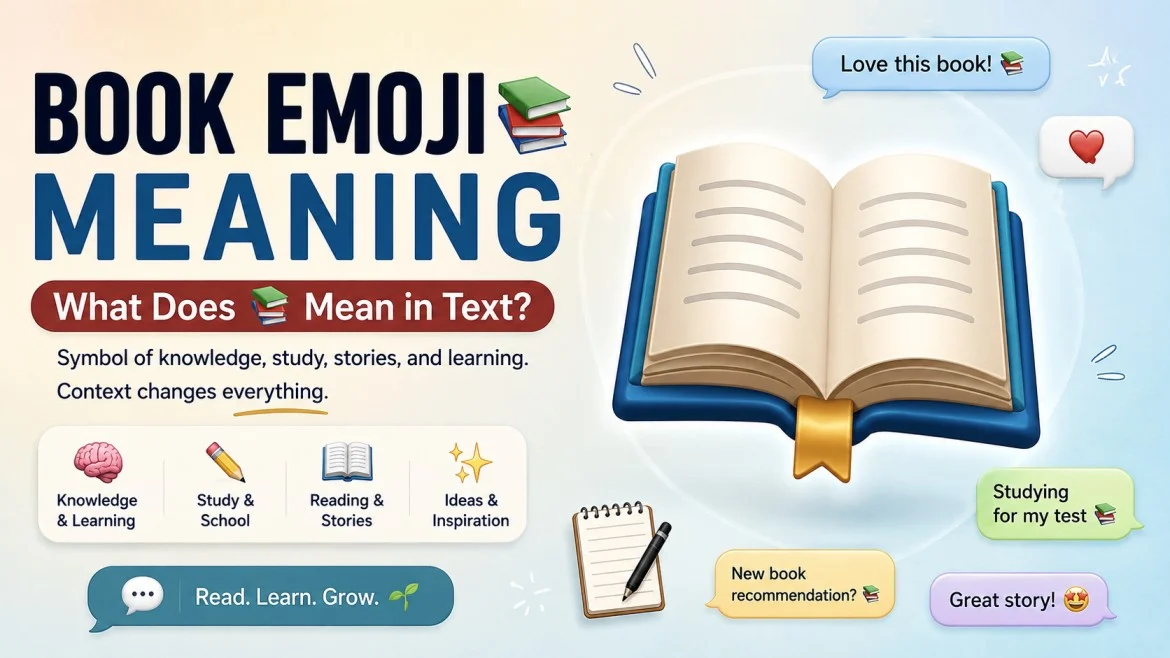
The book emoji 📖 usually represents reading, books, learning, knowledge, or a story. Its official Unicode name is Open Book, making it a natural choice when someone is talking about reading, studying, literature, education, or a favorite book. It can also carry a broader meaning, such as curiosity, gaining knowledge, or sharing an interesting story. (Unicode Consortium)
In texts, the book emoji can be literal or symbolic. “I’m reading before bed 📖” clearly refers to a book, while “There’s more to the story 📖” can use it to suggest a story or explanation. The surrounding words and conversation matter, especially when 📖 is being used beyond its literal meaning.
Quick Answer:
📖 usually means reading, books, study, knowledge, or stories. It can also suggest learning something new or talking about literature, depending on the context.
What Does the Book Emoji 📖 Mean?
The 📖 emoji shows an open book and is officially named Open Book by Unicode. Its Unicode code point is U+1F4D6. (Unicode Consortium)
The most common uses include:
- Reading a book
- Talking about literature
- Studying or learning
- Sharing knowledge
- Discussing a story
- Recommending something to read
- Talking about school or education
- Expressing an interest in books
- Referring to information or a written source
The meaning is usually straightforward, but 📖 can become more symbolic depending on the sentence.
For example:
“I finally started that novel 📖”
Here, the emoji directly represents reading.
But:
“Let me tell you the whole story 📖”
uses the book as a visual reference to a story or narrative.
Why Do People Use the 📖 Emoji?
The book emoji provides a quick visual way to show that a message is connected to reading, information, or stories.
Someone might add 📖 to a message because they are:
- Starting a new book
- Studying for an exam
- Sharing a reading recommendation
- Discussing a novel
- Learning a subject
- Talking about education
- Sharing a meaningful story
- Referring to written information
It can also make a short message feel more expressive.
“Time to study 📖”
is more visually specific than simply saying “Time to study.”
📖 Meaning in Text Messages
In texting, 📖 is generally easy to understand because it has a strong connection with reading and books.
Talking about reading
“I’m staying in tonight with my new book 📖”
The emoji reinforces that the person plans to read.
Studying
“Big exam tomorrow, so I’m hitting the books 📖”
Here, 📖 represents studying rather than leisure reading.
Sharing a recommendation
“You have to read this one 📖”
The emoji can make the recommendation feel more clearly connected to a book.
Talking about a story
“Okay, here’s what really happened 📖”
In this context, 📖 can suggest that a story is about to be told.
Sharing knowledge
“I learned something interesting today 📖”
The emoji can symbolize learning or information rather than an actual physical book.
Does 📖 Always Mean Reading?
No.
Reading is one of its clearest meanings, but the emoji can represent a wider idea of knowledge, learning, information, or storytelling.
Compare these messages:
“I’m reading a mystery novel 📖”
Literal reading.
“Studying all weekend 📖”
Learning or schoolwork.
“You need to hear this story 📖”
Storytelling.
“There’s a whole history behind that 📖”
Knowledge or historical information.
The emoji stays visually connected to a book, but the intended meaning expands with the surrounding text.
📖 Meaning for School and Studying
The book emoji is commonly useful when talking about education or study-related activities.
Examples include:
“Finals are coming up 📖”
“Back to studying tonight 📖”
“I need to finish this chapter 📖”
“Learning something new every day 📖”
In these situations, 📖 can represent textbooks, studying, lessons, or learning in general.
It does not necessarily mean the person is reading a novel. Context determines whether the book represents schoolwork, personal reading, research, or general knowledge.
📖 Meaning for Books and Literature
When the conversation is specifically about books, 📖 can work as a direct visual symbol for literature.
For example:
“Just finished an amazing novel 📖”
“Any good mystery books to recommend? 📖”
“This author never disappoints 📖”
It can also appear alongside a book title, review, recommendation, or reading list.
Because the emoji shows an open book rather than a particular genre, it does not automatically indicate fiction, nonfiction, romance, mystery, fantasy, or another category.
📖 Meaning in a Book Recommendation
Someone may use 📖 when recommending something to read.
“You should definitely read this 📖”
“Adding this to my reading list 📖”
“Have you read this one yet? 📖”
In these examples, the emoji acts as a visual cue for the reading topic.
If someone sends only:
“📖”
the intended meaning is less certain. They might be saying “book,” “reading,” “study,” or simply referring to something they are reading.
Can 📖 Mean “Knowledge”?
Yes.
Although the literal object is an open book, books are strongly associated with information and learning. As a result, 📖 can sometimes symbolize knowledge.
For example:
“Always keep learning 📖”
or:
“There’s so much to discover 📖”
Here, the emoji is less about a particular book and more about education, curiosity, or gaining information.
This is a contextual interpretation rather than a separate official emoji definition.
Can 📖 Be Used for Storytelling?
Yes.
A book can represent a story, so 📖 can be used when someone is introducing or discussing a narrative.
For example:
“Okay, here’s the full story 📖”
“That sounds like a story worth telling 📖”
“There’s a lot more behind that decision 📖”
In these messages, the emoji can make the idea of a story more visual and playful.
It does not mean the sender is literally writing a book.
Is the Book Emoji Romantic or Flirty?
📖 is not inherently a romantic or flirting emoji.
It can appear in a romantic conversation if the subject is books, reading, or storytelling, but the emoji itself does not establish romantic interest.
For example:
“You should read my favorite novel 📖❤️”
The ❤️ adds the stronger affectionate signal.
Similarly:
“Want to read together sometime? 📖”
could be an invitation to spend time together, but the romantic meaning would come from the broader context rather than 📖 alone.
Avoid assuming that someone is flirting simply because they send the book emoji.
What Does 📖 Mean From Someone?
The meaning depends heavily on what came before it.
If someone sends:
“I started that book you recommended 📖”
they are probably talking literally about reading.
If they send:
“I have a story to tell you 📖”
they are using the book as a symbol for storytelling.
If they send only:
“📖”
you may need more context.
The safest approach is to interpret the message around the emoji instead of assigning a hidden meaning to the character itself.
Is 📖 Formal or Casual?
The book emoji can work in both casual and somewhat educational conversations.
It fits naturally in:
- Text messages
- Reading discussions
- Study conversations
- Social media captions
- Book recommendations
- School-related posts
- Personal reading updates
Its tone is generally neutral and positive, although the surrounding message can make it playful, serious, academic, or enthusiastic.
For example:
“Reading before bed 📖”
feels casual.
“Studying constitutional law 📖”
feels more academic.
Emojis Similar to the Book Emoji 📖
| Emoji | Official Name | Common Meaning | Tone | Where or When It Is Used |
|---|---|---|---|---|
| 📖 | Open Book | Reading, books, knowledge, stories | Neutral, educational | Reading updates, study, book discussions |
| 📚 | Books | Multiple books, studying, reading collection | Educational, enthusiastic | Study sessions, libraries, reading lists |
| 📕 | Closed Book | A book, reading, or a specific volume | Neutral | Book discussions, reading references |
| 📗 | Green Book | A book or reading material | Neutral, academic | Reading, school, literature references |
| 📘 | Blue Book | A book, textbook, or written material | Neutral, academic | Study, education, book-related messages |
| 📙 | Orange Book | A book or reading material | Neutral | Book discussions and reading references |
| 📓 | Notebook | Notes, writing, schoolwork | Practical, academic | Taking notes, classes, writing |
| 📒 | Ledger | Notes, records, or written information | Practical, organized | Lists, notes, records, study contexts |
| 📝 | Memo | Writing, notes, or making a written record | Practical, focused | Assignments, reminders, writing tasks |
The most important distinction is between 📖 and 📚. 📖 shows one open book and is especially natural for reading or a specific book, while 📚 represents a collection of books and can suggest studying, a library, or multiple reading materials.
📓 and 📝 are more closely associated with writing and taking notes than with reading. The colored book emojis such as 📕, 📗, 📘, and 📙 are generally visual variations representing books rather than completely different emotions or meanings. Unicode assigns each its own official name. (Unicode Consortium)
📖 vs. 📚: What’s the Difference?
📖 represents an open book, so it naturally fits reading a particular book, discussing a story, or referring to learning.
📚 represents multiple books, which makes it useful for collections, libraries, extensive reading, or studying several subjects.
Compare:
“I’m reading this novel 📖”
with:
“My bookshelf is getting out of control 📚”
The first points toward an individual reading experience. The second suggests multiple books.
📖 vs. 📓: What’s the Difference?
📖 is primarily associated with reading or a book.
📓 is Notebook, making it more appropriate for writing, notes, schoolwork, or keeping information in a notebook. (Unicode Consortium)
For example:
“Reading my favorite chapter 📖”
fits 📖.
“Taking notes during class 📓”
fits 📓 better.
📖 vs. 📝: What’s the Difference?
📝 is Memo and is closely connected with writing or recording information.
Use 📖 when the focus is reading or a book.
Use 📝 when the focus is writing something down.
“I need to read this chapter 📖”
versus:
“I need to write this assignment 📝”
The two emojis can work together when both reading and writing are involved.
Book Emoji Examples in Text
Here are realistic examples of how 📖 can change meaning based on the message:
“Finally starting my vacation read 📖”
The emoji literally represents reading a book.
“I have three chapters left 📖”
It reinforces the idea of reading.
“Back to studying tonight 📖”
It represents study or education.
“Okay, here’s the whole story 📖”
It works symbolically as a storytelling cue.
“You have to read this book 📖”
It supports a recommendation.
“Never stop learning 📖”
It represents knowledge and learning rather than one specific book.
How to Respond to the Book Emoji 📖
If someone uses 📖 in a message, your response can follow the subject of the conversation.
- If they’re recommending a book
“I’ll add it to my reading list!”
- If they’re talking about studying
“Good luck with your studying!”
- If they’re discussing a story
“Okay, I’m listening. Tell me everything.”
- If they mention a book you have read
“I loved that one too!”
- If they send only 📖
“Reading something good?”
That last response is useful because it invites clarification without assuming what the sender means.
When Should You Use the 📖 Emoji?
📖 works well when you want to visually emphasize:
- Reading
- A book
- Literature
- Studying
- Learning
- Knowledge
- Stories
- Book recommendations
- A reading habit
It is especially useful when the written message already provides enough context.
For example:
“My weekend plan: coffee and a good book 📖”
The meaning is immediately clear.
Common Misunderstandings About 📖
One common mistake is assuming that 📖 always means school or studying.
It can simply mean reading for pleasure.
Another mistake is assuming that 📖 has a hidden romantic meaning. It does not. Any romantic tone comes from the surrounding message.
It is also easy to confuse 📖 with 📚. The first represents an open book, while the second represents multiple books.
Finally, a single 📖 can be too vague to interpret confidently. If someone sends only the emoji, the best way to understand it is to consider the conversation or ask what they mean.
Frequently Asked Questions
What is the official name of 📖?
The official Unicode name is Open Book, with the code point U+1F4D6. (Unicode Consortium)
What does 📖 mean in texting?
📖 usually means reading, a book, studying, learning, knowledge, or a story. The exact meaning depends on the surrounding message.
What does the book emoji mean from a girl or guy?
Its meaning does not change based on gender. 📖 generally refers to books, reading, learning, or storytelling regardless of who sends it.
Does 📖 mean studying?
It can. When used alongside messages about school, exams, homework, or learning, 📖 can represent studying. In other contexts, it may simply mean reading.
What is the difference between 📖 and 📚?
📖 is Open Book, while 📚 is Books. 📖 is often suited to one book or the act of reading, while 📚 represents multiple books or a collection.
Can 📖 mean a story?
Yes. A book can symbolize a story, so 📖 may be used when someone is introducing or discussing a story.
Is 📖 a good emoji for a book recommendation?
Yes. It provides a simple visual cue that the message is about reading or books.
Does 📖 mean knowledge?
It can symbolize knowledge or learning when the context is educational or informational. This is a contextual use rather than a separate official definition.
Is 📖 a flirting emoji?
Not by itself. 📖 is primarily associated with books, reading, learning, and stories. A romantic interpretation requires additional context.
Final Takeaway
The book emoji 📖, officially called Open Book, most often represents reading, books, learning, knowledge, or stories. It can describe a literal reading activity or work as a broader symbol for education and storytelling. (Unicode Consortium)
Its meaning is usually easy to understand when paired with words, but a single 📖 can be vague. Look at the surrounding message before assigning a deeper meaning. If the conversation is about novels, studying, recommendations, or stories, the emoji will usually reinforce that topic rather than carry a hidden message.
Read More Related Articles:
- Handshake Emoji Meaning | What Does Mean in Texts?
- Red Heart Emoji ❤️ Meaning | What Does ❤️ Mean in Texts?
- Pleading Emoji Meaning | What Does It Mean?











8 thoughts on “Book Emoji | Meaning, Symbolism, Uses, and Creative Ways to Share Your Reading Mood in 2026”