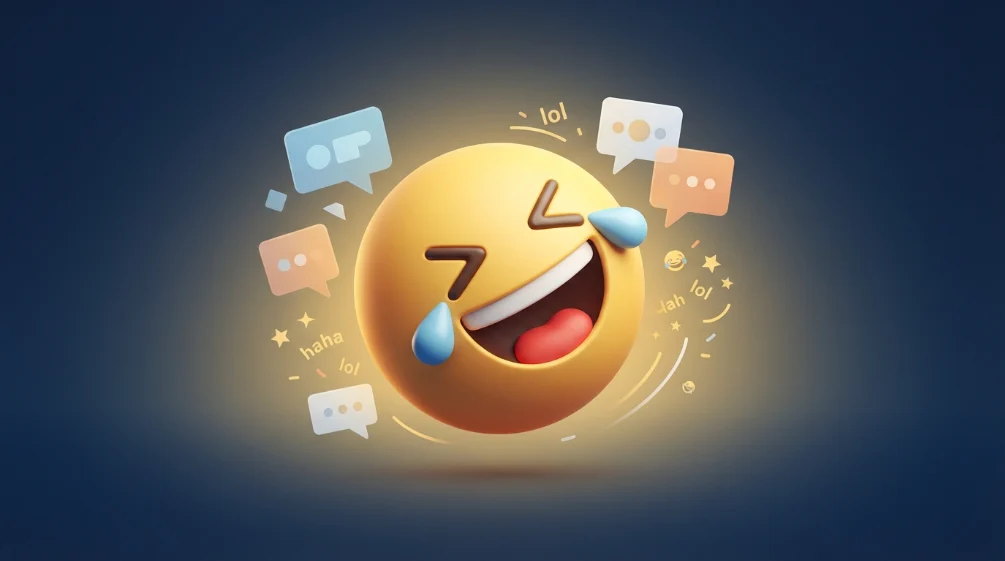
The ROFL emoji 🤣 officially called Rolling on the Floor Laughing is used to show extremely strong laughter. It usually means that something is hilarious, ridiculous, or so funny that the sender is exaggerating their reaction as if they are rolling on the floor laughing. The emoji shows a tilted face with a huge grin, tightly closed X-shaped eyes, and tears of laughter. Unicode lists 🤣 as U+1F923 and includes keywords such as funny, hilarious, laugh, lol, rofl, and tear.
In texts, 🤣 generally carries a stronger reaction than a normal smiling or laughing emoji. It can be used for a genuinely hilarious joke, an absurd situation, playful teasing, or a ridiculous mistake. Context still matters, though. A message like “That was the funniest thing ever 🤣” is clearly humorous, while “You actually did that 🤣” could combine laughter with disbelief or teasing.
Quick Answer:
🤣 means “Rolling on the Floor Laughing” and usually expresses very strong laughter, amusement, or a hilarious reaction.
It is often more exaggerated than 😂 and can also communicate disbelief, playful teasing, or laughing at an absurd situation.
What Does the ROFL Emoji 🤣 Mean?
The ROFL emoji 🤣 represents intense laughter. Its official Unicode name is Rolling on the Floor Laughing, while “ROFL” is the familiar internet abbreviation for the phrase.
The emoji was introduced with Unicode 9.0 in 2016 and added to Emoji 3.0 that same year. Its Unicode code point is U+1F923.
People commonly use 🤣 when something feels:
- Extremely funny
- Ridiculous
- Absurd
- Unexpected
- Entertaining
- Comically embarrassing
- Impossible to take seriously
The main idea is intense laughter. Unlike a simple smile, 🤣 tells the reader that the sender is reacting strongly to whatever was just said or shown.
What Does ROFL Stand For?
ROFL stands for “Rolling on the Floor Laughing.”
It is an internet abbreviation used to describe an extremely strong laughing reaction. The 🤣 emoji visually represents that idea by showing a face tilted sideways, as though it is physically rolling around while laughing.
Because the emoji itself depicts the phrase, “ROFL emoji” and 🤣 are commonly used as references to the same character.
🤣 Meaning in Text Messages
In text messages, 🤣 usually means:
“That is extremely funny.”
For example:
“You really sent that email to the wrong person 🤣”
The sender is probably laughing at the situation.
It can also intensify a reaction:
“I cannot believe you actually said that 🤣”
Here, the emoji may communicate both laughter and disbelief.
Another example:
“That dog just stole the entire sandwich 🤣”
The sender is reacting humorously to something unexpected.
The emoji does not necessarily mean the sender is literally lying on the floor laughing. Like many expressive emojis, it is often an exaggerated way to show emotional intensity.
Is 🤣 Stronger Than 😂?
Usually, yes.
😂 is officially called Face with Tears of Joy and commonly expresses laughter or amusement. 🤣 is specifically designed around the idea of extremely intense laughter.
A simple comparison:
“That was funny 😂”
sounds like a strong laugh.
“That was absolutely ridiculous 🤣”
usually feels more intense and dramatic.
Emojipedia describes 🤣 as often conveying laughter that is more intense than 😂.
That does not mean everyone uses the two emojis in exactly the same way. Personal texting style can make the difference less noticeable.
🤣 vs. 😂: What’s the Difference?
Both emojis can mean “that’s hilarious,” but they create slightly different impressions.
😂 Face with Tears of Joy focuses on laughing so hard that tears appear.
🤣 Rolling on the Floor Laughing takes that reaction even further by visually exaggerating the laughter.
Think of the difference as:
😂 = very funny
🤣 = absolutely hilarious or ridiculously funny
For example:
“That joke was good 😂”
versus:
“I can’t breathe, that was so funny 🤣”
The second feels more dramatic and over-the-top.
🤣 vs. 😭: What’s the Difference?
These emojis can be confusing because both can appear after something extremely funny.
🤣 clearly represents laughter. Its official name directly describes laughing.
😭 Loudly Crying Face officially represents intense crying, but it is also frequently used online as an exaggerated reaction to something hilarious. Emojipedia notes that 😭 can be used to represent laughing so hard that the user is brought to tears.
For example:
“That video was hilarious 🤣”
makes the laughter obvious.
“That video was hilarious 😭”
can also mean the video was extremely funny, but the tone is more exaggerated or emotionally dramatic.
If you want your message to unmistakably communicate laughter, 🤣 is the clearer choice.
Related Laughing Emojis and Their Meanings
| Emoji | Official Name | Common Meaning | Tone | Where or When It Is Used |
|---|---|---|---|---|
| 🤣 | Rolling on the Floor Laughing | Extremely strong laughter | Hilarious, dramatic, playful | Very funny jokes, absurd situations, reactions |
| 😂 | Face with Tears of Joy | Laughing or finding something very funny | Joyful, humorous | Jokes, funny messages, amusing reactions |
| 😆 | Grinning Squinting Face | Strong laugh or delighted reaction | Energetic, cheerful | Funny comments, playful conversations |
| 😅 | Grinning Face with Sweat | Nervous laughter, awkward relief, or amusement | Awkward, relieved, playful | Embarrassing moments, close calls, uncomfortable jokes |
| 😹 | Cat with Tears of Joy | Laughing very hard | Silly, playful | Cat-related humor or exaggerated laughter |
| 😭 | Loudly Crying Face | Intense emotion, often also exaggerated laughter | Dramatic, emotional, humorous | Funny reactions, sadness, frustration, emotional moments |
| 💀 | Skull | “I’m dead” from laughter or shock | Dramatic, slangy, humorous | Extremely funny or absurd reactions |
| 😭 | Loudly Crying Face | Overwhelming crying or exaggerated reaction | Emotional, dramatic | Sadness, humor, frustration, intense reactions |
The closest comparisons are 🤣, 😂, 😆, and 😭. 🤣 is the most direct choice when you want to emphasize extreme laughter. 😂 is slightly more straightforward, while 😭 and 💀 can carry more context-dependent or slang-like meanings.
What Does 🤣 Mean From Someone?
If someone sends you 🤣, they are usually reacting strongly to something funny.
Depending on the conversation, it can mean:
- “That is hilarious.”
- “I’m laughing so hard.”
- “I can’t believe you said that.”
- “That was ridiculous.”
- “You’re so funny.”
- “I can’t take this seriously.”
For example:
“You really thought that was going to work 🤣”
This could be playful teasing.
Or:
“I just watched that video 🤣”
The sender is probably saying they found the video extremely funny.
If 🤣 appears after a serious statement, however, it can sometimes feel dismissive or mocking. The surrounding words are important.
Can 🤣 Be Used Sarcastically?
Yes. 🤣 can be sarcastic, especially when someone is laughing at an absurd statement or pretending something is funny.
For example:
“Yeah, because waking up at 5 a.m. sounds like so much fun 🤣”
The sender probably does not genuinely think waking up early is hilarious. The emoji emphasizes sarcasm.
Another example:
“Great, my phone died right before the meeting 🤣”
This may express frustration through exaggerated humor.
The emoji itself does not guarantee sarcasm. The sentence and situation determine whether the laughter is sincere, playful, or sarcastic.
Can 🤣 Be Rude?
It can be, depending on how it is used.
If a friend says:
“I tripped over my own shoelace 🤣”
they are probably laughing at themselves.
But if someone responds to another person’s serious problem with:
“That’s what happened? 🤣”
it could come across as mocking or insensitive.
The emoji is not automatically rude. The issue is whether the laughter fits the situation.
When someone is sharing bad news, embarrassment, or a serious concern, 🤣 can easily send the wrong message.
Is 🤣 a Flirting Emoji?
Not by itself.
Someone may use 🤣 while flirting because flirting can involve jokes, teasing, and playful conversation. But the emoji itself simply communicates strong laughter.
For example:
“You are actually ridiculous 🤣”
could be friendly teasing.
In a romantic conversation, the same message might feel playful and flirtatious.
However, 🤣 alone does not prove attraction or romantic interest. The overall conversation matters much more than the emoji.
🤣 Meaning in Friendship
Among friends, 🤣 is often used for jokes, teasing, embarrassing stories, funny videos, and ridiculous situations.
For example:
“You wore two different shoes to class 🤣”
This could be friendly teasing.
Or:
“I just remembered what happened last weekend 🤣”
The emoji may signal that the memory is still funny.
Because close friends often understand each other’s humor, 🤣 can make teasing feel more obviously playful.
🤣 Meaning on Social Media
On social media, 🤣 can work as a quick reaction to:
- Funny posts
- Memes
- Unexpected comments
- Ridiculous videos
- Funny mistakes
- Playful arguments
- Absurd situations
It is particularly useful when the sender wants to communicate a strong laugh without writing a full response.
For example:
“The comment section is undefeated 🤣”
means the person finds the comments extremely funny.
The same emoji can also be combined with other emojis to create a stronger reaction:
“I wasn’t ready for that 🤣💀”
This combination usually emphasizes extreme amusement or disbelief.
When Should You Use 🤣 Instead of 😂?
Choose 🤣 when you want your reaction to feel especially intense or dramatic.
Use 😂 when you want a more familiar, straightforward laughing reaction.
For example:
Use 😂:
“That’s actually pretty funny 😂”
Use 🤣:
“I am crying, that was absolutely ridiculous 🤣”
The distinction is not a strict rule. People often use both interchangeably.
When Should You Use 🤣 Instead of 😭?
Use 🤣 when you want the reader to clearly understand that you are laughing.
Use 😭 when the reaction could be laughter, emotional overwhelm, frustration, affection, or another intense feeling.
Compare:
“That joke destroyed me 🤣”
The meaning is clearly laughter.
“That joke destroyed me 😭”
This can also mean laughter, but the reaction is more exaggerated and emotionally dramatic.
ROFL Emoji Examples in Text
“You actually believed that story 🤣”
Likely playful teasing or amusement.
“I just watched the whole video and I’m crying 🤣”
Means the video was extremely funny.
“Why would you send that to your boss 🤣”
Likely laughter mixed with disbelief.
“My cat knocked everything off the table again 🤣”
Expresses amusement at a ridiculous situation.
“That was the worst excuse I’ve ever heard 🤣”
Could be humorous disbelief or teasing.
“We really thought we had that game won 🤣”
Could express laughter at an unexpected outcome.
These examples are hypothetical illustrations. The exact tone always depends on the surrounding conversation.
Can 🤣 Mean “I’m Dying Laughing”?
Yes.
In casual online language, someone may use 🤣 to communicate an exaggerated version of:
- “I’m dying laughing.”
- “I’m crying.”
- “That is too funny.”
- “I can’t stop laughing.”
- “I’m losing it.”
This is not a literal statement that the person is physically rolling on the floor. The emoji is a visual exaggeration of a very strong laughing reaction.
The Unicode keywords for 🤣 include funny, hilarious, laugh, lol, rofl, roflmao, and tear, which reflect its association with intense laughter.
How to Respond to 🤣
Your response should match the tone of the conversation.
If they are laughing at your joke
“I knew you’d find that funny 🤣”
If you’re laughing together
“I can’t believe that actually happened 🤣”
If they are teasing you
“Okay, okay, you got me 😂”
If you are unsure why they are laughing
“Wait, what did I miss? 🤣”
If the conversation is serious
If someone uses 🤣 in a serious context, you may want to clarify rather than assume they are mocking you:
“Are you joking, or did you mean something else?”
This avoids reading too much into a single emoji.
What Does 🤣 Mean When Used Alone?
A single 🤣 often works as a complete reaction.
If you send someone a ridiculous story and they reply:
“🤣”
they are probably saying:
“That is hilarious.”
It can also mean:
“I can’t believe this.”
“You are killing me.”
“That’s ridiculous.”
Without the original message, however, it is impossible to know exactly which interpretation the sender intended.
Does 🤣 Mean Someone Is Actually Laughing?
Not necessarily.
People frequently use emojis as emotional reactions rather than literal descriptions of what their body is doing.
Someone can send 🤣 while simply finding something amusing, agreeing that a situation is ridiculous, or emphasizing a joke.
Likewise, someone might send 🤣 even if they are not literally laughing out loud.
The emoji communicates the tone of the reaction, not proof of a physical response.
Frequently Asked Questions
What is the official name of 🤣?
The official Unicode name is Rolling on the Floor Laughing. Its Unicode code point is U+1F923.
What does ROFL mean?
ROFL means “Rolling on the Floor Laughing.” It is an internet abbreviation describing an extremely strong laughing reaction.
Is 🤣 stronger than 😂?
Usually, yes. 🤣 is designed to represent an exaggerated, intense laughing reaction, while 😂 represents tears of joy from laughter. The exact difference depends on the sender’s personal texting style.
What is the difference between 🤣 and 😭?
🤣 directly represents intense laughter. 😭 officially represents loudly crying, although it is also commonly used online for exaggerated laughter and other intense reactions.
Is 🤣 sarcastic?
It can be. Someone may use 🤣 to make a sarcastic comment feel more obviously exaggerated or humorous. Context determines whether the laughter is sincere or sarcastic.
Is 🤣 a laughing emoji?
Yes. 🤣 is specifically classified as Rolling on the Floor Laughing and is one of the clearest emojis for an extremely strong laughing reaction.
Is 🤣 a flirting emoji?
Not inherently. It can appear in playful or flirtatious conversations, but 🤣 by itself simply signals strong laughter.
Can 🤣 be rude?
Yes, if it is used to laugh at someone during a serious or sensitive situation. With friends and in clearly humorous conversations, it is usually playful.
When was 🤣 added?
Rolling on the Floor Laughing was approved in Unicode 9.0 in 2016 and added to Emoji 3.0 in 2016.
Final Takeaway
The ROFL emoji 🤣, officially Rolling on the Floor Laughing, is used to express extremely strong laughter. It works especially well when something is hilarious, absurd, unexpected, or so ridiculous that a normal laughing reaction does not feel strong enough.
Compared with 😂, 🤣 usually feels more exaggerated. Compared with 😭, it makes the laughing meaning much clearer. Still, context matters. A message, relationship, and conversational tone can turn 🤣 from friendly laughter into teasing, sarcasm, disbelief, or even something that feels insensitive.
When you see 🤣 in a text, the safest interpretation is simple: the sender is reacting strongly to something they find funny or ridiculous.
Read More Related Articles:
- Book Emoji | Meaning, Symbolism, Uses, and Creative Ways …
- Happy Face Emoji Meaning | What Does Mean in Texts in 2026
- Choking Emoji Meaning | What It Really Says in Texts …








5 thoughts on “ROFL Emoji Meaning | The Ultimate Guide to Laughing Out Loud in 2026”