Quick Answer:
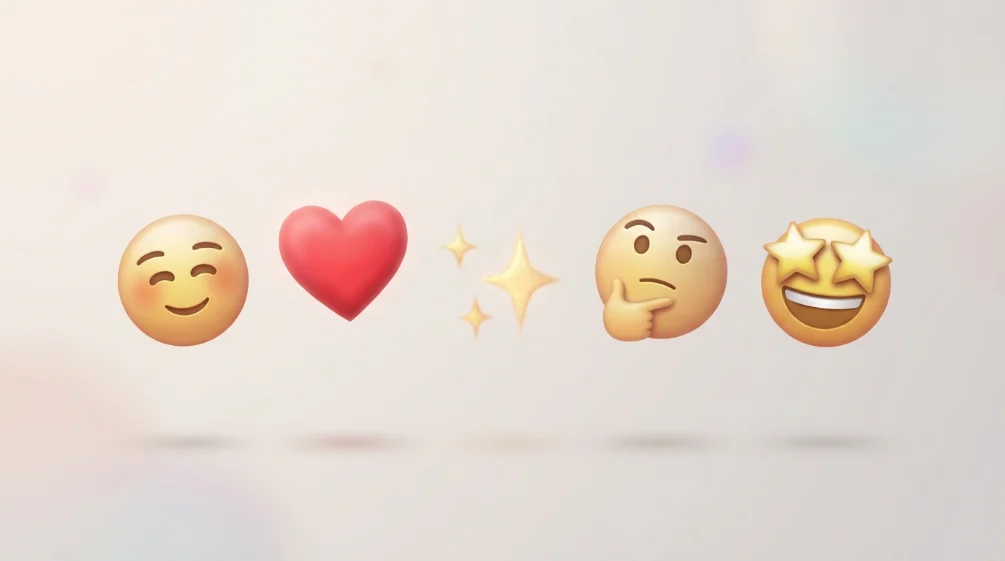
“3D emoji” usually refers to emoji artwork designed with visible depth, shading, highlights, and three-dimensional form rather than a flat appearance.
The visual style can make an emoji feel more expressive, but its underlying meaning still comes from the emoji itself and the context where it is used.
A 3D emoji is not a separate Unicode emoji category with one universal meaning. The phrase usually describes an emoji design that uses depth, shading, lighting, and dimensional details to give a familiar emoji a more lifelike appearance. In other words, 😍 can still mean admiration or strong affection whether it is displayed as a flatter graphic or as a glossy three-dimensional design. The artwork changes the visual presentation, not automatically the meaning. Google has also introduced a major 3D redesign of its Noto emoji artwork, showing how emoji design can evolve while the underlying characters remain recognizable.
This distinction matters because people sometimes search for “3D emoji” as though it were one specific emoji. It is better understood as a visual style or design approach. A 3D smiling face may feel warmer, richer, or more dramatic because of its shading and depth, while a 3D crying face may look more emotionally intense. Still, the context, words, and original emoji character provide the main clues to what the message means.
What Does “3D Emoji” Mean?
The term 3D emoji generally describes emoji artwork that creates the appearance of three dimensions.
Instead of looking relatively flat, a 3D-style emoji may use:
- Shadows
- Highlights
- Depth
- Rounded surfaces
- Textures
- Lighting effects
- More detailed facial features
- Three-dimensional modeling
These design choices can make an emoji appear closer to a small digital object or character.
However, 3D is a description of the artwork, not an emotion.
For example:
- 😀 still represents a smiling or happy expression.
- 😂 still represents laughter or amusement.
- 😭 still represents intense crying.
- ❤️ still represents love, affection, or a heart.
Changing the artwork to a three-dimensional style does not create a completely new meaning.
Why Do Some Emojis Look 3D?
Emoji artwork is created and displayed by different vendors and platforms, so the same Unicode character can have different visual designs.
A Unicode emoji character provides the underlying standardized character, while platforms create their own artwork for displaying it.
That means one emoji can look:
- Flat and simple
- Glossy and dimensional
- Soft and rounded
- Highly detailed
- Cartoon-like
- More realistic
Google’s Noto 3D project is a current example of this design shift. Google says its Noto 3D work reimagines almost 4,000 emoji with richer three-dimensional designs while keeping them expressive and accessible.
Emojipedia has also documented different vendor approaches to 3D emoji artwork, including Microsoft’s earlier 3D Fluent designs and Google’s Noto 3D development.
Does a 3D Style Change an Emoji’s Meaning?
Usually, no.
The underlying emoji character remains the most important part of its meaning.
For example, a three-dimensional version of 🥰 is still generally understood as Smiling Face with Hearts, while a three-dimensional version of 😎 remains Smiling Face with Sunglasses.
What can change is the visual feeling.
A dimensional design may make an expression seem:
- More vivid
- More playful
- More dramatic
- Softer
- More polished
- More character-like
But this is an impression created by the artwork rather than a new official definition.
This is why it is useful to separate emoji meaning from emoji design.
3D Emoji vs. Standard Emoji
A standard emoji and a 3D-style emoji can represent exactly the same Unicode character.
The difference is primarily visual.
| Feature | Standard Emoji | 3D Emoji |
|---|---|---|
| Appearance | Often flatter or simpler | Uses depth, shading, and dimensional form |
| Meaning | Based on the underlying emoji | Usually based on the same underlying emoji |
| Visual effect | Clean and symbolic | More physical and character-like |
| Detail | May be relatively simple | Can include richer lighting and textures |
| Emotional impression | Depends on the character | May feel more vivid or dramatic |
| Unicode identity | Determined by the character | Usually unchanged by the artwork |
The important point is that 3D does not automatically mean more emotional. A platform may design an emoji with subtle depth, while another may use a much more dramatic style.
Can 3D Emojis Be Used in Text Messages?
Yes.
If a messaging service supports the relevant emoji character and displays it using a three-dimensional design, it can be used just like the corresponding emoji character.
For example:
“That was so funny 😂”
The emoji still communicates laughter or amusement whether its artwork is flat or three-dimensional.
Similarly:
“I can’t believe you did that 😭”
The underlying meaning comes from 😭 and the sentence around it, not simply from the fact that the emoji has a dimensional appearance.
This is why you should interpret the character and the context together.
Do 3D Emojis Have Different Meanings on Different Platforms?
The same Unicode character can have different artwork across platforms.
The visual differences can affect how an emoji feels at first glance, but they do not necessarily create a different standardized meaning.
For example, a smiley might have:
- A softer expression on one platform
- Stronger highlights on another
- Different proportions
- Different eyes or mouth shapes
- A more glossy finish
- More pronounced shadows
These differences can influence interpretation at the edges, especially when two facial expressions are already similar.
Still, it is better to identify the underlying emoji rather than assuming every visual redesign is a separate emoji.
Google Noto 3D Emoji
- Google has been developing a major 3D redesign of its Noto emoji artwork.
- Google announced Noto 3D in 2026 as a redesign intended to give emoji greater physicality and expressive depth. The project covers nearly 4,000 emoji and includes attention to accessibility, including high-contrast considerations for dark mode.
Emojipedia reported that the Noto 3D designs debuted on Pixel 11 devices released in August 2026, while the broader rollout of the redesigned set is tied to Google’s platform updates.
This is a useful example of why 3D emoji is better understood as a design system or visual treatment rather than a new Unicode meaning.
3D Emoji and Emotional Tone
Although 3D is not an emotion, the visual treatment can influence the way an emoji feels.
A 3D smiley
A dimensional 😀 may look more like a small character with a physical presence. This can make the expression feel friendly or lively.
A 3D heart
A dimensional ❤️ may look more like a small object or glossy symbol, potentially giving it a richer visual presence.
A 3D crying face
A detailed 😭 can make tears, facial expression, and lighting more noticeable, which may make the emotion appear visually stronger.
A 3D angry face
A dimensional 😡 may emphasize facial contours and shadows, making the expression look more dramatic.
These are visual impressions, not official changes to the emoji definitions.
Related Emojis and Their Meanings
Because “3D emoji” refers to a visual style rather than one particular Unicode character, there is no single official set of emojis that means “3D.”
Still, these are useful examples of familiar emojis that may appear in dimensional artwork:
| Emoji | Official Name | Common Meaning | Tone | Where or When It Is Used |
|---|---|---|---|---|
| 😀 | Grinning Face | Happiness, friendliness, cheerful reaction | Positive, friendly | Greetings, casual texts, happy reactions |
| 😍 | Smiling Face with Heart-Eyes | Strong admiration, affection, excitement | Affectionate, enthusiastic | Compliments, favorites, romantic or excited reactions |
| 😂 | Face with Tears of Joy | Finding something very funny | Playful, humorous | Jokes, funny messages, reactions |
| 😭 | Loudly Crying Face | Intense sadness or exaggerated emotion | Dramatic, emotional | Sad reactions, overwhelming moments, humor |
| 🥰 | Smiling Face with Hearts | Affection, warmth, feeling loved | Warm, affectionate | Sweet messages, appreciation, romantic contexts |
| 😎 | Smiling Face with Sunglasses | Confidence, coolness, relaxed attitude | Playful, confident | Success, jokes, casual reactions |
| 😡 | Enraged Face | Anger, frustration, strong displeasure | Intense, negative | Arguments, complaints, strong reactions |
| 🤣 | Rolling on the Floor Laughing | Very strong amusement | Highly playful | Extremely funny reactions, jokes, exaggeration |
The important difference is that none of these emojis becomes a new meaning simply because it is rendered in 3D.
For example, a 3D 😍 is still primarily about admiration or affection. A 3D 😂 is still associated with strong laughter. The dimensional artwork changes presentation rather than replacing the character’s established meaning.
Are 3D Emojis More Expressive?
They can appear more expressive, but that does not mean every 3D emoji communicates a stronger emotion.
Depth allows designers to add:
- More visible facial contours
- Highlights around the eyes
- Stronger shadows
- Surface details
- More noticeable shapes
- Greater sense of physical presence
Google has described its Noto 3D redesign as a way to bring greater physicality and expressive depth to digital communication.
Still, users should not assume that a 3D rendering automatically means “more serious,” “more emotional,” or “more intense.” Those interpretations depend on the particular emoji and message.
Can 3D Emojis Be Flirty?
A 3D emoji can be used in a flirty message, but 3D itself does not make an emoji flirty.
For example:
“You look amazing 😍”
The message may feel romantic or flirtatious because of the wording and the 😍 emoji.
The fact that the emoji appears three-dimensional does not independently prove romantic interest.
Likewise:
“That outfit looks great 😍”
could be affectionate, admiring, friendly, or flirtatious depending on the relationship and conversation.
Always interpret the complete message rather than treating the visual style as a hidden signal.
Can 3D Emojis Be Used Sarcastically?
Yes, but the sarcasm comes from context and wording, not from the 3D format.
For example:
“Great, another meeting 😂”
The 😂 may be used humorously or sarcastically depending on the situation.
A 3D version might make the emoji look more visually noticeable, but it does not automatically turn the message into sarcasm.
3D Emoji Examples in Text
Friendly reaction
“That sounds awesome 😀”
Likely meaning: Genuine happiness or friendliness.
Strong amusement
“You actually said that 😂”
Likely meaning: The sender finds the situation very funny.
Affection
“Aww, that’s so sweet 🥰”
Likely meaning: Warmth, affection, or appreciation.
Dramatic reaction
“I have waited three hours for this 😭”
Likely meaning: Strong emotion, which could be genuine or exaggerated for humor.
Confidence
“Finally got it done 😎”
Likely meaning: Satisfaction or a playful sense of confidence.
In each example, the emoji character carries the main meaning. A 3D design may change how the emoji looks, but not necessarily what the sender intends.
Common Misunderstandings About 3D Emojis
“3D emoji” is not one specific emoji
There is no single Unicode character called “3D Emoji.” The phrase normally describes a style of emoji artwork.
3D does not mean realistic
A three-dimensional emoji can still be highly stylized and cartoon-like. Three-dimensional design simply means the artwork creates a sense of depth.
A 3D version is not automatically a new Unicode character
An emoji can receive a completely different visual design while retaining the same underlying Unicode character.
3D does not automatically mean stronger emotion
A glossy or detailed design may look more expressive, but interpretation still depends on the emoji and context.
Different platforms may display the same emoji differently
Emoji artwork is vendor-specific, so the same character can have noticeably different visual appearances across services.
How to Choose the Right Emoji
If you’re deciding which emoji to send, focus first on what you want to communicate, not whether the artwork is 2D or 3D.
For example:
- Use 😀 for a simple cheerful reaction.
- Use 😂 when something is genuinely funny.
- Use 🥰 for warmth or affection.
- Use 😍 for strong admiration.
- Use 😭 for intense sadness or dramatic emotion.
- Use 😎 for a confident or cool reaction.
The visual style comes second.
If the recipient sees the same emoji differently because their device uses another design, the surrounding words can make your meaning clearer.
Frequently Asked Questions
What is a 3D emoji?
A 3D emoji is generally an emoji design that uses depth, shading, highlights, and other visual effects to create a three-dimensional appearance. It is usually a style of displaying an emoji rather than a separate emoji meaning.
Is there an official “3D emoji”?
There is no single Unicode emoji whose official meaning is simply “3D emoji.” “3D emoji” is normally used to describe dimensional emoji artwork or a 3D emoji design system.
Do 3D emojis have different meanings?
Usually not. The underlying emoji character generally determines the meaning, while the 3D artwork changes its visual appearance.
Why do some emojis look 3D?
Emoji vendors and platforms create their own artwork. Some designs use depth, shadows, lighting, and detailed surfaces to create a three-dimensional appearance.
Are 3D emojis available on every device?
Not necessarily. Emoji artwork and support can vary between operating systems, apps, and vendors. A character may be supported while its visual design differs from another platform.
Are 3D emojis more expressive?
They can appear more expressive because depth, lighting, and detail make facial features and shapes more noticeable. However, this is a visual effect rather than a universal change in meaning.
Is a 3D emoji the same as an emoji sticker?
No. A 3D emoji is generally a dimensional rendering or design of an emoji character. A sticker can be a larger graphic, illustration, or custom image and may not correspond directly to a Unicode emoji character.
Can I use a 3D emoji in a text?
If the emoji character is supported by your device or messaging service, you can use it normally. The exact visual appearance depends on the platform displaying it.
Conclusion
3D emoji usually means emoji artwork designed with depth, shading, lighting, and dimensional detail. It describes how an emoji looks, not a separate emotional meaning.
A 3D 😀 remains a Grinning Face, a 3D 😂 remains Face with Tears of Joy, and a 3D ❤️ still represents a heart. The visual treatment can make familiar characters feel richer or more vivid, but the safest way to understand any emoji is to consider its underlying character, surrounding words, and conversation context.
Read More Related Articles:
- Worried Emoji Meaning | What It Really Says About Anxiety …
- Sword Emoji | Meaning, Symbolism & Creative Ways to Use …
- UwU Emoji Meaning | The Cute Internet Expression Behind …