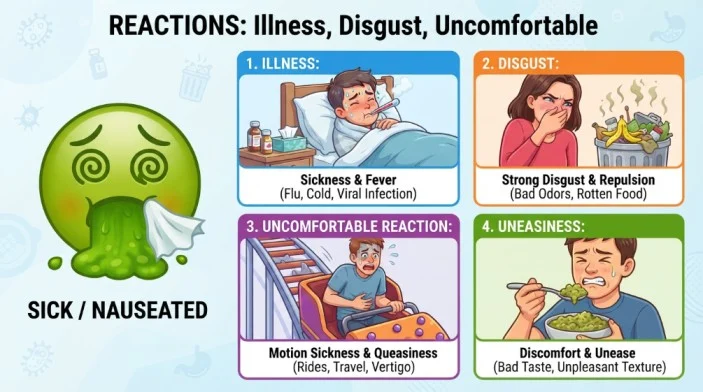
The sick emoji 🤢 usually means feeling nauseated, physically ill, or disgusted. Its official Unicode name is Nauseated Face, and its green face with puffed cheeks is designed to suggest someone who feels like they might vomit. It can describe actual sickness, a bad smell, unpleasant food, or something that feels deeply gross.
But 🤢 is not always a literal statement about being sick. In texts, people can use it as a strong reaction to something unpleasant, disturbing, embarrassing, or hard to tolerate. The surrounding words matter. “I feel sick 🤢” is very different from “That outfit is 🤢,” even though the same emoji appears in both messages.
Quick Answer:
🤢 usually means nausea, sickness, or disgust. It can describe feeling physically unwell or reacting strongly to something unpleasant, gross, or revolting.
The emoji is officially called Nauseated Face, while “sick emoji” is a common informal way to describe it.
What Does the Sick Emoji 🤢 Mean?
The sick emoji 🤢 represents a green face with a queasy expression and puffed cheeks. Unicode officially names it Nauseated Face, with the code point U+1F922. Unicode’s emoji data associates it with concepts such as being nauseated and vomiting.
Its most common meanings include:
- Feeling physically sick
- Nausea
- Feeling like vomiting
- Disgust
- Something being gross
- A bad smell or taste
- An unpleasant experience
- A strong negative reaction
The exact meaning depends on what the person is talking about.
For example:
“I ate something weird and now I feel 🤢”
This most likely means the person feels physically nauseated.
But:
“That smell is 🤢”
usually means the smell is disgusting or unpleasant.
The emoji therefore works both as a literal sickness reaction and a figurative disgust reaction.
Why Is 🤢 Called the Sick Emoji?
“Sick emoji” is a common descriptive term, but it is not the official Unicode name.
The official name is Nauseated Face. Unicode lists 🤢 as U+1F922, while Emojipedia describes it as a sickly green face that may represent physical illness or general disgust.
This distinction is useful because several emojis can relate to being sick:
- 🤢 Nauseated Face
- 🤮 Face Vomiting
- 🤒 Face with Thermometer
- 😷 Face with Medical Mask
- 🤧 Sneezing Face
They do not all communicate exactly the same thing.
When someone searches for the sick emoji, 🤢 is often the most direct match when the intended idea is nausea or disgust.
What Does 🤢 Mean in Text Messages?
In text messages, 🤢 can communicate different levels of discomfort.
Physical illness
“I think that food made me sick 🤢”
This is a straightforward reference to nausea or feeling physically unwell.
Disgust
“I opened the fridge and something smelled awful 🤢”
Here, the emoji expresses disgust rather than saying the sender is personally ill.
Gross reaction
“He showed me a picture of that wound 🤢”
The emoji emphasizes that the image was difficult or unpleasant to look at.
Bad taste or smell
“That milk definitely went bad 🤢”
The emoji can reinforce a reaction to something that tastes or smells disgusting.
Strong dislike
“I can’t stand that flavor 🤢”
In this context, the emoji may be figurative. The sender is emphasizing how unpleasant they find something.
Does 🤢 Always Mean Someone Is Sick?
No.
🤢 can literally mean nausea, but it can also represent disgust.
This is one of the most important differences between the emoji’s visual meaning and its use in conversation.
Compare:
“I’ve been sick all morning 🤢”
with:
“That movie scene was disgusting 🤢”
The first is about physical illness. The second is an emotional reaction to something unpleasant.
The emoji alone cannot tell you which meaning is intended. The surrounding sentence usually provides the answer.
What Does 🤢 Mean From Someone?
If someone sends you 🤢, the meaning depends heavily on what came before it.
They might be saying:
- “I feel nauseous.”
- “That is disgusting.”
- “That smells terrible.”
- “I don’t like this.”
- “That’s gross.”
- “I can’t look at that.”
- “That made me feel sick.”
If they send only:
“🤢”
you may need more context.
If you had just told them about something unpleasant, it may be a disgusted reaction. If they were discussing their health, it is more likely to refer to nausea or sickness.
Is 🤢 a Negative Emoji?
Usually, yes.
🤢 normally carries a negative emotional tone because it represents nausea, disgust, or something unpleasant.
However, the seriousness can vary.
For example:
“This medicine tastes awful 🤢”
is a relatively ordinary complaint.
“That was the grossest thing I’ve ever seen 🤢”
is a much stronger reaction.
And:
“You actually ate that? 🤢”
could be genuine disgust or playful teasing, depending on the relationship and conversation.
The emoji itself does not prove that the sender is angry, insulting, or hostile.
Can 🤢 Be Used as a Joke?
Yes.
People sometimes use 🤢 dramatically to make a humorous reaction look stronger.
For example:
“You put ketchup on ice cream? 🤢”
The sender may not literally feel nauseated. They may simply be exaggerating how strange they think the combination is.
Another example:
“He said pineapple belongs on every pizza 🤢”
This can be playful disagreement rather than genuine disgust.
The difference is often revealed by the overall tone of the conversation.
Can 🤢 Be Sarcastic?
Yes, but sarcasm comes from context rather than the emoji itself.
For example:
“Wow, another meeting at 7 a.m. 🤢”
The sender may be jokingly expressing disgust toward the idea of an early meeting.
Or:
“Oh great, leftovers again 🤢”
could be exaggerated complaining rather than actual nausea.
Because sarcasm can be difficult to detect in text, do not assume that 🤢 automatically means the sender is being sarcastic.
Is 🤢 a Flirting Emoji?
No, 🤢 is not normally a flirting emoji.
It usually communicates nausea, disgust, or a strong negative reaction.
That said, any emoji can appear in playful conversations between people who know each other well. For example:
“You really think that haircut looks good? 🤢😂”
could be teasing between friends or partners.
The presence of 🤢 does not establish romantic interest. If the surrounding conversation is affectionate or flirtatious, the emoji may simply be part of the joke.
What Does 🤢 Mean in a Relationship?
In a relationship, 🤢 can have several meanings depending on the situation.
If someone says:
“I feel awful today 🤢”
they are likely describing physical sickness.
If they say:
“You seriously ate my leftovers again 🤢”
it may be playful disgust or teasing.
If they send:
“That smell in your car 🤢”
they are probably reacting to something unpleasant.
The relationship itself does not give 🤢 a special romantic meaning. The message and situation still matter most.
Can 🤢 Mean “I Hate This”?
Sometimes.
When someone uses 🤢 after mentioning a food, smell, habit, opinion, or situation they strongly dislike, it can function as a visual way of saying:
“I hate this.”
For example:
“I can’t stand that smell 🤢”
The sender may not literally be nauseated. They are emphasizing strong dislike.
Still, it is better to read the emoji as “this is gross or unpleasant to me” rather than automatically translating it as “I hate this.”
Can 🤢 Be Rude?
It can feel rude in certain situations.
For example:
“You actually wore that? 🤢”
could easily come across as insulting.
Similarly:
“Your cooking 🤢”
could hurt someone’s feelings even if the sender intended it as a joke.
The emoji itself is not inherently rude. The problem comes from using a strong disgust reaction toward another person’s appearance, food, opinion, or personal choice.
If you’re joking with someone, make sure the surrounding conversation makes the playful intent clear.
🤢 Meaning When Someone Sends It Alone
A single 🤢 without words is especially dependent on context.
If you send a friend a picture of an unpleasant meal and they reply:
“🤢”
they are probably saying it looks gross.
If you tell someone:
“I haven’t felt well all day.”
and they reply:
“🤢”
they may be reacting to the idea of you being sick.
If you ask:
“Do you want to try this?”
and receive:
“🤢”
the likely meaning is “Absolutely not” or “That looks disgusting.”
When the emoji stands alone, think about the message or event immediately before it.
🤢 vs. 🤮: What’s the Difference?
🤢 Nauseated Face usually represents feeling sick, nauseated, or disgusted.
🤮 Face Vomiting goes further. Its design actually shows the face vomiting, making the reaction more graphic and intense. Emojipedia describes 🤮 as a stronger representation of physical illness or disgust than 🤢.
Compare:
“That smell is 🤢”
This suggests strong disgust.
“I actually threw up 🤮”
This communicates vomiting much more directly.
If you only feel queasy, 🤢 is usually the better choice. If vomiting itself is the point, 🤮 is more specific.
🤢 vs. 🤒: What’s the Difference?
🤒 is Face with Thermometer.
It is more closely associated with being ill, having a fever, or being physically unwell. Unicode lists “ill,” “sick,” and “thermometer” among its associated terms.
🤢 focuses on nausea or disgust.
Compare:
“I have a fever and need to stay home 🤒”
with:
“I feel like I’m going to throw up 🤢”
The first points toward general illness or fever. The second focuses on nausea.
🤢 vs. 😷: What’s the Difference?
😷 is Face with Medical Mask.
It can communicate being sick, wearing a mask because of illness, or a health-related situation. Unicode’s emoji data associates it with concepts such as cold, doctor, mask, and sick.
🤢 does not suggest a mask or general illness. It focuses on feeling nauseated or disgusted.
For example:
“I caught a cold 😷”
makes sense.
“That smell makes me nauseous 🤢”
is a better match for 🤢.
🤢 vs. 🤧: What’s the Difference?
🤧 is Sneezing Face.
It is more specific to sneezing, a runny nose, or cold and allergy-like symptoms.
🤢 is about nausea and disgust.
Compare:
“My allergies are terrible today 🤧”
with:
“That food made me nauseous 🤢”
These emojis can both appear in conversations about being sick, but they describe different symptoms.
Related Sick and Unwell Emojis
| Emoji | Official Name | Common Meaning | Tone | Where or When It Is Used |
|---|---|---|---|---|
| 🤢 | Nauseated Face | Nausea, sickness, or disgust | Gross, uncomfortable, negative | Feeling queasy, reacting to smells, food, or disturbing things |
| 🤮 | Face Vomiting | Vomiting or extreme disgust | Very intense, graphic | Actual vomiting, extremely gross reactions |
| 🤒 | Face with Thermometer | Illness, fever, feeling unwell | Sick, concerned | Telling someone you’re ill or have a fever |
| 😷 | Face with Medical Mask | Sickness, medical setting, or wearing a mask | Serious, health-related | Illness, medical situations, protective masking |
| 🤧 | Sneezing Face | Sneezing, cold, or allergy symptoms | Sick, uncomfortable | Sneezing, runny nose, cold-like situations |
| 🤕 | Face with Head-Bandage | Injury or physical pain | Hurt, concerned | Accidents, injuries, painful situations |
| 🥵 | Hot Face | Feeling overheated or feverish | Uncomfortable, intense | Heat, sweating, feeling overheated |
| 🥶 | Cold Face | Feeling very cold or chilled | Uncomfortable, dramatic | Freezing weather, intense cold |
| 🥴 | Woozy Face | Dizziness, disorientation, or feeling out of sorts | Confused, unsteady | Feeling dizzy, tipsy, or mentally overwhelmed |
The most important distinction is between 🤢 and 🤮. Both can communicate disgust or sickness, but 🤮 shows the act of vomiting and therefore tends to be much more intense. 🤒 and 😷 are better choices when the main point is general illness or a medical situation, while 🤧 is more specific to sneezing or cold-like symptoms. Unicode’s official emoji list identifies these characters with separate names, while Emojipedia specifically distinguishes 🤢 from 🤮.
How to Choose the Right Sick Emoji
Choose based on the feeling you want to communicate.
Use 🤢 when you mean:
- “I feel nauseous.”
- “That is gross.”
- “That smell is awful.”
- “I feel sick to my stomach.”
Use 🤮 when you mean:
- “I threw up.”
- “That is unbelievably disgusting.”
- “I can’t even look at that.”
Use 🤒 when you mean:
- “I’m sick.”
- “I have a fever.”
- “I’m not feeling well.”
Use 😷 when you mean:
- “I’m wearing a medical mask.”
- “I’m sick and trying to avoid spreading it.”
- “This is a medical or health-related situation.”
Use 🤧 when you mean:
- “I’m sneezing.”
- “I have cold or allergy symptoms.”
This makes the choice more precise than simply using any emoji associated with sickness.
Sick Emoji Examples in Text
Here are realistic examples showing how 🤢 changes meaning with context.
“I feel so nauseous today 🤢”
This is a literal physical reaction.
“That cheese has been sitting out all day 🤢”
The emoji expresses disgust or concern about something unpleasant.
“I smelled the leftovers and immediately felt 🤢”
This suggests nausea caused by an unpleasant smell.
“You seriously put that much hot sauce on it? 🤢”
This could be playful exaggeration or genuine dislike.
“That scene in the movie was 🤢”
The sender likely found the scene disturbing or gross.
“Your fridge needs some help 🤢”
This is probably a humorous way to express disgust.
The same emoji can therefore describe a physical sensation, a sensory reaction, or an exaggerated opinion.
How to Respond to 🤢
The best response depends on why the person sent it.
- If they are physically sick
“Are you okay? Do you need anything?”
- If they are reacting to something gross
“Right? That was disgusting 🤢”
- If they are joking
“You are so dramatic 😂”
- If you’re not sure
“Wait, are you actually feeling sick?”
A simple clarification is better than guessing when the context is unclear.
Can You Use 🤢 for Food?
Yes.
🤢 can be used when food looks, smells, or tastes unpleasant.
For example:
“I left that soup in the fridge for way too long 🤢”
or:
“That combination sounds awful 🤢”
It can also be used jokingly when someone dislikes a particular food:
“You put raisins in cookies? 🤢”
That does not necessarily mean the sender is physically sick. It can simply emphasize strong dislike.
Can 🤢 Mean Disgust With a Person?
Yes, but this use can be harsh.
For example:
“He treated everyone terribly 🤢”
could express moral disgust rather than physical nausea.
However, sending 🤢 directly about a person’s appearance or identity can come across as insulting or demeaning. When the subject is another person, consider whether the emoji adds useful meaning or simply makes the message more hurtful.
Can 🤢 Mean “Ew”?
Yes.
In casual conversation, 🤢 can work much like “ew” or “gross.”
For example:
“You found that under the bed? 🤢”
The emoji gives a visual version of the reaction.
It is especially useful when you want to communicate disgust without writing a longer response.
Official Name and Technical Details
The official Unicode name for 🤢 is Nauseated Face.
- Emoji: 🤢
- Official Unicode name: Nauseated Face
- Code point: U+1F922
- Unicode approval: Unicode 9.0
- Emoji addition: Emoji 3.0
- Primary concepts: nausea, sickness, vomiting, disgust
Unicode’s current emoji charts list 🤢 as Nauseated Face, while Emojipedia notes that it was approved in Unicode 9.0 and added to Emoji 3.0 in 2016.
The exact artwork can vary slightly between platforms, but the basic concept remains a green, nauseated-looking face.
Does the Sick Emoji Look the Same Everywhere?
Not exactly.
Emoji artwork can vary between operating systems, apps, and devices. The basic Unicode character remains the same, but details such as facial expression, shading, color, and the appearance of the cheeks can differ.
These visual differences generally do not change the core meaning of 🤢. It remains associated with nausea and disgust.
Frequently Asked Questions
What does the sick emoji 🤢 mean?
🤢 usually means nausea, feeling physically sick, or disgust. It can also be used as a dramatic reaction to something gross or unpleasant.
What is the official name of 🤢?
The official Unicode name is Nauseated Face. Its code point is U+1F922.
Is 🤢 the vomiting emoji?
Not exactly. 🤢 is Nauseated Face, while 🤮 is Face Vomiting. 🤮 specifically depicts vomiting and generally represents a more intense reaction.
What does 🤢 mean from a girl or guy?
The meaning does not depend on gender. Anyone can use 🤢 to express nausea, disgust, or a strong negative reaction.
Is 🤢 a rude emoji?
Not automatically. It can become rude when it is directed at someone in a mocking or insulting way, especially when commenting on their appearance, choices, or personal characteristics.
Can 🤢 mean “ew”?
Yes. In casual texting, 🤢 can function as a visual equivalent of “ew,” “gross,” or “that’s disgusting.”
Is 🤢 a flirting emoji?
No. 🤢 is not normally associated with flirting. It generally communicates nausea, disgust, or an unpleasant reaction.
What is the difference between 🤢 and 🤮?
🤢 usually represents feeling nauseated or disgusted. 🤮 depicts actual vomiting and is therefore more graphic and intense.
What is the difference between 🤢 and 🤒?
🤢 focuses on nausea or disgust, while 🤒, officially Face with Thermometer, is more associated with illness, fever, and feeling unwell.
Can 🤢 be used jokingly?
Yes. People may use 🤢 to exaggerate their reaction to an unpleasant food, smell, opinion, joke, or situation. The surrounding conversation determines whether the reaction is serious or playful.
Final Takeaway
The sick emoji 🤢, officially called Nauseated Face, is mainly used for nausea, feeling sick, and disgust. It can describe a real physical feeling, but it can also be a casual way to say “ew,” “gross,” or “I really don’t like that.”
The easiest way to understand 🤢 is to look at the context. If someone is talking about their health, it probably means nausea or sickness. If they’re reacting to food, a smell, an image, or an opinion, it may simply express disgust. When you need to show vomiting specifically, 🤮 is more direct, while 🤒 and 🤧 are better suited to other types of illness.
Read More Related Articles:
- Thank You Emoji Meaning | Best Emojis to Say Thanks
- Happy Face Emoji Meaning | What Does Mean in Texts in 2026
- Heart Emoji Meanings ❤️ | What Do the Different Hearts …