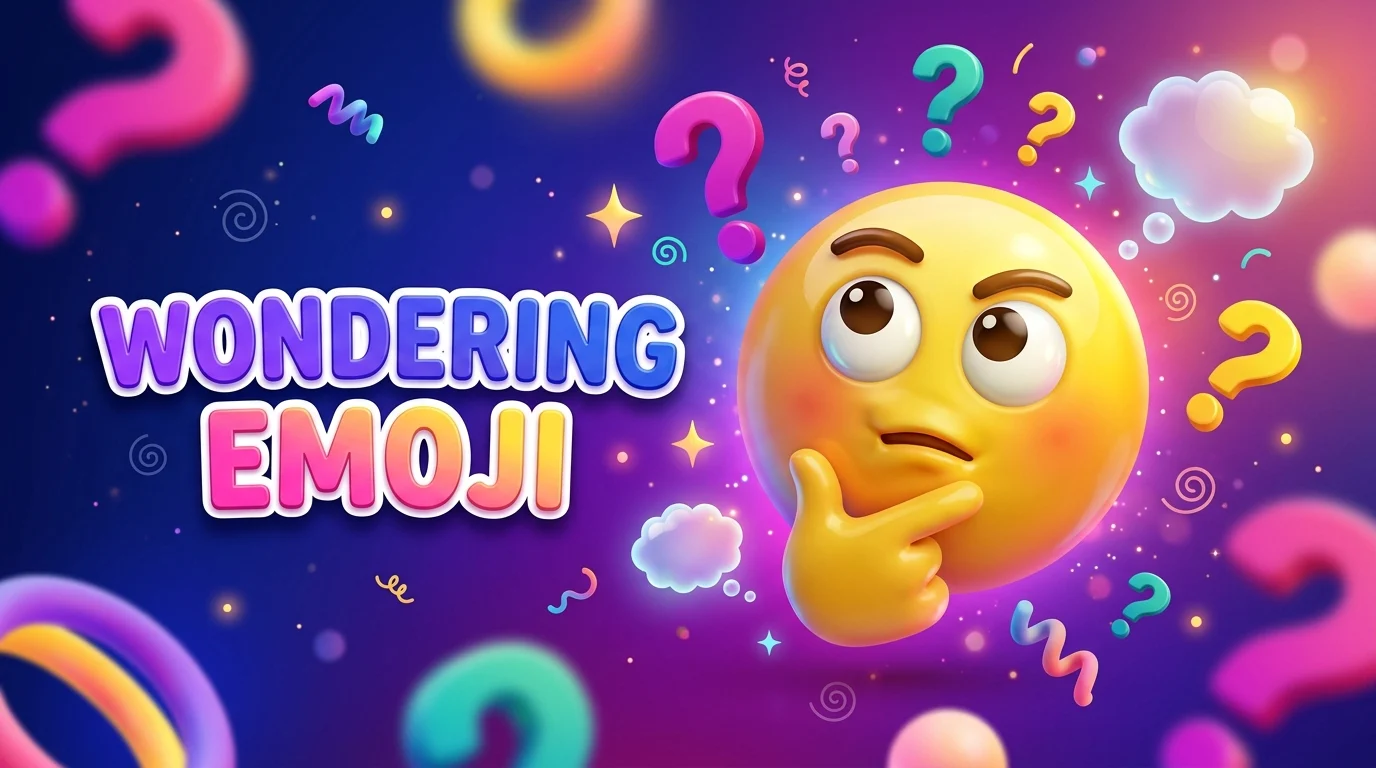
The wondering emoji 🤔 usually represents thinking, wondering, questioning, or considering something. Its thoughtful face and hand-on-chin pose make it a natural choice when someone is trying to understand an idea, make a decision, or figure out what something means. It can also communicate a simple “Hmm…” when you are not completely sure about something. Unicode lists 🤔 as Thinking Face, with keywords including thinking, pondering, considering, and wondering.
In texts and online conversations, 🤔 can have a wider tone. Depending on the words around it, it may show genuine curiosity, confusion, hesitation, doubt, skepticism, or playful sarcasm. A message such as “Let me think 🤔” sounds thoughtful, while “That sounds believable 🤔” may suggest doubt. The emoji itself does not guarantee one emotional meaning, so context matters.
Quick Answer
The wondering emoji 🤔 usually means thinking, wondering, questioning, or considering something.
It can also suggest doubt, confusion, skepticism, or playful sarcasm when the surrounding message changes the tone.
What Does the Wondering Emoji 🤔 Mean?
The emoji commonly called the wondering emoji is officially named Thinking Face.
It shows a yellow face with furrowed eyebrows, eyes looking upward, and a hand resting against the chin. The design visually represents someone thinking deeply about a question or idea.
The most common meanings include:
- Thinking about something
- Wondering what to do
- Considering an option
- Questioning an idea
- Feeling unsure
- Trying to understand something
- Showing mild doubt
- Expressing skepticism
- Adding a playful “Hmm…” tone
The exact meaning depends on the message.
For example:
“I wonder if I should go 🤔”
This is a straightforward use. The sender is genuinely considering a decision.
But:
“You expect me to believe that? 🤔”
has a much more skeptical tone.
The emoji stays the same, but the words around it change the interpretation.
Wondering Emoji Meaning in Text
In texting, 🤔 often works like a visual version of “Hmm,” “I wonder,” “Let me think,” or “I’m not sure.”
Someone might use it when:
- They need time to decide
- They are thinking about an answer
- Something does not make sense
- They are curious about a situation
- They are questioning what someone said
- They are unsure whether they agree
For example:
“Should we order pizza or burgers? 🤔”
This suggests genuine consideration.
Another example:
“Hmm, I’m not sure about that 🤔”
Here, the emoji adds hesitation and mild doubt.
It can therefore be softer than directly saying, “I don’t believe you.”
🤔 Can Mean “Hmm, Let Me Think”
One of the most natural uses of 🤔 is simply to show that someone is thinking before answering.
For example:
“Give me a minute to decide 🤔”
The emoji makes the message feel thoughtful rather than abrupt.
It can also be used after a question:
“What should I wear tonight? 🤔”
In this case, the sender is showing that they are weighing their options.
This is the most literal and neutral use of the emoji.
🤔 Can Mean Doubt or Skepticism
The wondering emoji can also communicate doubt.
For example:
“You said you were going to be home early 🤔”
This may imply that the sender has noticed something that does not quite add up.
Another example:
“Interesting explanation 🤔”
Depending on the conversation, this could mean:
- “I’m thinking about what you said.”
- “I’m not completely convinced.”
- “Something seems strange here.”
Emojipedia notes that Thinking Face can be used to question or scorn something, with tones ranging from earnest and puzzled to skeptical or mocking.
🤔 Meaning When Someone Is Confused
Although 😕 is more directly associated with confusion, 🤔 can also show that someone is trying to understand something.
For example:
“Wait, how does that work? 🤔”
This usually means the person is processing information.
Another example:
“I’m still trying to figure this out 🤔”
Here, 🤔 communicates mental effort rather than strong emotional confusion.
🤔 vs. 😕 for Confusion
🤔 feels more like:
“I’m thinking about this.”
😕 feels more like:
“I’m confused or unsure about this.”
That small difference can make one emoji feel more thoughtful and the other more emotionally confused.
Is the Wondering Emoji Sarcastic?
It can be, but it is not always sarcastic.
🤔 is often used sincerely when someone is thinking. It can also become sarcastic when it follows an obviously questionable statement.
For example:
“I definitely didn’t eat the last cookie 🤔”
If the context suggests otherwise, the emoji can make the sentence playful or ironic.
Another example:
“Wow, what a surprising coincidence 🤔”
Here, 🤔 may suggest that the sender is not fully buying the situation.
Dictionary.com also describes Thinking Face as having both a literal thinking use and a rhetorical use for doubting someone or something.
So if you receive 🤔, don’t automatically assume the sender is being sarcastic. Look at the surrounding words and the tone of the conversation.
Is 🤔 a Flirty Emoji?
Not by itself.
The wondering emoji is primarily about thinking, questioning, curiosity, or doubt. It does not inherently communicate romantic interest.
However, it can appear in a playful or flirty conversation.
For example:
“So… are you actually asking me out? 🤔”
The sentence can feel playful or flirtatious because of the wording.
But:
“Which restaurant should we choose? 🤔”
is simply a decision-making question.
The emoji alone cannot prove that someone is flirting.
What Does 🤔 Mean From Someone?
If someone sends you 🤔, they may be:
- Thinking about what you said
- Unsure how to respond
- Questioning your statement
- Considering an option
- Curious about something
- Slightly skeptical
- Playfully teasing you
The surrounding message is the strongest clue.
Example 1
“Let me think about it 🤔”
Likely meaning: They genuinely need time to consider something.
Example 2
“Really? You believe that? 🤔”
Likely meaning: They are doubtful or skeptical.
Example 3
“Hmm… interesting 🤔”
Likely meaning: They are thinking about the situation and may have questions.
Example 4
“You said you weren’t hungry 🤔”
Likely meaning: They noticed a contradiction and are playfully questioning it.
The sender’s gender does not create a separate meaning for 🤔. The same emoji can communicate the same basic ideas regardless of who sends it.
Wondering Emoji in Relationships
In relationships or close friendships, 🤔 can be useful when a person wants to question something without sounding overly harsh.
For example:
“You really don’t want dessert? 🤔”
This could be light teasing.
But:
“You’re saying everything is fine? 🤔”
could feel more serious because the surrounding words suggest concern or doubt.
If the topic is sensitive, relying only on an emoji can create confusion. Clear words are better when the meaning really matters.
Related Emojis and Their Meanings
| Emoji | Official Name | Common Meaning | Tone | Where or When It Is Used |
|---|---|---|---|---|
| 🤔 | Thinking Face | Thinking, wondering, questioning, considering | Thoughtful, curious, skeptical | Decisions, questions, doubtful reactions |
| 🤨 | Face with Raised Eyebrow | Suspicion, disbelief, doubt | Skeptical, questioning | Questionable claims or suspicious situations |
| 🧐 | Face with Monocle | Close examination, inspection, scrutiny | Curious, analytical, sometimes playful | Looking closely at details or claims |
| 😕 | Confused Face | Confusion, uncertainty, hesitation | Confused, unsure | When something is difficult to understand |
| 💭 | Thought Balloon | Thoughts, ideas, reflection | Quiet, thoughtful | Thinking, imagining, daydreaming |
| ❓ | Question Mark | A question or uncertainty | Direct, questioning | Questions, confusion, unclear information |
| 😐 | Neutral Face | Neutrality, uncertainty, or an unimpressed reaction | Flat, restrained | Awkward or emotionally neutral replies |
| 🙄 | Face with Rolling Eyes | Annoyance, disbelief, exasperation | Sarcastic, irritated | Frustrating or obvious statements |
The closest comparisons are 🤨 Face with Raised Eyebrow and 🧐 Face with Monocle.
🤔 generally focuses on thinking or considering, while 🤨 more strongly communicates suspicion or disbelief. 🧐 suggests careful examination, making it useful when someone is inspecting details rather than simply wondering about something.
🤔 vs. 🤨: What’s the Difference?
These two emojis can be confused because both can communicate doubt.
🤔 Thinking Face
Usually suggests:
“Hmm, I’m thinking about this.”
🤨 Face with Raised Eyebrow
Usually suggests:
“Hmm, I’m not sure I believe you.”
Unicode’s emoji data associates 🤨 with ideas such as disbelief, distrust, skepticism, and disapproval.
So if you want to sound thoughtful, 🤔 is often the better choice.
If you want to clearly raise an eyebrow at something questionable, 🤨 may fit better.
🤔 vs. 🧐: What’s the Difference?
🤔 suggests thinking or wondering.
🧐 suggests examining or inspecting something closely.
Compare:
“Should I buy this? 🤔”
This shows consideration.
“Let’s inspect the details 🧐”
This suggests closer examination.
Both can communicate curiosity, but their emphasis is different.
🤔 vs. 💭: What’s the Difference?
🤔 shows a person thinking.
💭 represents a thought or idea.
For example:
“I’m trying to decide 🤔”
focuses on the person thinking.
“I have an idea 💭”
focuses more on the thought itself.
Both work well for reflective messages, but 🤔 feels more active and questioning.
When the Wondering Emoji Feels Playful
🤔 can make an ordinary statement more playful.
For example:
“So who ate the last slice? 🤔”
This could be a joking investigation.
Or:
“Interesting that you suddenly love vegetables 🤔”
The emoji can give the sentence a teasing tone.
This is especially common when the sender is intentionally pretending to investigate something obvious.
When 🤔 May Feel Passive-Aggressive
The emoji can sometimes sound passive-aggressive if it follows a criticism or suspicious observation.
For example:
“You forgot again 🤔”
Depending on the relationship, this might sound playful or annoyed.
Another example:
“That’s your excuse? 🤔”
This clearly carries more skepticism.
If you want to avoid sounding critical, use softer wording around the emoji.
For example:
“Hmm, I’m not sure I understand 🤔”
This is generally less confrontational.
Realistic Text Message Examples
Genuine Thinking
“I need to think about which option is better 🤔”
Meaning: The sender is considering a choice.
Curiosity
“I wonder why she left so early 🤔”
Meaning: The sender is curious about the reason.
Doubt
“Are you sure that’s the right address? 🤔”
Meaning: The sender is questioning the information.
Playful Teasing
“You said you weren’t hungry, but that’s your third slice 🤔”
Meaning: The sender is jokingly pointing out a contradiction.
Mild Skepticism
“That sounds a little too easy 🤔”
Meaning: The sender is not completely convinced.
Confusion
“Wait, how did we get here? 🤔”
Meaning: The sender is trying to understand what happened.
Common Misunderstandings About 🤔
🤔 Does not always mean doubt
The emoji can simply mean someone is thinking.
🤔 does not automatically mean sarcasm
Sarcasm depends heavily on the wording and situation.
🤔 is not automatically negative
It can be completely neutral, especially when someone is making a decision.
🤔 does not prove someone is suspicious of you
A person may use it because they are genuinely considering your message.
🤔 does not automatically mean confusion
Confusion is one possible interpretation, but thinking and wondering are closer to its core meaning.
The emoji’s appearance can vary
Different platforms can render the same Unicode emoji with slightly different artwork. The underlying character remains the same. Emojipedia lists platform variations for Thinking Face across major vendors and services.
How to Respond to the Wondering Emoji
The best response depends on why the person used 🤔.
If they are thinking
“Take your time.”
If they seem confused
“Want me to explain?”
If they are questioning your statement
“Yes, I’m sure. Here’s why.”
If they are joking
“😂 You know exactly what I mean.”
If they seem skeptical
“Fair question. Let me explain.”
If you are unsure
“What are you wondering about?”
These responses keep the conversation natural without assuming what the sender meant.
Copy and Paste the Wondering Emoji
🤔
You can copy and paste the wondering emoji into texts, captions, comments, posts, and messages.
Useful combinations include:
- 🤔💭 = thinking deeply
- 🤔❓ = wondering or questioning
- 🤔💡 = thinking about an idea
- 🤔👀 = questioning what you noticed
- 🤔🤨 = strong doubt or suspicion
- 🤔😂 = playful or joking thought
Official Name and Technical Details
The emoji commonly called the wondering emoji is officially known as Thinking Face.
- Emoji: 🤔
- Official Unicode name: Thinking Face
- Unicode code point: U+1F914
- Unicode version: 8.0
- Emoji version: Emoji 1.0
- Category: Smileys & Emotion
- Subcategory: Face-Hand
- Common keywords: thinking, pondering, consider, hmm, wondering
Unicode’s current emoji list identifies U+1F914 as thinking face and includes keywords such as chin, consider, hmm, ponder, pondering, thinking, and wondering.
Emojipedia states that Thinking Face was approved as part of Unicode 8.0 in 2015 and added to Emoji 1.0 in the same year.
Frequently Asked Questions
What does the wondering emoji 🤔 mean?
The wondering emoji 🤔 usually means thinking, wondering, questioning, or considering something. It can also express doubt or skepticism depending on the message.
What is the official name of 🤔?
The official Unicode name is Thinking Face. “Wondering emoji” is a common descriptive way to refer to it because wondering is one of its typical uses.
Does 🤔 mean “I don’t know”?
It can. When used alone or with an uncertain statement, 🤔 may communicate “I’m not sure,” “Let me think,” or “I don’t know yet.”
Is 🤔 a confused emoji?
It can express mild confusion, but its main idea is thinking or pondering. 😕 Confused Face is more directly associated with confusion and uncertainty.
Is 🤔 a skeptical emoji?
It can be. When placed after a questionable statement, it may communicate doubt or skepticism. The context determines whether it feels curious, doubtful, or sarcastic.
Is 🤔 flirty?
Not inherently. 🤔 is mainly about thinking, wondering, and questioning. It may appear in a flirty conversation, but the emoji alone does not establish romantic interest.
What is the difference between 🤔 and 🤨?
🤔 is more focused on thinking or considering, while 🤨 more strongly suggests suspicion, disbelief, or skepticism.
What is the difference between 🤔 and 🧐?
🤔 usually means thinking or wondering, while 🧐 suggests closer inspection or examination.
Can 🤔 be sarcastic?
Yes. It can be used sarcastically when the sender pretends to be thoughtfully considering something they clearly doubt or find questionable.
Conclusion
The wondering emoji 🤔, officially called Thinking Face, is mainly used for thinking, wondering, questioning, and considering. It can also take on more specific tones such as curiosity, hesitation, skepticism, playful teasing, or sarcasm.
The most useful rule is to read 🤔 together with the words around it. A simple “Let me think 🤔” is likely genuine, while “You really expect me to believe that? 🤔” is much more skeptical. When you understand that difference, it becomes easier to interpret the emoji accurately and choose the right emoji for your own message.
Read More Related Articles:
- Thank You Emoji Meaning | Sincere Gratitude, Warmth …
- Siren Emoji Meaning | Discover Its Hidden Signals, Warnings …
- Dead Rose Emoji Meaning | What It Really Says About Love, Loss …