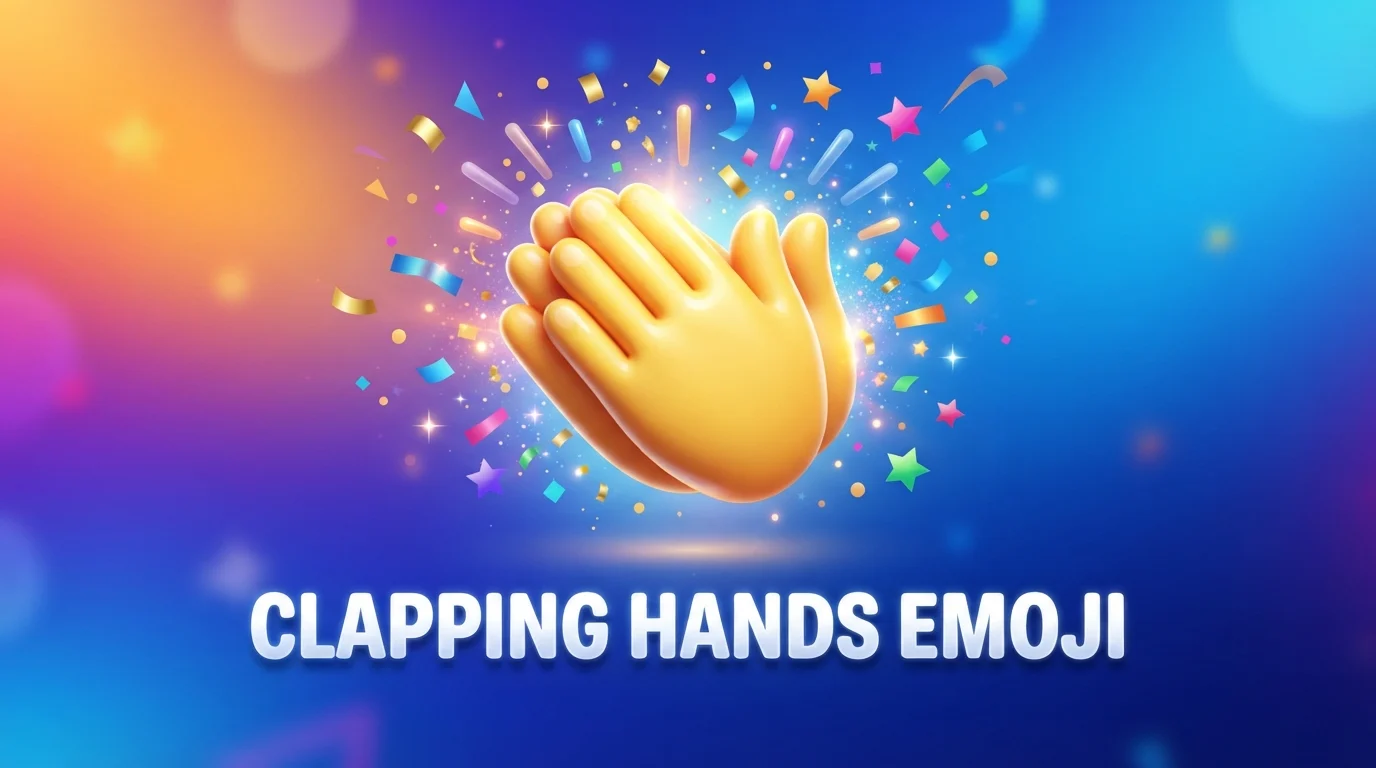
The clapping hands emoji 👏 usually means applause, approval, praise, congratulations, or appreciation. It can show that someone likes what was said, supports an achievement, or wants to celebrate a good result. In texting, repeated clapping emojis can make the reaction feel stronger, while a single 👏 may simply signal approval. Unicode lists 👏 as “clapping hands,” with related keywords including applause, approval, awesome, congratulations, and yay.
Context can change the tone. A message such as “Great job 👏” is clearly supportive, while “Wow 👏👏👏” can feel enthusiastic or celebratory. The same emoji can also be used playfully or sarcastically, especially when placed between words for emphasis. Understanding the surrounding message is therefore more useful than assuming 👏 always has one fixed meaning.
Quick Answer
The clapping hands emoji 👏 usually means applause, praise, approval, congratulations, or appreciation.
It can also be used for emphasis or sarcasm, especially when several 👏 emojis are placed between words.
What Does the Clapping Hands Emoji 👏 Mean?
The 👏 emoji represents two hands clapping together. Its most direct meaning is applause.
People commonly use it to show:
- Approval
- Praise
- Congratulations
- Appreciation
- Support
- Excitement
- Recognition
- Celebration
For example:
You did an amazing job 👏
This clearly expresses praise.
Another example:
That was such a good answer 👏👏
Here, the repeated emojis make the approval more enthusiastic.
Unicode’s current emoji list associates 👏 with terms including applause, approval, awesome, congratulations, excited, good, great, nice, and yay.
The emoji does not always represent literal applause. In digital conversations, it can act as a visual reaction that adds emotion or emphasis to a sentence.
👏 Meaning in Text Messages
In texting, the clapping hands emoji can communicate several closely related ideas.
“Good job”
You handled that perfectly 👏
The sender is praising your performance.
“Congratulations”
You finally graduated 👏🎓
Here, 👏 celebrates an achievement.
“I agree”
Exactly what I was thinking 👏
The emoji reinforces agreement or approval.
“That deserves recognition”
She worked really hard for this 👏
This gives the message a supportive tone.
“That was impressive”
Okay, that comeback was good 👏
Here, it expresses admiration or approval.
The exact meaning depends on what the sender is reacting to.
What Does 👏 Mean From Someone?
If someone sends you 👏, they are often approving of, praising, or celebrating something you said or did.
For example:
You got the promotion? 👏
This is likely congratulations.
That presentation was great 👏
This is praise.
Well said 👏
This signals agreement or approval.
But one emoji does not always tell you exactly how the sender feels. Their words, punctuation, previous messages, and normal communication style can change the tone.
Is the Clapping Hands Emoji Positive?
Usually, yes.
The most straightforward use of 👏 is positive. It often communicates:
- “Nice!”
- “Great job!”
- “Well done!”
- “Congratulations!”
- “I agree!”
- “That deserves applause!”
However, 👏 can become sarcastic or mocking when the surrounding words clearly suggest a different intention.
For example:
Amazing job forgetting the deadline again 👏
The words make the emoji sound sarcastic rather than genuinely congratulatory.
So the emoji itself is generally positive, but context can reverse or alter the tone.
Can 👏 Be Sarcastic?
Yes. The clapping hands emoji can be sarcastic when the message around it is critical, exaggerated, or obviously ironic.
For example:
Great, another meeting 👏
The sender may not actually be celebrating the meeting.
Another common use is:
You finally replied after three days 👏
This can communicate playful annoyance rather than sincere applause.
The emoji does not inherently mean sarcasm. The wording creates the sarcastic meaning.
The Emphasis Clap: 👏 Between Words
One of the most recognizable informal uses of 👏 is placing it between words to give each phrase extra emphasis.
For example:
That 👏 was 👏 not 👏 okay.
This style makes the sentence feel more forceful and dramatic.
It can be serious:
We 👏 need 👏 better 👏 communication.
Or playful:
This 👏 cake 👏 is 👏 incredible.
Emojipedia has documented this use as an “emphasis clap,” noting that placing clapping hands between words became a recognizable way to emphasize talking points in digital communication.
Because this usage has cultural and linguistic history, it is better to understand it as an established expressive style rather than treating it as a completely random emoji trend.
Does 👏 Mean “Thank You”?
It can sometimes accompany a thank-you message, but 👏 does not specifically mean “thank you.”
For example:
Thank you for helping me 👏
The actual “thank you” comes from the words. 👏 adds appreciation or emphasis.
If you specifically want to express gratitude, 🙏 may communicate that more directly in many contexts, although its meaning also depends on the conversation.
Does 👏 Mean Clapping or Applause?
Yes. Literal applause is the most direct interpretation.
For example:
Everyone gave her a huge round of applause 👏
It can also be used figuratively to show approval without anyone physically clapping.
That is why it works naturally in comments, texts, captions, congratulations, and reactions.
Related Hand Emojis and Their Meanings
| Emoji | Official Name | Common Meaning | Tone | Where or When It Is Used |
|---|---|---|---|---|
| 👏 | Clapping Hands | Applause, praise, approval | Supportive, enthusiastic | Compliments, congratulations, reactions |
| 🙌 | Raising Hands | Celebration, excitement, hooray | Joyful, energetic | Achievements, victories, celebrations |
| 🙏 | Folded Hands | Thanks, prayer, request, appreciation | Grateful, respectful | Thank-you messages, requests, support |
| 🫶 | Heart Hands | Love, affection, support | Warm, affectionate | Appreciation, friendship, caring messages |
| 🤝 | Handshake | Agreement, cooperation, deal | Professional, friendly | Agreements, teamwork, mutual support |
| 👐 | Open Hands | Openness, welcome, hug-like gesture | Friendly, welcoming | Warm reactions, openness, playful messages |
| 🤲 | Palms Up Together | Offering, receiving, prayer, openness | Respectful, thoughtful | Requests, wishes, spiritual contexts |
| 💪 | Flexed Biceps | Strength, confidence, encouragement | Motivational, energetic | Support, determination, achievements |
The closest comparison is 🙌 Raising Hands, but the two communicate different reactions. 👏 focuses on applause or approval, while 🙌 more strongly suggests celebration or excitement. Unicode identifies these as separate hand emojis with different names and keyword associations.
🙏 Folded Hands is another emoji that people sometimes confuse with 👏, especially when expressing appreciation. However, 🙏 can communicate thanks, prayer, asking, or respect, while 👏 is much more directly connected to applause and approval.
👏 vs. 🙌: What’s the Difference?
The difference is mainly applause versus celebration.
👏 Clapping Hands
Usually means:
“Great job!”
“Well done!”
“I approve!”
🙌 Raising Hands
More often suggests:
“Yes!”
“We did it!”
“Let’s celebrate!”
For example:
You passed the exam 👏
focuses on congratulating the achievement.
We passed the exam 🙌
sounds more like shared excitement and celebration.
Both can appear together:
You did it! 👏🙌
This combines praise with celebration.
👏 vs. 🙏: What’s the Difference?
These emojis can both appear in appreciative messages, but they carry different ideas.
👏 is closer to “well done” or “great job.”
🙏 can mean “thank you,” “please,” “I appreciate it,” or prayer, depending on context.
Compare:
Thanks for helping me 👏
This sounds like appreciation with applause.
Thanks for helping me 🙏
This can feel more directly grateful or heartfelt.
Neither interpretation is guaranteed in every conversation, but the distinction helps when choosing an emoji.
Is 👏 Flirty?
The clapping hands emoji is not inherently flirty.
Someone might use it in a playful or romantic conversation, but 👏 by itself does not prove attraction or romantic interest.
For example:
You look amazing 👏
could be a compliment, playful reaction, or enthusiastic praise.
The relationship between the people and the rest of the conversation matter more than the emoji alone.
If you are trying to make a romantic message clearly affectionate, an emoji such as 🫶 or ❤️ may communicate that intention more directly.
Is 👏 Rude?
Usually not.
A sincere:
Great work 👏
is clearly positive.
But the same emoji can feel rude or dismissive when used sarcastically:
Oh, you finally decided to show up 👏
Here, the words create the negative tone.
Repeated clapping can also make a message feel more dramatic:
👏 Seriously 👏 what 👏 was 👏 that?
Whether this sounds playful, annoyed, or confrontational depends on the conversation.
Clapping Hands Emoji in Social Media Comments
The 👏 emoji works especially well as a short reaction.
Someone might comment:
👏👏👏
to show strong approval.
Or:
This is so good 👏
to praise a post, performance, idea, or achievement.
It can also be combined with other emojis:
- 👏🔥 for strong praise
- 👏🎉 for congratulations
- 👏❤️ for heartfelt appreciation
- 👏😂 for something funny or entertaining
- 👏💯 for strong agreement or approval
These combinations are informal, so their exact tone depends on the surrounding post or conversation.
Text Message Examples
1. Genuine praise
Message:
“I finished the project ahead of schedule 👏”
Likely meaning:
The emoji celebrates the achievement and signals approval.
2. Congratulations
Message:
“You got the job! 👏🎉”
Likely meaning:
The sender is congratulating you and celebrating your success.
3. Agreement
Message:
“We really need to stop making excuses.”
“👏 Exactly.”
Likely meaning:
The sender strongly agrees with the statement.
4. Playful sarcasm
Message:
“You remembered my birthday only two weeks late 👏”
Likely meaning:
The sender is teasing rather than genuinely applauding.
5. Emphasis
Message:
“That 👏 was 👏 completely 👏 unnecessary.”
Likely meaning:
The clapping emojis add dramatic emphasis to each part of the sentence.
Common Misunderstandings About 👏
It does not always mean genuine applause
The emoji can be sarcastic, especially when the words around it are critical or ironic.
It does not automatically mean anger
A dramatic use of 👏 can sound confrontational, but the emoji itself is not an anger emoji.
It does not automatically mean flirting
A compliment containing 👏 can be friendly, enthusiastic, or romantic depending on the broader context.
It is not the same as 🙌
👏 focuses on applause and approval, while 🙌 is more closely associated with celebration and excitement.
More 👏 emojis do not always mean a stronger compliment
Repeated emojis can add enthusiasm, drama, humor, or sarcasm. Their effect depends on the message.
How to Respond to 👏
Your response depends on what the person is reacting to.
If they are praising you
“Thank you! 😊”
If they are congratulating you
“Thanks! I’m really excited!”
If they are agreeing with you
“Exactly!”
If they are being playful
“😂 I know, right?”
If they are being sarcastic
“Okay, okay 😂”
You do not need a special response just because someone sends 👏. Read the accompanying words and respond to the actual message.
Copy and Paste the Clapping Hands Emoji
👏
Skin tone variations are also available:
👏🏻 👏🏼 👏🏽 👏🏾 👏🏿
Unicode lists these as clapping hands sequences combined with the five available skin tone modifiers.
Popular Combinations
- 👏👏👏 = strong applause
- 👏🎉 = congratulations
- 👏🔥 = impressive
- 👏❤️ = heartfelt appreciation
- 👏😂 = funny or playful approval
- 👏💯 = strong agreement
- 👏🙌 = applause and celebration
Official Name and Technical Details
The official Unicode name for 👏 is CLAPPING HANDS SIGN. Unicode identifies the character as U+1F44F.
Key details:
- Emoji: 👏
- Unicode code point: U+1F44F
- Official Unicode name: CLAPPING HANDS SIGN
- Common short name: Clapping Hands
- Unicode approval: Unicode 6.0
- Emoji addition: Emoji 1.0
Emojipedia states that Clapping Hands was approved as part of Unicode 6.0 in 2010 under the name “Clapping Hands Sign” and added to Emoji 1.0 in 2015.
The visual design can vary between platforms. Different services may use slightly different hand shapes, colors, shading, and positioning while representing the same Unicode character. For example, platform-specific versions can have noticeably different visual styles.
Frequently Asked Questions
What does the clapping hands emoji 👏 mean?
👏 usually means applause, praise, approval, congratulations, or appreciation. It can also add emphasis to a statement.
What does 👏 mean in texting?
In texts, 👏 often means “good job,” “well done,” “I agree,” or “congratulations.” It can also be playful or sarcastic depending on the wording.
Does 👏 mean congratulations?
Yes. 👏 is commonly used to congratulate someone on an achievement or success.
Can 👏 be sarcastic?
Yes. For example, “Great job forgetting again 👏” can use the emoji sarcastically. The surrounding words determine the tone.
What does 👏👏👏 mean?
Multiple clapping hands usually create a stronger sense of applause, enthusiasm, or celebration. In some contexts, repeated 👏 can also make a message feel dramatic or sarcastic.
What is the difference between 👏 and 🙌?
👏 usually represents applause or approval, while 🙌 more often expresses celebration, excitement, or joy.
What is the difference between 👏 and 🙏?
👏 is generally about applause and praise, while 🙏 can express thanks, prayer, a request, or appreciation depending on context.
Does 👏 mean “I agree”?
It can. When placed after an opinion or statement, 👏 can reinforce agreement or approval.
Is 👏 a positive emoji?
Usually, yes. Its basic meaning is positive, but it can become sarcastic, teasing, or critical when the surrounding message changes the tone.
Conclusion
The clapping hands emoji 👏 is mainly used to express applause, praise, approval, appreciation, and congratulations. It can celebrate someone’s achievement, support an opinion, or simply show that something deserves recognition.
Its meaning becomes more flexible in casual texting. A single 👏 may offer simple approval, several 👏 emojis can create enthusiastic applause, and clapping placed between words can add dramatic emphasis. The emoji can even become sarcastic when the surrounding words suggest irony.
When choosing between similar hand emojis, remember the basic distinction: 👏 is for applause and approval, 🙌 is for celebration, and 🙏 is often used for thanks, requests, or prayer.
Read More Related Articles:
- Peace Emoji Meaning | Symbolism, Uses & Positive Vibes …
- Yikes Emoji Meaning | Reactions, Uses & Hidden Emotional …
- X Emoji Meaning | What It Really Means in Texts and Chats in …