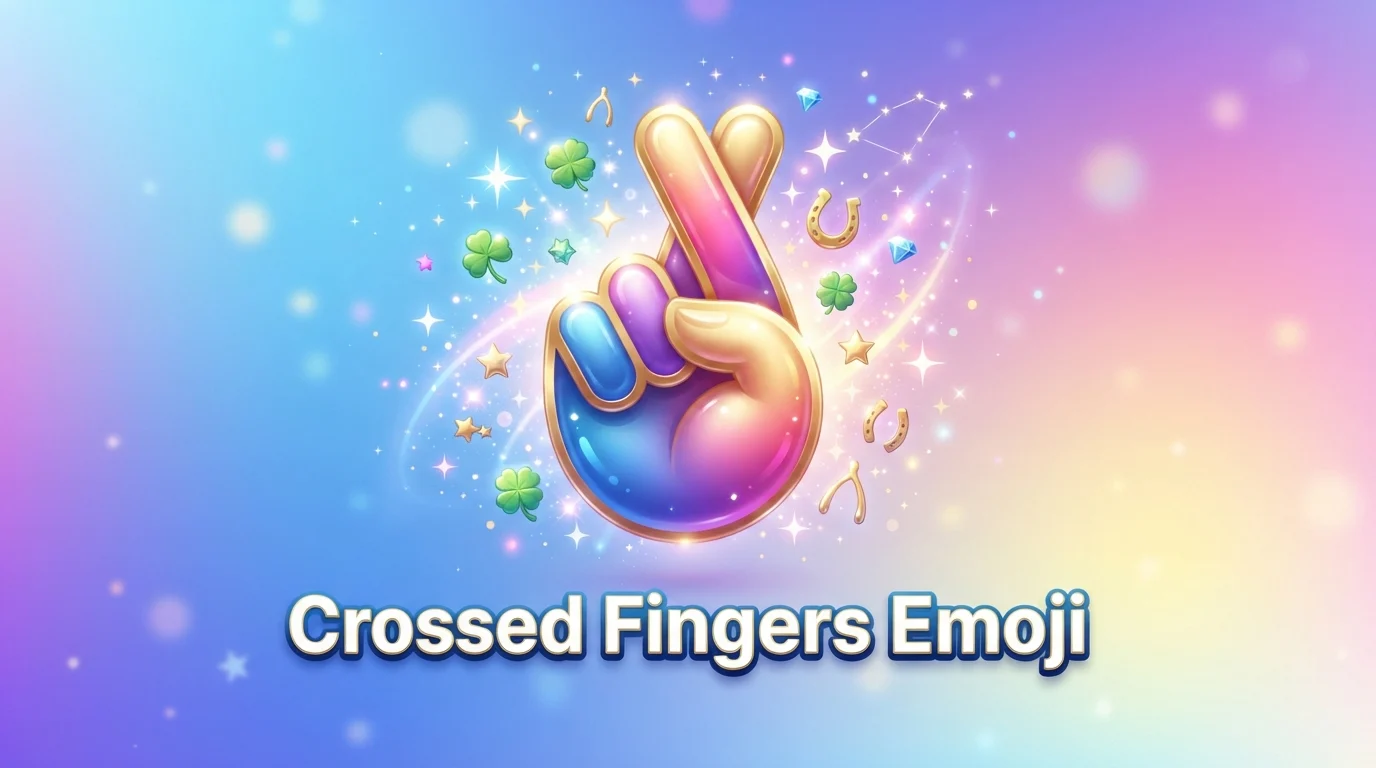
The crossed fingers emoji 🤞 usually means hoping for good luck or wishing for a positive outcome. It shows the index and middle fingers crossed, reflecting a gesture used when someone wants things to go well. In texts, people send it before an exam, interview, trip, decision, or uncertain event. It can also express hopeful anticipation when the result is unknown.
Context can give 🤞 a specific tone. A friend might use it to cheer you on, while someone discussing plans may use it to say “I hope this works.” It can sometimes appear in playful, nervous, or superstitious messages. The emoji does not automatically mean romance, dishonesty, or a promise. The surrounding words and situation provide the clearest meaning.
Quick Answer
The crossed fingers emoji 🤞 usually means “good luck,” “I hope it works,” or “fingers crossed.”
It often expresses hope for a favorable result, but the exact feeling can range from supportive and optimistic to nervous or playful depending on the conversation.
What Does the Crossed Fingers Emoji 🤞 Mean?
The 🤞 emoji represents crossed fingers, a familiar hand gesture associated with hoping for good luck or a positive outcome.
In everyday texting, it is commonly used when someone is waiting for something to happen and wants the result to go well. For example:
“I have my interview tomorrow 🤞”
This usually means:
“I hope it goes well.”
Someone might also send it after making a wish:
“Hopefully we get the tickets 🤞”
Here, the emoji adds a sense of hope and anticipation.
The emoji does not guarantee that something will happen. Instead, it communicates the sender’s hope, wish, or desire for a good result.
Emojipedia describes 🤞 as a gesture commonly used to indicate luck or a desire for a favorable outcome.
🤞 Meaning in Text and Chat
In texts, the crossed fingers emoji can replace or reinforce phrases such as:
- “Fingers crossed”
- “Good luck”
- “I hope so”
- “Hopefully”
- “Wish me luck”
- “I hope everything works out”
- “Let’s hope for the best”
The exact meaning depends on what is happening in the conversation.
For example:
“My test results should arrive tomorrow 🤞”
This expresses hope that the results will be good.
“Maybe we can get a table tonight 🤞”
This shows that the person hopes the plan works out.
“Wish me luck 🤞”
This directly connects the emoji with good luck.
Because 🤞 has a hopeful meaning, it often works naturally after a statement about an uncertain future event.
The Emotional Tone of 🤞
The crossed fingers emoji is generally hopeful, optimistic, supportive, and slightly uncertain.
Its emotional intensity can change with the situation.
Hopeful
“I really hope I get the job 🤞”
The sender wants a positive result.
Supportive
“You’ve got this! 🤞”
The emoji adds encouragement and good wishes.
Nervous
“Waiting for the doctor’s call 🤞”
The emoji can show hope during an uncertain moment.
Playful
“Hopefully you forget what I said yesterday 🤞😂”
The crossed fingers make the statement feel lighthearted.
Superstitious
“Crossing my fingers that nothing goes wrong 🤞”
Here, the emoji directly reflects the traditional gesture of wishing for good luck.
The emoji itself does not tell you whether the situation is serious or casual. The surrounding message provides that information.
Why Do People Use 🤞?
People use 🤞 because it communicates a complete idea with a single symbol.
Instead of typing:
“I really hope everything goes well.”
Someone can write:
“Hope everything goes well 🤞”
The emoji adds a visual expression of hope.
It is especially useful when the outcome is uncertain. If something has already happened successfully, a celebration emoji may be more appropriate. If the result has not happened yet, 🤞 can show that the sender is hoping for the best.
For example:
“The weather forecast looks better for Saturday 🤞”
The person is not saying the weather will definitely be good. They are expressing hope that it will be.
🤞 Meaning From Someone
If someone sends you 🤞, they are usually expressing hope, encouragement, or a wish for something to work out.
Consider the message around it.
“Let me know how your interview goes 🤞”
This sounds supportive.
“I hope we can meet this weekend 🤞”
This communicates hope about a plan.
“I submitted everything. Now we wait 🤞”
This shows anticipation and uncertainty.
A single 🤞 without any text can be harder to interpret, but the most natural reading is usually “good luck,” “I hope so,” or “fingers crossed.”
Avoid assuming that the emoji contains a hidden message beyond the situation being discussed.
Is the Crossed Fingers Emoji Flirty?
Not by itself.
🤞 is primarily associated with luck, hope, and wishing for a favorable outcome. It is not a standard flirting emoji.
It could appear in a flirtatious conversation, but the romantic meaning would normally come from the surrounding words.
For example:
“Hope I get to see you tonight 🤞❤️”
The ❤️ and the message create a romantic possibility. The 🤞 itself mainly means the person hopes the plan happens.
Compare:
“Good luck on your date 🤞”
This is supportive, not necessarily romantic.
So if someone sends 🤞, do not automatically interpret it as attraction or romantic interest.
Does 🤞 Mean “Good Luck”?
Yes. Good luck is one of the most common interpretations of 🤞.
It can be used before an event or situation where someone wants a favorable outcome.
Examples include:
- “Good luck on your exam 🤞”
- “Hope the interview goes well 🤞”
- “Fingers crossed for your presentation 🤞”
- “Hope you get the apartment 🤞”
- “Let’s see what happens 🤞”
The emoji can also stand alone after someone tells you about an uncertain situation.
“I find out tomorrow.”
“🤞”
That response can naturally mean:
“I hope it goes well.”
Does 🤞 Mean “I Hope So”?
Yes.
In many conversations, 🤞 works almost exactly like “I hope so.”
For example:
“Do you think they’ll approve it?”
“I hope so 🤞”
Here, the emoji reinforces uncertainty and optimism.
It is especially useful when the sender does not want to make a definite prediction.
Can 🤞 Mean Nervousness?
It can.
The emoji is not officially an anxiety symbol, but people may use it when they are nervous about an uncertain outcome.
For example:
“Waiting for my results today 🤞”
The sender may feel nervous while still hoping for good news.
This is an important distinction. 🤞 generally communicates hope despite uncertainty, rather than pure fear or anxiety.
Can 🤞 Be Sarcastic?
Yes, depending on the wording.
The emoji itself is not inherently sarcastic. However, someone can use it with exaggerated or ironic language.
For example:
“Maybe I’ll finally start cleaning my room tomorrow 🤞”
If the person frequently says this but never does it, the message could be playful or sarcastic.
Another example:
“Hopefully my Wi-Fi behaves today 🤞”
This may be a humorous way to express frustration with an unreliable connection.
The words and conversation history determine whether the emoji is sincere or sarcastic.
Related Emojis and Their Meanings
| Emoji | Official Name | Common Meaning | Tone | Where or When It Is Used |
|---|---|---|---|---|
| 🤞 | Hand with Index and Middle Fingers Crossed | Hope, luck, wishing for a good result | Hopeful, supportive | Exams, plans, decisions, uncertain outcomes |
| 🙏 | Folded Hands | Prayer, thanks, hope, request | Respectful, grateful, hopeful | Requests, gratitude, wishes, support |
| 🤲 | Palms Up Together | Offering, receiving, prayer, openness | Warm, sincere | Support, prayer, asking, giving |
| ✌️ | Victory Hand | Peace, victory, positivity | Friendly, upbeat | Greetings, celebrations, casual messages |
| 🫶 | Heart Hands | Love, affection, appreciation | Warm, affectionate | Support, friendship, gratitude |
| 🍀 | Four Leaf Clover | Luck, good fortune | Cheerful, hopeful | Good luck wishes, lucky moments |
| 🌟 | Glowing Star | Success, excitement, something special | Positive, celebratory | Achievements, encouragement, praise |
| 💪 | Flexed Biceps | Strength, confidence, encouragement | Motivational | Challenges, support, determination |
The closest match to 🤞 is 🍀 Four Leaf Clover when the goal is specifically to communicate luck. However, 🍀 focuses more on the idea of being lucky, while 🤞 expresses the action or wish of hoping for a favorable result.
🙏 Folded Hands can also overlap with 🤞 when someone is hoping for something, but 🙏 may suggest prayer, gratitude, or a request depending on context.
✌️ Victory Hand is different because its common meanings center on peace, victory, or a casual positive gesture rather than hoping for an uncertain outcome.
🫶 Heart Hands is much more affectionate and is usually better when you want to express love, appreciation, or emotional support.
🤞 vs. 🍀: What’s the Difference?
These two emojis are easy to connect because both can relate to luck.
🤞 means you are hoping for a favorable result.
🍀 represents luck or good fortune more directly.
Compare:
“I hope I pass the exam 🤞”
The sender is expressing hope.
“Hope some luck is on my side 🍀”
The clover emphasizes luck.
They can also be combined:
“Hope everything works out 🤞🍀”
That combination makes the idea of hoping for good luck even clearer.
🤞 vs. 🙏: What’s the Difference?
🤞 and 🙏 can both appear when someone hopes for something, but their emotional signals are different.
🤞 is more directly connected to hoping for a favorable outcome.
🙏 can communicate prayer, gratitude, pleading, appreciation, or a heartfelt request.
For example:
“Please let everything go well 🤞”
sounds hopeful and casual.
“Please keep my family in your prayers 🙏”
has a more serious and prayerful tone.
The best choice depends on whether you want to emphasize hope and luck or prayer and sincerity.
Text Message Examples
1. Before an exam
“My final is tomorrow. Wish me luck 🤞”
Likely meaning: The sender hopes to perform well.
2. Waiting for an answer
“They said they’d call me today 🤞”
Likely meaning: The sender hopes the call brings good news.
3. Making plans
“Maybe we can get tickets for Friday 🤞”
Likely meaning: The sender hopes tickets will be available.
4. Supporting a friend
“You’ve worked so hard. I hope you get it 🤞”
Likely meaning: The sender is encouraging the other person and wishing them success.
5. Being playful
“Hopefully I can make it through Monday 🤞😂”
Likely meaning: The sender is joking about getting through a difficult day.
6. Showing nervous hope
“Results come out tomorrow 🤞”
Likely meaning: The sender is uncertain and hopes for a positive result.
Common Misunderstandings About 🤞
It does not guarantee good luck
🤞 expresses a wish or hope. It does not mean the sender knows that something will turn out well.
It does not automatically mean lying
Some people associate crossed fingers with the cultural idea of crossing your fingers while making a false promise. That is a separate cultural association and should not automatically be applied to every use of the emoji.
For example:
“Hope you get the job 🤞”
clearly expresses good wishes, not deception.
It does not automatically mean flirting
Romantic context can change how any emoji feels, but 🤞 alone is not a reliable sign of attraction.
It does not always mean nervousness
The sender may simply be wishing someone good luck. Nervousness is possible, but it depends on the situation.
It is not the same as ✌️
The hand shapes may look somewhat similar at a glance, but their meanings are different. 🤞 represents crossed fingers, while ✌️ is the Victory Hand.
How to Respond to the Crossed Fingers Emoji
Your response can be simple because 🤞 usually carries a straightforward message of hope or support.
If someone wishes you luck
“Thank you! 🤞”
If they are waiting for good news
“I hope it works out too!”
If they are nervous
“You’ve got this!”
If they are talking about plans
“Fingers crossed!”
If they use it playfully
“Haha, same 🤞😂”
You do not need to give the emoji a special interpretation. Match the tone of the conversation and respond to the actual situation.
Crossed Fingers Emoji Copy and Paste
🤞
You can copy and paste the crossed fingers emoji into texts, captions, comments, messages, and social posts.
Useful combinations include:
- 🤞🍀 for hoping for good luck
- 🤞❤️ for hopeful support with affection
- 🤞✨ for hopeful or positive wishes
- 🤞🙏 for hope or heartfelt wishes
- 🤞😊 for cheerful encouragement
- 🤞😂 for playful hope
The crossed fingers emoji also has skin tone variants:
🤞🏻 🤞🏼 🤞🏽 🤞🏾 🤞🏿
Unicode lists these as modifier sequences for the crossed fingers character.
Official Name and Technical Details
The emoji 🤞 has the Unicode code point U+1F91E.
Its official Unicode character name is:
HAND WITH INDEX AND MIDDLE FINGERS CROSSED
Unicode’s current code charts list U+1F91E with that name.
Key details:
- Emoji: 🤞
- Unicode code point: U+1F91E
- Unicode character name: HAND WITH INDEX AND MIDDLE FINGERS CROSSED
- Unicode version: 9.0
- Emoji version: 3.0
- Category: People & Body
- Subcategory: Hand Fingers Partial
- Common short name: crossed fingers
Unicode records show that the character was included in Unicode 9.0, and Emojipedia notes that it was added to Emoji 3.0 in 2016.
The emoji can be displayed with different skin tones through Unicode’s emoji modifier sequences.
Its visual design can also vary between platforms. The basic concept remains the same, but the shape, proportions, shading, and hand details may look different depending on the device or service.
Frequently Asked Questions
What does 🤞 mean?
🤞 usually means good luck, hope, or wishing for a positive outcome. It is commonly used when someone is waiting for an uncertain result.
What does the crossed fingers emoji mean in text?
In texting, 🤞 can mean “fingers crossed,” “I hope so,” “good luck,” or “I hope everything works out.”
Is 🤞 a good luck emoji?
Yes. Good luck is one of its most common uses. It can express a wish for something to go well.
Does 🤞 mean “I hope so”?
Yes. When used after a statement about an uncertain outcome, 🤞 can naturally mean “I hope so” or “hopefully.”
Is 🤞 a flirting emoji?
Not usually. Its primary meaning is hope or luck. Any romantic meaning comes from the surrounding conversation rather than the emoji itself.
What does 🤞 mean from a girl or guy?
The basic meaning does not change based on gender. A person of any gender can use 🤞 to express hope, luck, encouragement, or anticipation.
Does 🤞 mean lying?
Not automatically. Although crossed fingers have a separate cultural association with making a false promise, the emoji is commonly used for luck and hope. Context is necessary before interpreting it as deception.
What is the difference between 🤞 and 🍀?
🤞 focuses on hoping for a good outcome, while 🍀 more directly represents luck or good fortune. They can be used together when both ideas are intended.
What is the difference between 🤞 and 🙏?
🤞 usually communicates hope or good luck. 🙏 can express prayer, gratitude, a request, or heartfelt support. Their meanings can overlap, but their tones are different.
Can 🤞 mean “wish me luck”?
Yes. When someone uses 🤞 around an upcoming challenge or uncertain event, it can communicate “wish me luck” or “fingers crossed.”
Conclusion
The crossed fingers emoji 🤞 is mainly a symbol of hope, good luck, and wishing for a favorable outcome. It works especially well when the result is uncertain, such as before an exam, interview, important decision, trip, or planned event.
Its meaning can become supportive, nervous, playful, or even slightly superstitious depending on the surrounding words. The key is not to treat 🤞 as a fixed emotional signal. Look at the complete message and situation to understand what the sender actually means.
Read More Related Articles:
- Peace Emoji Meaning | Symbolism, Uses & Positive Vibes …
- Yikes Emoji Meaning | Reactions, Uses & Hidden Emotional …
- X Emoji Meaning | What It Really Means in Texts and Chats in …