Quick Answer:
The cringe emoji 😬 usually represents awkwardness, embarrassment, nervousness, discomfort, or a “yikes” reaction.
It can also soften an awkward message or show that someone knows a situation is uncomfortable or embarrassing.
The cringe emoji 😬 is commonly used when something feels awkward, embarrassing, uncomfortable, or a little hard to watch. You might send it after making an embarrassing mistake, hearing an awkward comment, facing a stressful situation, or reacting to something that makes you think, “Yikes.” Although people often call 😬 the cringe emoji, its official Unicode name is Grimacing Face, so its meaning is broader than cringe alone.
In texts and social media, 😬 can express nervousness, discomfort, embarrassment, tension, or even playful sarcasm. For example, “I forgot to submit the assignment 😬” sounds embarrassed, while “My interview starts in five minutes 😬” sounds nervous. The exact meaning depends on the message, situation, and relationship between the people using it.
What Does the Cringe Emoji 😬 Mean?
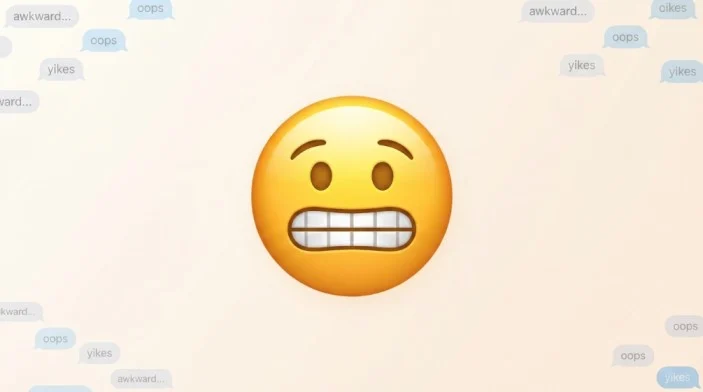
The emoji commonly called the cringe emoji is officially named Grimacing Face. It shows a yellow face with open eyes and tightly clenched teeth.
In everyday texting, 😬 is often used when something feels awkward, embarrassing, uncomfortable, tense, or difficult to react to.
For example:
“I accidentally called my teacher ‘Mom’ 😬”
The emoji communicates the uncomfortable feeling without needing a long explanation.
It can also mean:
- “That was awkward.”
- “Oops.”
- “Yikes.”
- “I feel embarrassed.”
- “This is uncomfortable.”
- “I don’t know what to say.”
- “That could have gone better.”
- “I’m nervous about this.”
- “I’m cringing at myself.”
Although people commonly call it the cringe emoji, “cringe” is not its official Unicode name. The official name is Grimacing Face.
Unicode identifies 😬 as U+1F62C, and the emoji was approved in Unicode 6.1.
Why Is 😬 Called the Cringe Emoji?
The nickname comes from the expression itself.
The face has a tense-looking mouth with clenched teeth, which can resemble the expression people make when they feel uncomfortable, embarrassed, or uneasy.
That makes 😬 a natural choice for situations that feel cringeworthy.
For example:
“I just reread the message I sent last night 😬”
Here, “cringe emoji” is a useful informal description because the sender is reacting to their own embarrassing moment.
However, 😬 does not have one fixed meaning of “cringe.” It can express a wider range of uncomfortable or tense emotions.
Emojipedia describes the emoji as conveying moderately negative or tense emotions, including nervousness, embarrassment, awkwardness, discomfort, and disapproval.
😬 Meaning in Texting
In texting, 😬 usually adds an uncomfortable or nervous emotional tone to a message.
Its exact meaning depends heavily on what comes before it.
“I forgot the meeting was today 😬”
Likely meaning: embarrassment or an awkward mistake.
“I have to present this in front of everyone tomorrow 😬”
Likely meaning: nervousness or anxiety about an upcoming situation.
“He told the same joke three times 😬”
Likely meaning: awkwardness or discomfort.
“Well… that didn’t go as planned 😬”
Likely meaning: an uncomfortable or disappointing situation.
The emoji can sometimes replace a phrase such as “yikes,” “oops,” or “that was awkward.”
😬 Meaning in a Conversation
The cringe emoji can change the emotional tone of an ordinary sentence.
Compare:
“I sent the email to the wrong person.”
with:
“I sent the email to the wrong person 😬”
The second version signals that the sender recognizes the mistake and feels uncomfortable about it.
It can also make a serious statement feel slightly lighter:
“I completely forgot your birthday 😬”
The emoji does not erase the mistake, but it shows embarrassment and self-awareness.
This is one reason 😬 is useful in casual conversations. It can communicate an emotional reaction without requiring the sender to spell everything out.
Does 😬 Mean Cringe?
It can, especially when someone is reacting to something embarrassing, awkward, or uncomfortable.
For example:
“Why did I say that in front of everyone 😬”
Here, the emoji clearly fits a cringe reaction.
But the emoji can also represent nervousness, tension, discomfort, or embarrassment even when nothing is particularly “cringe.”
For example:
“My dentist appointment is tomorrow 😬”
This is more likely to communicate nervousness or discomfort than embarrassment.
So, “cringe emoji” is a common nickname, but it is broader than simply saying “this is cringe.”
Does 😬 Mean Awkward?
Yes. Awkwardness is one of the most common ways to understand 😬.
Someone may use it when:
- They made an embarrassing mistake
- Someone said something inappropriate
- A conversation became uncomfortable
- They witnessed an awkward moment
- They do not know how to respond
- Something feels socially uncomfortable
Example:
“She asked him if he was single in front of his girlfriend 😬”
The emoji communicates the awkwardness of the situation.
Does 😬 Mean Embarrassed?
It can.
A person might use 😬 when they are embarrassed about something they did or said.
“I waved back at someone who wasn’t waving at me 😬”
The emoji captures that familiar feeling of realizing you made a small social mistake.
It can also be used when someone is embarrassed for another person:
“He tried to sing the high note and completely missed it 😬”
In that situation, the sender may be reacting to someone else’s uncomfortable moment.
Does 😬 Mean Nervous?
Yes. 😬 can communicate nervousness or tension, especially when the message describes something that has not happened yet.
For example:
“Waiting for my test results 😬”
or:
“First day at my new job tomorrow 😬”
Here, there is no embarrassing event to “cringe” about. The clenched-teeth expression instead suggests nervous anticipation.
This is an important difference between the nickname cringe emoji and the emoji’s broader use.
Can 😬 Mean “Yikes”?
Yes. In some contexts, 😬 works much like “yikes.”
For example:
“He accidentally sent the private message to the entire group 😬”
The emoji can communicate a reaction such as:
“Yikes.”
“Oh no.”
“That’s awkward.”
“That’s not good.”
The surrounding text determines which interpretation fits best.
Can 😬 Be Sarcastic?
Yes, although sarcasm comes from the context, not from the emoji itself.
For example:
“Great, another two-hour meeting 😬”
The sender may be jokingly presenting the meeting as “great” while actually expressing discomfort or annoyance.
Another example:
“I definitely love getting stuck in traffic 😬”
The words suggest enthusiasm, but the emoji can signal that the statement is not meant literally.
Without enough context, however, it may be difficult to know whether 😬 is sincere, playful, or sarcastic.
Is 😬 a Negative Emoji?
It usually carries a mildly negative or tense emotional tone, but it is not necessarily harsh or hostile.
It can show:
- Awkwardness
- Nervousness
- Embarrassment
- Discomfort
- Uneasiness
- Mild disapproval
- A difficult situation
- Self-consciousness
The intensity can be very small.
For example:
“I forgot to bring my umbrella 😬”
is much lighter than:
“I think I just made a huge mistake 😬”
The same emoji can therefore fit minor awkward moments and more serious uncomfortable situations.
What Does 😬 Mean From Someone?
If someone sends you 😬, they may be telling you that something feels awkward, uncomfortable, embarrassing, or nerve-racking.
Consider the difference:
“I have to tell my boss what happened 😬”
This likely expresses nervousness.
“I accidentally sent that text to my boss 😬”
This likely expresses embarrassment.
“Your ex just walked in 😬”
This may signal an awkward situation.
The emoji itself does not tell you exactly what the sender is feeling. The message around it provides the missing context.
What Does 😬 Mean From a Girl or Guy?
The basic meaning of 😬 does not change based on the sender’s gender.
A woman, man, or anyone else can use it to express awkwardness, embarrassment, nervousness, discomfort, or a tense reaction.
If someone sends you:
“I don’t know if I should say it 😬”
the important clues are the words and conversation history, not the sender’s gender.
Avoid reading romantic or personal meaning into 😬 simply because someone you like uses it. It is generally an emotional reaction emoji rather than a clear flirting signal.
Is 😬 a Flirting Emoji?
Usually, no.
😬 is not primarily a romantic or flirting emoji. It is much more closely associated with awkwardness, nervousness, embarrassment, and discomfort.
However, a person might use it during a flirtatious conversation to show nervousness.
For example:
“Okay, I might have a little crush on you 😬”
Here, the romantic meaning comes from the words. 😬 adds a nervous or embarrassed tone.
So the emoji can appear in flirting, but it does not independently mean “I’m flirting with you.”
😬 in Friendship
Friends often use 😬 when talking about mistakes, awkward situations, embarrassing memories, or nervous plans.
For example:
“I think we both forgot to invite him 😬”
or:
“I have to apologize to her tomorrow 😬”
The emoji can make the message sound self-aware rather than overly serious.
It can also help communicate an inside joke:
“Remember when we thought that was a good idea? 😬”
The exact feeling might be embarrassment, amusement, regret, or all three.
😬 vs. 😅: What’s the Difference?
These emojis are frequently confused because both can appear after an awkward moment.
😬 Grimacing Face tends to emphasize tension, discomfort, awkwardness, or embarrassment.
😅 Grinning Face with Sweat often suggests relief, nervous laughter, or an awkward situation that turned out okay.
Compare:
“I completely forgot the deadline 😬”
This sounds uncomfortable.
“I completely forgot the deadline, but my teacher gave me another day 😅”
This sounds more like nervous relief.
The difference is subtle, but 😬 usually feels more tense.
😬 vs. 😳: What’s the Difference?
Both can communicate embarrassment, but they focus on different reactions.
😬 emphasizes a tense or uncomfortable feeling.
😳 Flushed Face emphasizes surprise, shock, embarrassment, or being caught off guard.
For example:
“I accidentally called my boss ‘Dad’ 😬”
focuses on the awkwardness.
“Wait, you heard that?! 😳”
focuses more on surprise and embarrassment.
😬 vs. 😖: What’s the Difference?
😬 Grimacing Face usually looks like a restrained, clenched-teeth reaction.
😖 Confounded Face has a much more distressed expression and can communicate frustration, pain, or intense discomfort.
Use 😬 for:
“This is awkward.”
Use 😖 for something closer to:
“This is really frustrating.”
The emotional intensity is generally stronger with 😖.
Related Emojis and Their Meanings
| Emoji | Official Name | Common Meaning | Tone | Where or When It Is Used |
|---|---|---|---|---|
| 😬 | Grimacing Face | Awkwardness, nervousness, embarrassment, discomfort | Tense, awkward | Mistakes, uncomfortable moments, nervous situations |
| 😅 | Grinning Face with Sweat | Nervous relief, awkward laughter, “that was close” | Nervous, relieved | Mistakes that worked out, uncomfortable jokes, close calls |
| 😳 | Flushed Face | Embarrassment, surprise, shock | Startled, embarrassed | Unexpected comments, awkward attention, surprising situations |
| 😖 | Confounded Face | Frustration, distress, intense discomfort | Distressed, tense | Problems, frustration, difficult situations |
| 😣 | Persevering Face | Struggle, determination, discomfort | Strained, serious | Difficult tasks, stressful moments, trying to cope |
| 😓 | Downcast Face with Sweat | Stress, worry, relief after difficulty | Worried, tired | Pressure, mistakes, stressful situations |
| 😰 | Anxious Face with Sweat | Anxiety, nervousness, worry | Anxious, tense | Serious uncertainty, nervous anticipation |
| 🙈 | See-No-Evil Monkey | Embarrassment, playful avoidance, “I can’t look” | Playful, embarrassed | Awkward moments, embarrassing posts, funny mistakes |
| 🫣 | Face with Peeking Eye | Nervous curiosity, embarrassment, reluctance to look | Shy, nervous, curious | Scary or awkward situations, uncomfortable curiosity |
The closest alternatives to 😬 are 😅, 😳, and 🫣, but they emphasize different parts of an uncomfortable reaction. 😬 is especially useful when the main feeling is tension or awkwardness. 😅 adds nervous laughter or relief, 😳 highlights surprise or embarrassment, and 🫣 suggests wanting to look while also feeling shy or uncomfortable.
Message Examples With the Cringe Emoji
“I just realized I replied to the wrong group chat 😬”
Likely meaning: Embarrassment and concern about a mistake.
“My presentation starts in five minutes 😬”
Likely meaning: Nervousness.
“That conversation got awkward really fast 😬”
Likely meaning: Directly expressing discomfort or awkwardness.
“I watched my old videos from high school 😬”
Likely meaning: Cringing at an embarrassing memory.
“He told that joke again 😬”
Likely meaning: The sender finds the situation awkward or uncomfortable.
“I asked if she wanted to go out and she said ‘we’ll see’ 😬”
Likely meaning: Uncertainty or discomfort about the response.
These examples show why the same emoji cannot be translated into one exact word. Depending on the situation, 😬 might mean awkward, embarrassed, nervous, uncomfortable, or yikes.
When Should You Use 😬?
Use 😬 when you want to show that something feels tense, awkward, embarrassing, or uncomfortable.
It works particularly well after:
- A small mistake
- An awkward confession
- A nervous admission
- An embarrassing memory
- An uncomfortable situation
- A risky decision
- A difficult conversation
- A situation that could go badly
For example:
“I may have accidentally deleted the file 😬”
The emoji makes the speaker’s emotional reaction clear.
It is less suitable when you want to communicate genuine happiness, strong affection, or celebration. In those situations, a different emoji will usually communicate your intention more clearly.
When Should You Avoid 😬?
You may want to avoid 😬 when your message could be interpreted as judgmental or critical.
For example:
“You really wore that? 😬”
Depending on the relationship, this can sound like an insult or negative reaction.
Likewise:
“Nice job 😬”
could be read as sarcastic rather than supportive.
If you want your message to sound clearly encouraging, choose an emoji that matches that intention more directly.
How Should You Respond to 😬?
Your response depends on why the sender used it.
- If they are nervous
“You’ll be fine! You’ve got this.”
- If they made a mistake
“Don’t worry, it happens 😅”
- If they are embarrassed
“Honestly, I wouldn’t worry about it.”
- If they are describing an awkward situation
“Oh no 😭 What happened?”
- If they are joking
“Okay, that sounds bad 😂”
The best response usually addresses the actual situation rather than trying to decode the emoji by itself.
Can You Use 😬 for Something Funny?
Yes. 😬 can appear in humorous situations, especially when the humor comes from embarrassment or awkwardness.
For example:
“Me realizing I’ve been calling him the wrong name for six months 😬”
The situation is funny because it is embarrassing.
The emoji does not necessarily mean the sender is genuinely upset. It can make the joke’s awkwardness clearer.
Does 😬 Mean “I’m Sorry”?
Not by itself.
Someone may use 😬 alongside an apology:
“Sorry, I completely forgot 😬”
In that message, the emoji adds embarrassment or discomfort.
But if someone simply sends:
“😬”
you cannot reliably translate it as “I’m sorry.”
The words around the emoji matter.
Does 😬 Mean “I Don’t Know What to Say”?
Sometimes.
When someone receives an unexpected or uncomfortable message, they might respond:
“😬”
as a way of showing that they are unsure how to react.
For example:
“So I told my parents we’re getting married next week.”
“😬”
The response could communicate surprise, discomfort, uncertainty, or awkwardness.
It does not provide a precise verbal answer, but it signals that the situation has made the person uncomfortable or unsure.
Official Name and Unicode Details
The official Unicode name for 😬 is Grimacing Face.
Its Unicode code point is U+1F62C. Unicode lists related keywords including “awkward,” “dentist,” “grimace,” “grinning,” and “smiling.”
Grimacing Face was approved in Unicode 6.1 in 2012 and added to Emoji 1.0 in 2015.
The emoji’s visual design can vary somewhat between platforms. Historically, some designs made 😬 look more like a smile or another facial expression, which contributed to confusion with other smiling emojis.
Why Can 😬 Be Confusing?
The clenched teeth can make 😬 look like it is smiling at first glance.
That is especially important when comparing it with 😁 Beaming Face with Smiling Eyes.
The two emojis can look quite different today, but older platform designs sometimes made the distinction less obvious. Emojipedia notes that Apple’s earlier design for 😁 used a similar mouth shape before the designs were changed.
This means that if someone uses 😬 after a positive statement, you should consider the entire message before deciding whether they are being happy, nervous, awkward, or sarcastic.
Common Misunderstandings About 😬
Does 😬 always mean “cringe”?
No. It can also communicate nervousness, embarrassment, discomfort, tension, or a general “yikes” reaction.
Does 😬 mean someone is angry?
Not usually. It generally suggests tension or discomfort rather than straightforward anger.
Does 😬 mean someone is laughing?
Not necessarily. The clenched teeth can look like a smile, but the emoji’s common uses are more closely connected to awkward or tense emotions.
Is 😬 a rude emoji?
It can sound rude or judgmental in certain messages, but the emoji itself is not inherently rude.
Does 😬 mean someone is nervous?
It can. Contexts involving uncertainty, pressure, or anticipation often give it a nervous meaning.
Does 😬 mean flirting?
Not by itself. It may appear in a flirtatious conversation to show nervousness or embarrassment, but the surrounding words provide the romantic meaning.
What does “cringe emoji” officially mean?
“Cringe emoji” is an informal nickname. The official Unicode name is Grimacing Face.
Frequently Asked Questions
What is the cringe emoji?
The emoji commonly called the cringe emoji is 😬 Grimacing Face. It usually expresses awkwardness, embarrassment, nervousness, discomfort, or tension.
What does 😬 mean from a girl?
It can mean that she feels awkward, nervous, embarrassed, uncomfortable, or unsure about something. The meaning depends on the message and situation, not simply on gender.
What does 😬 mean from a guy?
It has the same general range of meanings: awkwardness, nervousness, embarrassment, discomfort, or tension. The surrounding conversation matters more than the sender’s gender.
Is 😬 a bad emoji?
Not necessarily. It often represents a mildly uncomfortable emotion, but it can also be used humorously or playfully.
What does 😬 mean after a compliment?
It may show nervousness, embarrassment, or uncertainty about the compliment. The exact meaning depends on the rest of the conversation.
What does 😬 mean after an apology?
It can add embarrassment or self-consciousness to the apology, such as admitting a mistake.
What is the difference between 😬 and 😅?
😬 generally emphasizes awkwardness or tension, while 😅 often adds nervous laughter or relief after an uncomfortable situation.
What is the difference between 😬 and 😳?
😬 usually focuses on tension or awkwardness, while 😳 more strongly emphasizes surprise, shock, or embarrassment.
Can 😬 be used as “yikes”?
Yes. In the right context, 😬 can function as a visual version of “yikes,” “oh no,” or “that’s awkward.”
Conclusion
The cringe emoji 😬, officially called Grimacing Face, is most often used for awkwardness, embarrassment, nervousness, discomfort, and tense situations. It can also communicate a casual “oops” or “yikes” reaction.
Its meaning is flexible. A message about an embarrassing mistake may make 😬 mean “I’m cringing,” while an upcoming presentation may make it mean “I’m nervous.” In a joking conversation, it can even add sarcasm or playful discomfort.
If you’re trying to understand what someone means by 😬, focus on the words, situation, and relationship around the emoji. The symbol adds emotional tone, but it does not have one guaranteed interpretation.
Read More Related Articles:
- Nervous Emoji Meaning | What Does Mean in Texts?
- Thank You Emoji Meaning | Best Emojis to Say Thanks
- Nerd Emoji Meme | Meaning, Uses, and Funny Examples in …











5 thoughts on “Cringe Emoji | Meaning, Uses, and the Awkward Moments It Captures in 2026”