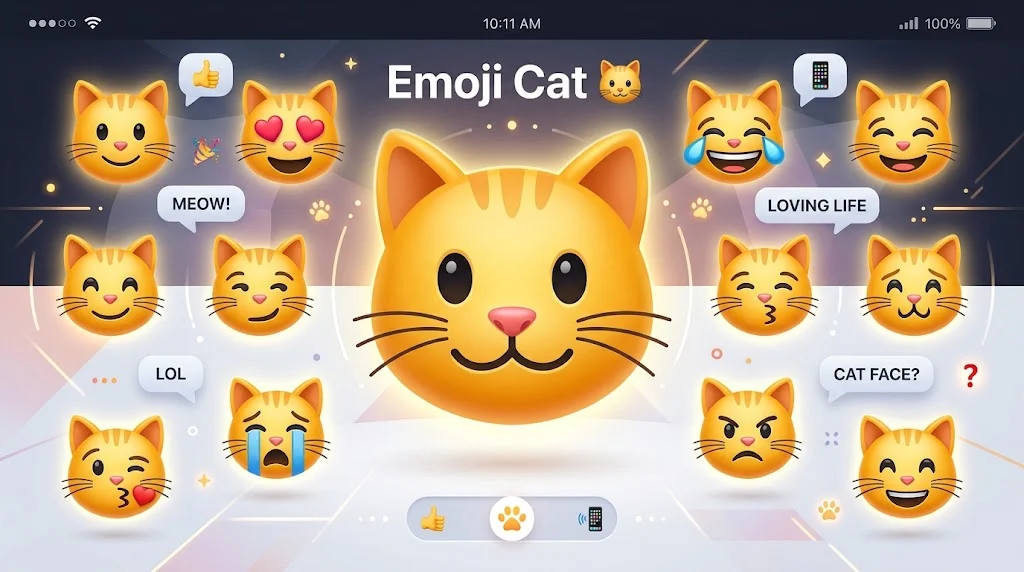
The emoji cat 🐱, officially called Cat Face, usually represents a cat, kitten, pets, cuteness, or a playful mood. In texts, however, it can do more than simply say “cat.” People may use 🐱 to make a message feel friendly, cute, silly, affectionate, or lighthearted. Unicode lists 🐱 as Cat Face, with the code point U+1F431, while related cat-face emojis show different expressions such as laughter, love, worry, and sadness.
The exact meaning depends on the message around it. “Look at this kitten 🐱” is a straightforward reference to a cat, while “Good morning 🐱” can feel playful or cute. Because “emoji cat” can refer to several different cat emojis, it is also useful to understand how 🐱 differs from 😺, 😻, 😹, 😼, 😽, 🙀, 😿, and 😾.
Quick Answer:
🐱 usually means a cat, kitten, cuteness, or a playful and friendly mood.
In texting, it can also add an affectionate or silly tone, but the exact meaning depends on the surrounding conversation.
What Is the Emoji Cat 🐱?
🐱 is the Cat Face emoji. It shows the face of a cat looking forward, generally with pointed ears and whiskers. Unicode identifies it as U+1F431, and its keywords include cat, face, kitten, kitty, and pet.
Unlike the expressive cat-face emojis, 🐱 has a relatively neutral expression. That makes it useful in many different situations.
People may use it to:
- Talk about cats or kittens
- Mention a pet
- Show that something is cute
- Add a playful tone
- Make a message feel softer
- Express a general love of cats
- React to something adorable
- Add personality to a casual message
The emoji itself does not automatically mean flirting, affection, sarcasm, or humor. Those meanings come from context.
What Does 🐱 Mean in Texting?
In a text message, 🐱 often works as a visual reference to a cat.
For example:
“My cat just jumped on my desk 🐱”
Here, the meaning is literal.
But the same emoji can have a more expressive role:
“That kitten is way too cute 🐱”
Now it helps reinforce the feeling of cuteness.
It can also make a simple message feel more playful:
“Good night 🐱”
In this situation, the emoji may add a cute or friendly tone without changing the basic meaning of the words.
🐱 Meaning in Different Contexts
When talking about cats
This is the most direct use.
“I’m obsessed with cats 🐱”
The emoji simply reinforces the subject.
When something is cute
“Look at those tiny paws 🐱”
Here, 🐱 helps express affection toward a cute animal.
When being playful
“I didn’t eat the cookies 🐱”
Depending on the conversation, the emoji may make the statement feel mischievous or joking.
When talking about a pet
“My cat woke me up at 5 a.m. 🐱”
The emoji adds a clear visual connection to the pet.
When making a message feel softer
“See you tomorrow 🐱”
The emoji can make a short message feel more cheerful and playful.
Is 🐱 a Cute Emoji?
Yes, 🐱 is commonly used to add a cute or playful feeling, especially when the conversation is about kittens, pets, or adorable things.
However, “cute” is a contextual interpretation rather than the emoji’s only official meaning. Unicode identifies the character simply as Cat Face and provides related keywords such as kitten, kitty, and pet.
Compare:
“My cat is sleeping 🐱”
This is mostly descriptive.
“Look how tiny she is 🐱”
This has a stronger cute or affectionate tone.
The same emoji can therefore feel neutral in one message and adorable in another.
Does 🐱 Mean Love or Affection?
It can suggest affection, but 🐱 is not specifically a love emoji.
Someone might use it while talking about a beloved pet:
“I miss my little cat 🐱”
Or when reacting to something adorable:
“That is so cute 🐱”
For stronger romantic or affectionate meaning, other cat emojis can be more specific. For example, 😻 is officially Smiling Cat With Heart-Eyes and is much more clearly associated with love or admiration.
So if someone sends 🐱, it is better not to assume romantic feelings from the emoji alone.
Is 🐱 a Flirting Emoji?
Not by itself.
A person may include 🐱 in a playful or flirty conversation, but the emoji does not automatically indicate romantic interest.
For example:
“You looked really good today 🐱”
could be playful or affectionate depending on the relationship.
But:
“My kitten is sleeping 🐱”
is simply about a pet.
If you’re trying to understand whether someone is flirting, the surrounding words and the overall conversation are much more important than 🐱 alone.
Can 🐱 Be Used as a Reaction?
Yes. Someone can send 🐱 as a standalone reaction, although its meaning will be less specific.
For example:
“🐱”
might communicate:
- “Cute!”
- “Cat!”
- “I love cats.”
- “That is adorable.”
- “I’m being playful.”
- “This reminds me of my cat.”
When an emoji is sent without words, the conversation immediately before it becomes especially important.
What Does 🐱 Mean From Someone?
If someone sends you 🐱, avoid assigning a fixed hidden meaning to it.
Consider what you were discussing.
If you were talking about pets, it probably refers directly to cats.
If you were joking around, it may simply add a cute or silly reaction.
If the conversation is affectionate, it might make the message feel warmer.
If the person regularly uses animal emojis, 🐱 may simply be part of their normal texting style.
The emoji alone cannot reliably prove attraction, flirting, sarcasm, or any other specific intention.
Cat Emojis and Their Meanings
There are several expressive cat-face emojis, and they can communicate very different emotions. Unicode lists nine cat-face characters, including 😺 Grinning Cat, 😸 Grinning Cat With Smiling Eyes, 😹 Cat With Tears of Joy, 😻 Smiling Cat With Heart-Eyes, 😼 Cat With Wry Smile, 😽 Kissing Cat, 🙀 Weary Cat, 😿 Crying Cat, and 😾 Pouting Cat.
Related Cat Emojis and Their Meanings
| Emoji | Official Name | Common Meaning | Tone | Where or When It Is Used |
|---|---|---|---|---|
| 🐱 | Cat Face | Cat, kitten, pet, or cuteness | Neutral, cute, playful | Talking about cats, pets, adorable moments |
| 😺 | Grinning Cat | Happiness or a cheerful reaction | Happy, playful | Friendly reactions and upbeat messages |
| 😸 | Grinning Cat With Smiling Eyes | Warm happiness or delight | Cheerful, affectionate | Positive reactions and cute messages |
| 😹 | Cat With Tears of Joy | Strong laughter | Funny, exaggerated | Jokes, funny stories, humorous reactions |
| 😻 | Smiling Cat With Heart-Eyes | Love, admiration, or intense affection | Affectionate, excited | Cute things, admiration, romantic or playful messages |
| 😼 | Cat With Wry Smile | Smugness, irony, or a knowing expression | Playful, ironic | Teasing, jokes, clever reactions |
| 😽 | Kissing Cat | Kissing or affection | Sweet, affectionate | Friendly or romantic messages |
| 🙀 | Weary Cat | Shock, worry, or distress | Dramatic, startled | Surprising or stressful situations |
| 😿 | Crying Cat | Sadness or emotional distress | Sad, emotional | Disappointing or upsetting messages |
| 😾 | Pouting Cat | Anger, annoyance, or displeasure | Irritated, grumpy | Complaints, frustration, playful annoyance |
The biggest difference is that 🐱 is comparatively neutral, while the other cat-face emojis add a specific facial expression. Unicode’s official names distinguish these expressions clearly.
🐱 vs. 😺: What’s the Difference?
🐱 is Cat Face, while 😺 is Grinning Cat.
🐱 has a more neutral cat expression, so it can simply represent a cat.
😺 has an obvious grin, making it more suitable when you want to communicate happiness or cheerfulness.
Compare:
“I got a new kitten 🐱”
with:
“I finally finished my project 😺”
The first uses the emoji as an animal reference. The second uses the cat’s facial expression to reinforce a happy reaction.
🐱 vs. 😻: What’s the Difference?
😻 is Smiling Cat With Heart-Eyes, so it communicates much stronger admiration or affection than 🐱. Unicode includes heart and love among its keywords.
Use 🐱 when you simply want a cat or cute-cat reference.
Use 😻 when you want the cat’s expression itself to communicate excitement, admiration, or affection.
“My kitten is sleeping 🐱”
“That kitten is unbelievably cute 😻”
The second reaction is much more emotionally expressive.
🐱 vs. 😹: What’s the Difference?
😹 is Cat With Tears of Joy and is designed for laughter.
🐱 does not specifically communicate laughter.
So:
“That joke was hilarious 😹”
is clearly a laughing reaction.
But:
“My cat just stole my chair 🐱”
is simply a cat-related message.
If humor is the main emotion, 😹 is more specific.
🐱 vs. 🐈: What’s the Difference?
🐱 is Cat Face, while 🐈 is officially Cat. Unicode lists them separately.
The difference is mainly visual and contextual.
🐱 shows a cat’s face and works naturally when emphasizing the animal’s expression or cuteness.
🐈 represents the full animal and can work better when referring to a cat as an animal rather than focusing on its face.
Both can represent cats and pets, so there is substantial overlap.
🐱 vs. 🐈⬛: What’s the Difference?
🐈⬛ is Black Cat, while 🐱 is Cat Face. Unicode identifies black cat as a separate emoji sequence.
🐈⬛ is useful when the black-cat detail matters, including Halloween-related contexts.
🐱 is a general cat face without a specific coat color.
Neither one automatically carries a supernatural or negative meaning.
Can 🐱 Be Sarcastic?
Yes, but the sarcasm comes from the message rather than the emoji itself.
For example:
“Sure, I’ll clean the entire house myself 🐱”
If the surrounding conversation is clearly joking, the emoji may contribute to a playful or ironic tone.
But 🐱 does not have a fixed sarcastic meaning. It is the combination of words, situation, and communication style that creates sarcasm.
Can 🐱 Be Used in a Funny Message?
Absolutely.
Cat emojis work naturally in humorous messages because the animal itself can make a sentence feel more playful.
“My cat owns the house. I just pay the rent 🐱”
Here, 🐱 reinforces the joke without needing to explain it.
A funny use does not mean that 🐱 officially means “funny.” It simply fits the tone of the message.
Emoji Cat Examples in Text Messages
“Look at my new kitten 🐱”
The emoji refers directly to the kitten.
“This cat is so tiny 🐱”
It reinforces the cute subject of the message.
“Good morning, sleepyhead 🐱”
It adds a playful and gentle tone.
“My cat decided my keyboard was a bed 🐱”
It adds a lighthearted reaction to a pet story.
“You are being way too cute 🐱”
Here, the emoji may add affection, although the exact tone depends on the relationship.
“I definitely did not eat the last cookie 🐱”
The emoji can make the statement feel mischievous or joking.
How to Respond to 🐱
Your response depends on why the person used it.
If they’re talking about a cat
“Aww, what’s their name?”
If they send a cute cat picture
“That face is adorable 🥹”
If they’re being playful
“Okay, cat person 😂”
If you’re unsure what they mean
“Wait, what does the cat mean here? 😂”
A simple response is usually better than trying to assign a hidden meaning to a single emoji.
When Should You Use 🐱?
🐱 works well when you want to:
- Talk about a cat or kitten
- React to something cute
- Add a playful touch to a message
- Mention a pet
- Make a casual message feel friendlier
- Show a general cat-loving mood
- Respond to cat-related content
If you want to express a specific emotion, choose an expressive cat emoji instead.
For example, use 😻 for strong admiration, 😹 for laughter, 😿 for sadness, or 😽 for a kissing or affectionate tone. Unicode’s official emoji names reflect these different expressions.
When Can 🐱 Be Misunderstood?
The most common problem is assuming that 🐱 has a deeper meaning when it may simply represent a cat.
For example:
“Good night 🐱”
could be cute and affectionate, but it does not automatically mean romantic interest.
Similarly:
“Okay 🐱”
could be playful, random, or part of someone’s usual texting style.
If the meaning matters, look at the whole conversation rather than decoding the emoji in isolation.
Frequently Asked Questions
What is the official name of 🐱?
The official Unicode name is Cat Face, and its code point is U+1F431.
What does 🐱 mean in texting?
It usually represents a cat, kitten, pet, or something cute. Depending on context, it can also make a message feel playful or affectionate.
Is 🐱 a cat emoji?
Yes. 🐱 is officially Cat Face. Unicode also lists 🐈 as Cat, which is a separate emoji.
Does 🐱 mean cute?
It can. People often use it with cute animals or adorable situations, but its official meaning is simply Cat Face rather than “cute.”
Does 🐱 mean flirting?
Not automatically. It can appear in playful or affectionate conversations, but the emoji alone does not establish romantic interest.
What is the difference between 🐱 and 😻?
🐱 is a general cat face. 😻 is Smiling Cat With Heart-Eyes, which more clearly expresses admiration, love, or strong affection.
What is the difference between 🐱 and 😹?
🐱 represents a cat face, while 😹 is Cat With Tears of Joy and is specifically associated with laughter or joyful amusement.
What is the difference between 🐱 and 🐈?
🐱 is Cat Face, while 🐈 is Cat. One focuses on the face and the other represents the full animal.
Is 🐱 an affectionate emoji?
It can add an affectionate or cute feeling, especially in messages about pets or adorable things. However, affection is a contextual interpretation rather than a fixed meaning.
Final Takeaway
The emoji cat 🐱 officially known as Cat Face is a simple and flexible way to represent cats, kittens, pets, and cuteness. In texts, it can also add a playful, friendly, or affectionate tone without necessarily carrying a hidden message.
If you need a more specific emotional reaction, the expressive cat emojis are better choices. 😻 can show admiration, 😹 can show laughter, 😿 can show sadness, and 😼 can add a sly or ironic tone. The best choice depends on the emotion you want your message to communicate.
Read More Related Articles:
- Hot Emoji Meaning | What Really Says in Texts, Chats, and …
- Excited Emoji Meaning | A Complete Guide to Its Energy …
- Mewing Emoji Meaning | What It Really Represents, How It’s …