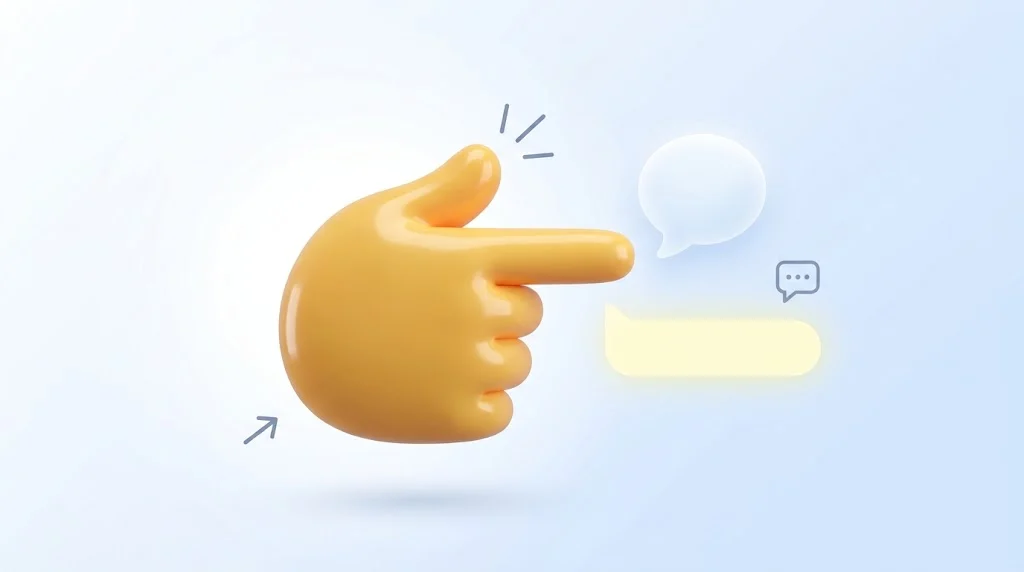
The point emoji 👉 usually represents pointing, directing attention, or indicating something to the right. Its official Unicode name is Backhand Index Pointing Right, and people commonly use it to point toward a word, person, link, image, punchline, or idea. In text messages, it can also add emphasis, making a statement feel more direct, playful, or attention grabbing.
Context can change the feeling of 👉. It may simply mean “look here,” “this one,” or “you mean this,” but combinations such as 👉👈 can create a shy or bashful expression. The emoji can also be used humorously, sarcastically, or dramatically. Its meaning depends on the surrounding words, the direction of the pointing finger, and the relationship between the people communicating.
Quick Answer
👉 usually means pointing to something on the right, directing attention, or saying “this,” “that,” or “look here.”
In playful texting, it can also emphasize a person, statement, link, punchline, or shy 👉👈 combination.
What Does the Point Emoji 👉 Mean?
The 👉 emoji is officially called Backhand Index Pointing Right. It shows an index finger pointing toward the right.
In everyday messages, people often use it as a visual pointer. Instead of writing a longer explanation, the emoji can direct the reader toward something nearby.
For example:
Check this out 👉
Here, 👉 tells the reader to look at what follows.
Another example:
This part 👉 is my favorite.
The finger points toward a specific idea or section.
The emoji can therefore have several closely related meanings:
- Look here
- This one
- That one
- Pay attention to this
- You
- Check this out
- I am pointing something out
- This is the important part
The exact meaning comes from the surrounding message.
👉 Meaning in Text Messages
In texting, 👉 is often used as a visual way to point something out.
Someone might write:
👉 Read the last sentence.
This is a direct instruction to look at something.
They might also write:
This is exactly what I meant 👉
Here, the emoji emphasizes the idea being discussed.
It can also work as a playful attention marker:
Guess who finally showed up 👉
In this example, the emoji helps create anticipation and directs attention toward the person being mentioned.
What Does 👉 Mean From Someone?
When someone sends 👉 to you, it does not have one guaranteed meaning.
Depending on the message, it could mean:
- “Look at this.”
- “I’m talking about you.”
- “This is the one.”
- “Pay attention.”
- “You know who you are.”
- “Check this out.”
- “This part is important.”
For example:
You really did that 👉
This could be playful teasing.
I’m talking to you 👉
This sounds more direct.
That’s the one 👉
This simply identifies or selects something.
The surrounding words are more useful than the emoji alone when figuring out the sender’s intention.
Is 👉 Flirty?
The 👉 emoji can appear in flirty conversations, but the emoji itself does not automatically mean flirting.
For example:
You look good today 👉
The sentence may feel playful or flirtatious because of the compliment and context. The pointing emoji mainly adds emphasis.
On the other hand:
You forgot your keys again 👉
This is more likely teasing or calling attention to something.
So, if someone sends 👉 in a romantic conversation, look at the complete message and previous conversation rather than assuming that the emoji proves attraction.
👉 Meaning in Relationships
In relationships or close friendships, 👉 can make a message feel more direct or playful.
For example:
You are the one who said it 👉
This can sound teasing.
That’s your favorite song 👉
This simply points out something associated with the other person.
Look who is smiling 👉
This can create a light, joking tone.
The emoji can also be used to call attention to something positive:
You did great on this 👉
Here, the finger directs attention toward the achievement.
When 👉 Feels Playful or Teasing
The point emoji often becomes more playful when paired with humorous wording.
For example:
Someone is feeling confident today 👉
The emoji can make the sentence feel like friendly teasing.
Another example:
We all know who this is about 👉😂
Here, the pointing gesture helps create a joking tone.
It can also be used to call someone out without necessarily being hostile:
You started this conversation 👉
Whether that sounds funny or confrontational depends on the relationship and the rest of the conversation.
👉👈 Meaning: Why Are These Pointing Emojis Used Together?
One of the most recognizable combinations involving 👉 is:
👉👈
When these pointing fingers are placed together, they can suggest shyness, bashfulness, nervousness, or timid behavior, especially when paired with 🥺.
For example:
Can I ask you something? 👉👈
This can make the message feel shy or hesitant.
Another common combination is:
🥺👉👈
This is often used online to create a bashful or pleading pose. Emojipedia documents the combination as a known use of the two pointing emojis.
The meaning here is very different from using 👉 by itself.
👉 alone: pointing or directing attention
👉👈: shy, bashful, hesitant, or playful
🥺👉👈: often adds a pleading or cute tone
Other Meanings of the Point Emoji
Although pointing is its basic function, 👉 can take on different roles in casual communication.
To Highlight a Person
That’s you 👉
The emoji visually identifies the person being discussed.
To Highlight a Choice
This one 👉
It can point toward a selected option.
To Emphasize a Statement
I told you 👉
The emoji adds extra emphasis.
To Direct Attention
Look at this 👉
It functions almost like a visual arrow.
To Add Humor
Not me doing it again 👉😂
The emoji can make the sentence feel more expressive.
Point Emoji Compared With Similar Pointing Emojis
| Emoji | Official Name | Common Meaning | Tone | Where or When It Is Used |
|---|---|---|---|---|
| 👉 | Backhand Index Pointing Right | Points right, highlights something, directs attention | Direct, playful, neutral | Texts, captions, comments, pointing to information |
| 👈 | Backhand Index Pointing Left | Points left or highlights something on the left | Direct, playful | Texts, visual references, 👉👈 combinations |
| 🫵 | Index Pointing at the Viewer | Points directly at “you” | Direct, teasing, attention grabbing | Calling someone out or emphasizing “you” |
| 👆 | Backhand Index Pointing Up | Points upward or highlights something above | Neutral, instructional | Directions, captions, menus, references |
| 👇 | Backhand Index Pointing Down | Points downward or highlights something below | Neutral, attention grabbing | Comments, captions, links, instructions |
| ☝️ | Index Pointing Up | Indicates one, an idea, or “one moment” | Emphatic, instructional | Advice, reminders, statements |
| 👇🏻 | Backhand Index Pointing Down: Light Skin Tone | Downward pointing gesture | Neutral, direct | Personalized pointing or visual directions |
| 👆🏻 | Backhand Index Pointing Up: Light Skin Tone | Upward pointing gesture | Neutral, direct | Pointing upward or highlighting something above |
The most important difference is direction and target. 👉 points right, 👈 points left, 👆 points upward, and 👇 points downward. 🫵 is different because it points directly toward the viewer and therefore commonly represents “you.” Unicode lists these as distinct pointing hand characters.
👉 vs. 🫵: What’s the Difference?
These two emojis are easy to confuse because both can involve pointing at someone.
👉 Backhand Index Pointing Right points toward the right side.
🫵 Index Pointing at the Viewer points directly toward the person viewing the emoji.
Compare:
Check this out 👉
The finger directs attention toward something.
I’m talking to you 🫵
The finger directly identifies the recipient.
Unicode gives 🫵 the official name Index Pointing at the Viewer. It was approved in Unicode 14.0 and added to Emoji 14.0 in 2021.
👉 vs. ☝️: What’s the Difference?
👉 is primarily directional.
☝️ points upward and can communicate ideas such as:
- One
- One moment
- Important point
- I have something to say
- Pay attention
For example:
This link 👉
The emoji points toward something.
But:
☝️ One thing first.
The emoji helps emphasize the idea of “one thing.”
👉 vs. 👇: What’s the Difference?
The main difference is direction.
👉 points right.
👇 points down.
For example:
More details below 👇
The downward pointing emoji naturally directs the reader toward information underneath.
By contrast:
Click this 👉
The right pointing emoji can direct attention toward something positioned to its right.
Realistic Text Examples
Pointing to a Link
“The details are here 👉”
Likely meaning: Directing attention to a link or information that follows.
Calling Someone Out Playfully
“You started this 👉😂”
Likely meaning: Friendly teasing or playful blame.
Choosing Something
“I want this one 👉”
Likely meaning: Selecting or identifying an option.
Emphasizing a Person
“That’s you 👉”
Likely meaning: Directly identifying the person being discussed.
Adding Drama
“And then this happened 👉”
Likely meaning: Building anticipation before revealing something.
Shy Combination
“Can I tell you something? 👉👈”
Likely meaning: A shy, hesitant, or bashful tone.
Common Misunderstandings About 👉
It Does Not Always Mean “You”
👉 can point toward a person, but its primary function is directional. If the goal is specifically to represent “you,” 🫵 is more directly suited to that meaning.
It Does Not Automatically Mean Flirting
A flirty message can contain 👉, but the emoji itself does not prove romantic interest.
It Is Not Automatically Rude
A pointing gesture can feel direct in some messages, but the surrounding words and relationship determine whether it feels playful, neutral, or confrontational.
👉 and 👈 Are Not the Same
Their direction is reversed. 👉 points right, while 👈 points left.
👉👈 Has a Different Meaning
When the two pointing fingers face each other, they can create a shy or bashful expression that is different from either emoji used alone.
How to Respond to 👉
Your response should depend on what the person is pointing toward.
If They Pointed Something Out
“Oh, I see it 😂”
If They Are Teasing You
“Okay, okay, I admit it.”
If They Pointed at You
“Me? 😂”
If They Are Being Direct
“Got it.”
If They Used 👉👈
A playful response can match the shy tone:
“What are you trying to ask? 👀”
The emoji does not require a special response. The surrounding message should guide your reply.
Copy and Paste the Point Emoji
👉
You can copy and paste it into texts, captions, comments, messages, and social posts.
Common combinations include:
- 👉👈
- 👉😂
- 👉👀
- 👉💯
- 👉❤️
- 👉✨
- 👉🫵
- 👈👉
Official Name and Technical Details
The official Unicode name for 👉 is BACKHAND INDEX POINTING RIGHT.
- Emoji: 👉
- Unicode code point: U+1F449
- Official Unicode name: BACKHAND INDEX POINTING RIGHT
- Unicode approval: Unicode 6.0
- Emoji addition: Emoji 1.0
- Basic category: People and Body
- Gesture: Index finger pointing right
Unicode’s current emoji list identifies U+1F449 as backhand index pointing right and includes “point” and “pointing” among its related keywords.
Emojipedia notes that the character was approved as part of Unicode 6.0 in 2010 under the earlier name White Right Pointing Backhand Index, and it was added to Emoji 1.0 in 2015.
Different platforms can give the emoji slightly different artwork while keeping the same underlying Unicode character.
Frequently Asked Questions
What does the point emoji 👉 mean?
👉 usually means pointing right, directing attention, highlighting something, or identifying something or someone.
What is the official name of 👉?
Its official Unicode name is Backhand Index Pointing Right.
Does 👉 mean “you”?
It can be used to point at someone and can therefore suggest “you,” but 🫵 is the emoji specifically designed to point at the viewer.
What does 👉👈 mean?
👉👈 commonly creates a shy, bashful, hesitant, or timid gesture, especially in playful online conversations.
Is 👉 a flirty emoji?
It can appear in flirtatious messages, but 👉 does not inherently mean flirting. The surrounding message provides the stronger context.
What is the difference between 👉 and 🫵?
👉 points to the right, while 🫵 points directly toward the viewer. 🫵 therefore more directly represents “you.”
What is the difference between 👉 and 👈?
👉 points right, while 👈 points left.
Can 👉 be sarcastic?
Yes. A sarcastic sentence can use 👉 to emphasize a person, statement, or punchline. The sarcasm comes from the wording and context rather than the emoji alone.
Is 👉 rude?
Not automatically. It can be neutral, playful, teasing, or direct depending on how it is used.
Conclusion
The point emoji 👉 is mainly used to point toward something, direct attention, highlight an idea, or identify a person or choice. Its official name is Backhand Index Pointing Right, and its basic meaning is closely tied to its direction.
Context can make the emoji feel neutral, playful, teasing, dramatic, or more direct. The meaning also changes when it is combined with other emojis. In particular, 👉👈 can create a shy or bashful expression, while 🫵 is better suited when the intended meaning is specifically “you.”
Discover More Post:
- Devious Emoji Meaning | The Mischievous Side of You Need …
- Muscle Emoji Meaning | Strength, Confidence & Power in 2026