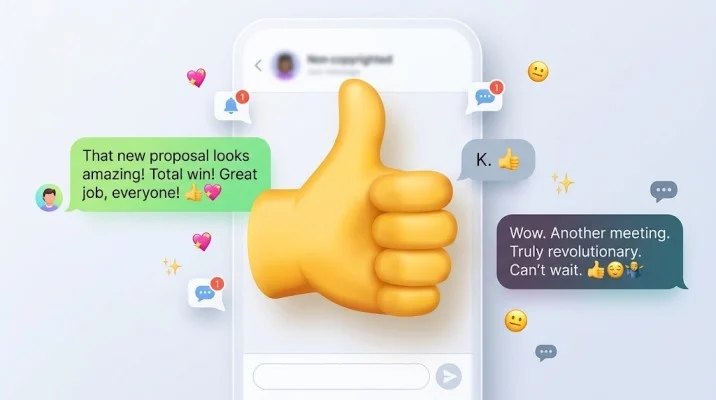
The thumbs up emoji 👍 usually means approval, agreement, acknowledgment, or “okay,” but its meaning can change dramatically when it appears in a meme. A simple 👍 can look supportive in one message and hilariously dry, awkward, dismissive, or sarcastic in another. That contrast is what makes the thumbs up emoji such a useful part of meme culture. Unicode lists 👍 as thumbs up, with the code point U+1F44D, while everyday users often give it extra meaning through context and humor.
In a thumbs up emoji meme, the humor often comes from using an ordinary positive reaction in an unexpected situation. “Sure 👍” might genuinely mean yes, while “Everything is completely fine 👍” could jokingly suggest the opposite. The surrounding words, relationship between the people, and tone of the conversation determine how the emoji should be read.
Quick Answer:
A thumbs up emoji meme 👍 usually turns a simple sign of approval into a humorous, awkward, exaggerated, or sarcastic reaction.
The emoji officially means thumbs up, but meme context can make it communicate anything from “okay” and “sounds good” to “I have no idea what to say” or “this situation is definitely not okay.”
What Does the 👍 Emoji Mean?
The 👍 emoji represents a thumbs-up gesture and commonly communicates:
- Approval
- Agreement
- Acceptance
- Encouragement
- Confirmation
- “Okay”
- “Good”
- “Yes”
- Acknowledgment
Unicode’s current emoji charts list the character as thumbs up at U+1F44D. Its related keywords include “+1,” “good,” “hand,” “like,” “thumb,” and “yes.”
Emojipedia describes the thumbs up as a gesture indicating approval while also noting that it can sometimes be interpreted as passive-aggressive or sarcastic depending on context. It was approved in Unicode 6.0 in 2010 under the name Thumbs Up Sign and added to Emoji 1.0 in 2015.
That difference between the basic meaning and contextual meaning is especially important for memes.
Why Is the Thumbs Up Emoji Funny in Memes?
The 👍 emoji is funny in memes because it is extremely simple.
A person can write:
“Okay 👍”
and the message may sound perfectly normal.
But place the same emoji after:
“I accidentally deleted the entire project 👍”
and the reaction becomes intentionally absurd.
The humor comes from the mismatch between the seriousness of the situation and the calmness of the thumbs-up gesture.
A meme may use 👍 to create a feeling of:
- Awkward acceptance
- Fake confidence
- Dry humor
- Deadpan comedy
- Sarcasm
- Emotional detachment
- “What else can I say?”
- Pretending everything is fine
The emoji itself has not officially changed meaning. The meme simply gives the ordinary gesture a new conversational role.
Thumbs Up Emoji Meme Meaning in Text
In meme-style conversations, 👍 can act almost like a short sentence.
For example:
“I have no idea what I’m doing 👍”
This may humorously mean:
“I have no idea what I’m doing, but I’m pretending everything is under control.”
Another example:
“Sounds good 👍”
Normally, this is straightforward agreement.
But in a meme about an obviously terrible plan, the same phrase can become sarcastic.
The important clue is the relationship between the words and the situation.
When 👍 Means “Okay”
One of the most common uses is simply:
“Okay 👍”
This can mean:
- Got it
- Sure
- Sounds good
- I agree
- I’ll do that
- Understood
There is nothing inherently sarcastic about it.
For example:
“Can you send me the file tonight?”
“Sure 👍”
That is a normal acknowledgment.
A meme may exaggerate this ordinary use by putting 👍 after increasingly ridiculous statements, turning a basic confirmation into the joke itself.
When 👍 Feels Sarcastic
The thumbs up emoji can feel sarcastic when the message sounds positive but the situation clearly is not.
For example:
“My flight got canceled again 👍”
The emoji can suggest:
“Great. Exactly what I needed.”
Another example:
“Love paying $50 for parking 👍”
Here, the thumbs up may communicate the opposite of genuine approval.
This is why the thumbs up emoji should not always be read literally. Context can make a positive-looking gesture sound negative or ironic. Emojipedia specifically notes that 👍 can sometimes be perceived as passive-aggressive or sarcastic.
Is the Thumbs Up Emoji Passive-Aggressive?
It can be, but it is not automatically passive-aggressive.
Consider:
“Thanks for helping me 👍”
This could be sincere.
Now compare:
“Thanks for ignoring my messages all day 👍”
The second example has a very different tone.
The emoji may make the statement feel deliberately dry or pointed.
A single 👍 is not enough to prove someone’s attitude. The surrounding words and previous conversation matter much more.
What Does 👍 Mean in a Meme?
In memes, 👍 can represent an exaggerated version of everyday approval.
Common meme interpretations include:
“Everything is fine.”
“Everything is completely under control 👍”
The joke is that everything obviously is not under control.
“Sure, why not?”
“Let’s make the worst possible decision 👍”
This creates an intentionally careless or ironic tone.
“I accept my fate.”
“Another meeting at 7 AM tomorrow 👍”
Here, the thumbs up can humorously represent resignation.
“I don’t know what to say.”
“That was certainly a decision 👍”
The emoji gives the sentence a dry, understated reaction.
“I’m pretending this is okay.”
“The deadline moved to tomorrow 👍”
The emoji can turn frustration into a deadpan joke.
👍 as a Dry Reaction
A dry reaction is one of the most recognizable meme uses of 👍.
Instead of responding with a long emotional message, someone simply sends:
👍
That tiny response can feel funny because it provides almost no emotional detail.
Depending on the conversation, it might mean:
- “Okay.”
- “Noted.”
- “Sure.”
- “I understand.”
- “Fine.”
- “What do you want me to say?”
- “I’m done arguing.”
The shorter the response, the more room there is for the reader to interpret the tone.
Can 👍 Be Rude?
Yes, it can feel rude in some situations, but the emoji itself is not inherently rude.
For example, if someone writes:
“I spent hours explaining this to you.”
and receives only:
👍
they might interpret the response as dismissive.
But in another conversation:
“I’ll meet you at 7.”
“👍”
the same emoji is simply efficient acknowledgment.
This is a good example of why emoji interpretation depends on conversational context rather than a universal dictionary definition.
👍 Meme vs. Normal 👍 Emoji
The same character can have very different effects.
| Use | Example | Likely Tone |
|---|---|---|
| Normal approval | “Great idea 👍” | Positive |
| Confirmation | “I’ll be there at 8 👍” | Neutral |
| Encouragement | “You got this 👍” | Supportive |
| Dry reaction | “Okay 👍” | Neutral or detached |
| Sarcasm | “Another meeting tomorrow 👍” | Ironic |
| Meme reaction | “Everything is fine 👍” | Comedic |
| Awkward response | “Sure 👍” | Potentially uncomfortable |
| Passive-aggressive use | “Thanks for telling me 👍” | Potentially pointed |
The emoji has not changed. The surrounding context changes how the reader experiences it.
Related Emojis and Their Meanings
| Emoji | Official Name | Common Meaning | Tone | Where or When It Is Used |
|---|---|---|---|---|
| 👍 | Thumbs Up | Approval, agreement, acknowledgment | Positive, neutral, sometimes dry | Confirmations, reactions, memes, casual texts |
| 👎 | Thumbs Down | Disapproval or rejection | Negative, direct | Disagreeing, rating something poorly, rejecting an idea |
| 👌 | OK Hand | “Okay,” approval, or reassurance | Casual, confident | Agreement, confirmation, quick reactions |
| 🙌 | Raising Hands | Celebration, excitement, praise | Energetic, positive | Good news, achievements, congratulations |
| 👏 | Clapping Hands | Applause, praise, approval | Supportive, celebratory | Compliments, achievements, reactions |
| 🤝 | Handshake | Agreement, cooperation, mutual understanding | Friendly, respectful | Deals, teamwork, agreements |
| ✊ | Raised Fist | Strength, determination, solidarity | Strong, supportive | Encouragement, resilience, solidarity |
| 💯 | Hundred Points | Complete agreement, excellence, emphasis | Enthusiastic, approving | Praise, agreement, “exactly” reactions |
The closest alternatives to 👍 are 👎, 👌, 👏, and 💯, but each adds a different emotional layer. 👎 reverses the basic approval, 👌 can feel more casual, 👏 emphasizes praise, and 💯 often intensifies agreement or approval.
For meme use, 👍 is particularly effective when the humor depends on understatement. A 💯 reaction usually feels more enthusiastic, while 👍 can intentionally feel calm, dry, or almost too casual for the situation.
👍 vs. 👌: What’s the Difference?
- 👍 and 👌 can both communicate approval, but they do not always sound identical.
- 👍 is often a straightforward “yes,” “good,” or “okay.”
- 👌 can communicate “okay,” “perfect,” “all good,” or satisfaction with something.
Compare:
“See you at 6 👍”
This feels like simple confirmation.
“See you at 6 👌”
This can feel slightly more casual or confident.
In memes, either can become sarcastic, but 👍 is especially useful for deadpan reactions because it looks like such a simple acknowledgment.
👍 vs. 👎: The Opposite Reactions
This is the easiest comparison.
👍 generally communicates approval.
👎 generally communicates disapproval.
For example:
“Should we order pizza? 👍”
means yes.
“Should we order pizza? 👎”
means no or disapproval.
In memes, placing 👍 next to an obviously bad situation can create irony, while 👎 usually makes the negative reaction more direct.
👍 vs. 😂: Approval or Laughter?
These emojis serve different basic purposes.
👍 communicates approval or acknowledgment.
😂 Face with Tears of Joy communicates strong laughter.
A meme may use both:
“I can’t believe you actually did that 😂👍”
Here, 😂 shows amusement while 👍 can suggest approval or playful acknowledgment.
Using only 👍 makes the reaction much drier, which may be exactly what makes the meme funny.
👍 Meme Examples
Example 1: Fake confidence
“I definitely know how to fix this 👍”
Likely meaning: The person probably does not know how to fix it and is joking about pretending to be confident.
Example 2: Resignation
“The meeting starts at 6 AM tomorrow 👍”
Likely meaning: A humorous “well, I guess that’s happening” reaction.
Example 3: Sarcastic approval
“My internet stopped working during the presentation 👍”
Likely meaning: The thumbs up is probably ironic rather than genuine approval.
Example 4: Simple acknowledgment
“Don’t forget to bring your ID.”
“👍”
Likely meaning: “Got it.”
Example 5: Dry meme humor
“Everything is going exactly according to plan 👍”
Likely meaning: The situation is probably going badly, and the emoji makes the statement intentionally deadpan.
Why One 👍 Can Change the Whole Message
Emoji placement can change the emotional reading of a sentence.
Compare:
“Great job.”
with:
“Great job 👍”
The second message can feel warmer or more casual.
But:
“Great job 👍”
after someone makes an obvious mistake may sound sarcastic.
This is why the thumbs up emoji is so effective in memes. It creates a small visual contrast between the words and the intended tone.
Is 👍 a Meme Emoji?
👍 is not officially classified as a “meme emoji.”
It is an ordinary hand emoji with an established meaning of approval or a positive gesture. Unicode does not assign a separate meme definition to it.
However, people can use any emoji in memes. In the case of 👍, its simple appearance and broad meaning make it easy to repurpose for irony, dry humor, awkward reactions, and exaggerated agreement.
So “thumbs up emoji meme” describes a style of use, not a separate Unicode emoji.
Does 👍 Mean “I Don’t Care”?
Sometimes it can give that impression, but this is not its standard meaning.
For example:
“Okay 👍”
could simply mean “Okay.”
But if someone gives a very short 👍 response after a long emotional message, the receiver might perceive it as:
- Dismissive
- Uninterested
- Emotionally distant
- Passive-aggressive
That interpretation comes from the context, not from an official meaning of the emoji.
How to Respond to a Thumbs Up Meme
Your response depends on what the sender appears to mean.
- If it is clearly a joke
“That 👍 says everything.”
- If they are being sarcastic
“Okay, I see the sarcasm 😂”
- If they simply acknowledged your message
“Perfect!”
- If you are unsure
“Was that a serious 👍 or a sarcastic one?”
If you want to match the meme energy
“👍”
Sometimes replying with the same emoji is the joke.
Copy and Paste Thumbs Up Emojis
Here are a few versions you can copy:
👍
👍🏻
👍🏼
👍🏽
👍🏾
👍🏿
Unicode supports skin-tone modifier sequences for the thumbs up emoji, including light, medium-light, medium, medium-dark, and dark skin tones.
The base emoji is 👍, while the modified versions combine the thumbs-up character with a skin-tone modifier.
Official Name and Technical Details
The current Unicode short name for 👍 is thumbs up, and its Unicode code point is U+1F44D. Unicode’s emoji data also lists related keywords such as “+1,” “good,” “like,” “yes,” and “thumb.”
The emoji was approved as part of Unicode 6.0 in 2010 and later included in Emoji 1.0 in 2015. Emojipedia identifies its earlier official Unicode name as Thumbs Up Sign.
Different platforms can draw the emoji with slightly different visual details, but the basic thumbs-up gesture remains recognizable.
Frequently Asked Questions
What does the thumbs up emoji meme mean?
It usually turns the ordinary 👍 gesture into a humorous or ironic reaction. Depending on context, it can suggest approval, awkward acceptance, sarcasm, resignation, or “everything is fine” humor.
Is the 👍 emoji sarcastic?
It can be sarcastic, but it is not always sarcastic. A message such as “See you tomorrow 👍” is usually straightforward, while “Another bill to pay 👍” may be ironic.
Why is 👍 used in memes?
Its simple meaning makes it easy to place against an unexpected situation. The contrast between a calm positive gesture and a ridiculous or frustrating statement can create dry humor.
Does 👍 mean okay?
Yes. “Okay,” “sure,” “got it,” and “sounds good” are common interpretations of 👍 in casual conversation.
Can 👍 be passive-aggressive?
It can be interpreted that way in some contexts, particularly when the response is extremely short or follows a frustrating conversation. The emoji itself does not guarantee passive-aggressive intent.
Is the thumbs up emoji rude?
Not inherently. It can be perfectly friendly and practical, although a one-word or one-emoji response may feel dismissive in certain conversations.
What is the official name of 👍?
Unicode’s current short name is thumbs up, while it was previously referred to as Thumbs Up Sign. Its code point is U+1F44D.
Does 👍 mean “I agree”?
Usually, yes. It can communicate agreement or acknowledgment, although the exact tone depends on the message around it.
What is the difference between 👍 and 👎?
👍 generally expresses approval or agreement, while 👎 generally expresses disapproval or rejection.
Final Takeaway
The thumbs up emoji meme 👍 works because a very ordinary gesture can become surprisingly expressive when placed in the right context. Its official meaning is approval or a positive thumbs-up gesture, but meme culture can turn it into dry humor, sarcasm, awkward acceptance, fake confidence, or a joking “everything is fine.”
When you see 👍 in a meme or text, do not assume it is automatically sincere or sarcastic. Read the words around it and consider the situation. Sometimes 👍 really means “good job.” Other times, the entire joke is that the person is giving a cheerful thumbs up while everything is clearly falling apart.
Read More Related Articles:
- Thank You Emoji Meaning | Best Emojis to Say Thanks
- Happy Face Emoji Meaning | What Does Mean in Texts in 2026
- Heart Emoji Meanings ❤️ | What Do the Different Hearts …