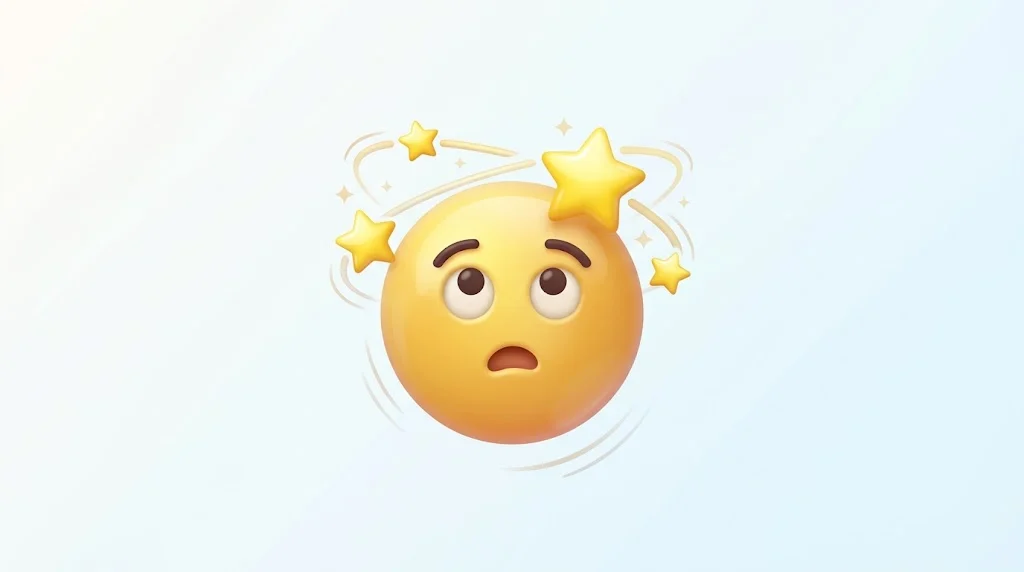
The dizzy emoji 💫 can turn a message into a signal of confusion, shock, excitement, or feeling overwhelmed. But what does it really mean when someone sends it? Its meaning depends on the words, tone, and situation around it. Understanding these details helps you read conversations more accurately, especially when emojis replace facial expressions and body language.
In this guide, we explain the dizzy emoji meaning with practical examples and context. You’ll learn how 💫 is used in texting and social media, when it can suggest being stunned or overwhelmed, and how its meaning changes. Whether you’re interpreting a message from a friend, reading a romantic text, or choosing an emoji, this guide helps you understand and use it confidently.
Quick Answer
💫 usually means dizziness, disorientation, spinning, or feeling overwhelmed.
In texts, it can also add emphasis, excitement, surprise, or a dramatic “my head is spinning” feeling.
What Does the Dizzy Emoji 💫 Mean?
The official Unicode name for 💫 is DIZZY, while Unicode’s character documentation identifies it as DIZZY SYMBOL and describes the symbol as circling stars or “squeans.” Its visual idea comes from comic-style imagery used to show that someone is dizzy or disoriented.
In a text conversation, 💫 can communicate several closely related ideas:
- Feeling dizzy or disoriented
- Feeling overwhelmed
- Being confused
- Feeling stunned or amazed
- Having a spinning or chaotic experience
- Adding dramatic emphasis
- Making a message feel energetic or visually expressive
The emoji itself does not guarantee one specific emotion. Context determines whether it feels serious, playful, dramatic, or simply decorative.
💫 Meaning in Text Messages
When someone uses 💫 in a text, it can have different meanings depending on what they are saying.
“My head is spinning”
“I have so much work to finish 💫”
Here, 💫 can suggest mental overload or feeling overwhelmed.
Feeling physically dizzy
“I stood up too fast and now I feel 💫”
In this context, the emoji is being used more literally to represent dizziness.
Feeling stunned
“That plot twist left me 💫”
The sender may be saying that they were so surprised or shocked that they feel mentally disoriented.
Adding dramatic flair
“Me trying to understand the instructions 💫”
The emoji makes the situation feel more humorous and exaggerated.
Emotional Tone of 💫
The dizzy emoji does not have a fixed positive or negative emotional tone.
Its tone can change significantly based on context.
Confused or overwhelmed
“Three meetings, five emails, and two deadlines today 💫”
The emoji suggests that everything feels like too much.
Playful
“I opened the menu and immediately forgot what I wanted 💫”
Here, it creates a humorous sense of confusion.
Amazed or stunned
“You actually finished the whole project in one day 💫”
The emoji can emphasize being impressed or surprised.
Physically dizzy
“I got off the roller coaster and still feel 💫”
This is a more literal use.
Dramatic
“That ending 💫”
The emoji can make a short reaction feel more expressive without specifying exactly what emotion the sender feels.
Does 💫 Mean Confused?
It can suggest confusion, especially when someone feels mentally overwhelmed or unable to process something.
For example:
“Wait, what happened? 💫”
The emoji adds a sense of being mentally thrown off.
However, confusion is not the only meaning. 💫 is more directly associated with dizziness and disorientation, while emojis such as 😵💫 can communicate a facial expression of confusion or mental overload more clearly.
Does 💫 Mean Shock or Surprise?
It can.
Someone may use 💫 after something unexpected happens:
“You got tickets for tonight? 💫”
Here, the emoji may express amazement rather than literal dizziness.
This is a good example of why emoji meaning should be interpreted from the whole message. The same 💫 can suggest physical dizziness in one sentence and exaggerated surprise in another.
Is 💫 a Flirty Emoji?
Not usually. 💫 is not specifically a romantic or flirting emoji.
It may appear in a flirtatious conversation, but the emoji itself does not prove attraction or romantic interest.
For example:
“You looked amazing tonight 💫”
The message may sound affectionate because of the wording, while 💫 simply adds emphasis.
On the other hand:
“I have no idea what just happened 💫”
is clearly not a romantic message.
If someone sends 💫 during a romantic conversation, consider the surrounding words, conversation history, and their normal communication style instead of assigning a romantic meaning to the emoji alone.
What Does 💫 Mean From Someone?
If someone sends you 💫, their intended meaning depends heavily on the message.
It may mean:
- “I’m dizzy.”
- “I’m overwhelmed.”
- “My brain is spinning.”
- “That was confusing.”
- “I’m stunned.”
- “That was intense.”
- “I’m amazed.”
- “This is chaotic.”
- “I’m being dramatic about this.”
For example:
“I just read the instructions twice and still don’t understand 💫”
This likely means they are confused or overwhelmed.
“You remembered my birthday 💫”
This may communicate pleasant surprise or appreciation.
“That was the wildest meeting ever 💫”
Here, the emoji adds dramatic emphasis to the experience.
💫 Meaning in Relationships
In relationship conversations, 💫 does not have a special universal romantic meaning.
Its interpretation depends on what the couple or friends are discussing.
For example:
“That conversation was a lot 💫”
This may suggest emotional or mental overwhelm.
“You really surprised me tonight 💫”
This can suggest pleasant surprise.
“I don’t know what to say 💫”
This may indicate that the sender feels stunned or overwhelmed.
The emoji should not be treated as proof of love, attraction, disappointment, or rejection.
Related Emojis and Their Meanings
| Emoji | Official Name | Common Meaning | Tone | Where or When It Is Used |
|---|---|---|---|---|
| 💫 | Dizzy | Dizziness, spinning, disorientation, emphasis | Playful to dramatic | Confusion, overwhelm, surprise, dizzy feelings |
| 😵 | Face with Crossed-Out Eyes | Shock, disorientation, extreme reaction, sometimes sickness | Intense | Strong reactions, disbelief, feeling knocked out |
| 😵💫 | Face with Spiral Eyes | Confusion, dizziness, mental overload, being overwhelmed | Dramatic | When someone’s thoughts feel scrambled |
| 🥴 | Woozy Face | Feeling woozy, awkward, intoxicated, or uncomfortable | Uneasy to playful | Strange situations, awkward moments, feeling off |
| 🤯 | Exploding Head | Extreme shock, amazement, or mind blown | Very intense | Unexpected facts, shocking news, impressive discoveries |
| 🌀 | Cyclone | Spinning, swirling, chaos, or a literal cyclone | Neutral to dramatic | Chaotic situations or visual references to spinning |
| ✨ | Sparkles | Shine, excitement, emphasis, positivity | Bright, playful | Celebrations, compliments, emphasis, decorative messages |
| 🌟 | Glowing Star | Something special, excellent, or shining | Positive | Praise, achievements, special moments |
| ⭐ | Star | Star, rating, excellence, or something notable | Neutral to positive | Ratings, praise, favorites, general emphasis |
The most important distinction is between 💫, 😵, and 😵💫. 💫 is a symbol rather than a face and focuses on the idea of spinning or dizziness. 😵 shows a strong facial reaction, while 😵💫 specifically uses spiral eyes to communicate a more obvious dizzy or confused expression. Unicode currently lists 😵 as Face with Crossed-Out Eyes and 😵💫 as Face with Spiral Eyes.
✨ Sparkles and 🌟 Glowing Star are easier to confuse visually with 💫, but their usual meanings are different. 💫 has a stronger connection to spinning, dizziness, or disorientation, while the star emojis are more often associated with brightness, praise, excitement, or decoration.
💫 vs. 😵: What’s the Difference?
The biggest difference is that 💫 is a symbol, while 😵 is a face.
💫 can represent:
“My head is spinning.”
😵 can represent:
“I’m completely stunned.”
The two can overlap when someone wants to communicate extreme disorientation, but 😵 usually creates a stronger facial reaction.
Emojipedia notes that 😵 can also be used for shock, surprise, disbelief, amazement, sickness, nausea, intoxication, and other heightened reactions.
💫 vs. 😵💫: What’s the Difference?
These two are especially easy to confuse.
💫 Dizzy uses swirling stars as the main visual idea.
😵💫 Face with Spiral Eyes shows a face with spiral eyes and can communicate confusion, dizziness, being hypnotized, or feeling mentally overwhelmed. Unicode’s current annotations include terms such as “confused,” “dizzy,” “hypnotized,” and “woozy” for 😵💫.
A simple way to remember the difference:
- 💫 = spinning or dizzy feeling as a symbol
- 😵💫 = a person’s face showing a dizzy or confused reaction
💫 vs. ✨: What’s the Difference?
Both emojis contain star-like shapes, but they communicate different ideas.
💫 is associated with dizziness, spinning, and disorientation.
✨ usually adds sparkle, shine, excitement, or positive emphasis.
Compare:
“I have no idea what’s happening 💫”
This suggests confusion.
“You look amazing ✨”
This adds positive emphasis.
Using ✨ instead of 💫 can therefore change the emotional direction of the message.
Can 💫 Mean “Mind Blown”?
Yes, informally it can.
If something is extremely surprising, someone may use 💫 to suggest that their mind is spinning.
For example:
“Wait, that’s how it works? 💫”
The intended feeling is closer to “Wow, my brain is spinning” than literal physical dizziness.
For a stronger “mind blown” meaning, 🤯 Exploding Head is usually more direct.
Can 💫 Mean Drunk?
It can sometimes appear in messages about feeling dizzy or disoriented after drinking, but 💫 does not specifically mean drunk.
For example:
“Two drinks later and I’m already 💫”
The surrounding text creates the drinking context.
Without that context, 💫 could simply mean dizziness, confusion, surprise, or dramatic emphasis.
Text Message Examples
1. Feeling overwhelmed
Message:
“Finals week is destroying me 💫”
Likely meaning:
The sender feels overwhelmed and mentally exhausted.
2. Literal dizziness
Message:
“I got up too quickly and everything went 💫”
Likely meaning:
The emoji represents a dizzy or spinning sensation.
3. Surprise
Message:
“You finished it already? 💫”
Likely meaning:
The sender is surprised or impressed.
4. Confusion
Message:
“I read that email three times 💫”
Likely meaning:
The sender still feels confused or overwhelmed.
5. Playful exaggeration
Message:
“I looked at the restaurant menu and immediately forgot how to choose 💫”
Likely meaning:
The sender is joking about feeling overwhelmed by too many choices.
6. Dramatic reaction
Message:
“That plot twist 💫”
Likely meaning:
The sender is emphasizing how shocking or overwhelming the plot twist felt.
Common Misunderstandings About 💫
It does not always mean physical dizziness
Although dizziness is the emoji’s core concept, people can use it figuratively for confusion, surprise, overload, or dramatic emphasis.
It does not automatically mean sickness
If someone uses 💫 after mentioning feeling ill, it may relate to sickness or dizziness. On its own, it does not establish that the person is sick.
It does not automatically mean being drunk
A drinking-related meaning requires surrounding context.
It is not the same as 😵💫
💫 represents the dizzy symbol, while 😵💫 is a face with spiral eyes. Their meanings can overlap, but their visual concepts are different.
It is not the same as ✨
✨ generally adds sparkle or positive emphasis, while 💫 has a stronger connection to spinning and dizziness.
It does not prove an emotional state
An emoji is only one part of a message. The surrounding words and conversation context can change its meaning.
How to Respond to 💫
There is no special response required for 💫. Match your reply to the message.
- If they say they are dizzy
“Are you okay?”
- If they are confused
“Yeah, that was confusing. Let me explain.”
- If they are overwhelmed
“Take it one thing at a time.”
- If they are joking
“😂 I know exactly what you mean.”
- If they are surprised
“Haha, I knew that would surprise you!”
- If you’re unsure what the sender means, responding to their actual words is safer than trying to decode the emoji by itself.
Copy and Paste the Dizzy Emoji
💫
You can copy and paste 💫 into texts, captions, comments, messages, and social posts.
Some useful combinations include:
- 💫😵💫 = dizzy or mentally overwhelmed
- 💫🤯 = extremely surprised or mind blown
- 💫✨ = dramatic or energetic emphasis
- 💫🌀 = spinning or chaotic feeling
- 💫😵 = strong disorientation or shock
- 💫😂 = playful exaggeration
Official Name and Technical Details
The official Unicode name associated with 💫 is DIZZY. Unicode’s character names documentation identifies the underlying character as DIZZY SYMBOL, with the descriptive meaning “circling stars” and “squeans.”
- Emoji: 💫
- Unicode code point: U+1F4AB
- Official Unicode name: DIZZY
- Character name: DIZZY SYMBOL
- Unicode version: 6.0
- Emoji version: 1.0
Emojipedia reports that 💫 was approved as part of Unicode 6.0 in 2010 under the name “Dizzy Symbol” and added to Emoji 1.0 in 2015.
The artwork can differ across platforms. For example, vendor designs may use different numbers, shapes, or colors for the circling stars while retaining the same underlying Unicode character.
Frequently Asked Questions
What does 💫 mean?
💫 usually represents dizziness, spinning, disorientation, or feeling overwhelmed. It can also be used for surprise, amazement, confusion, or dramatic emphasis.
What is the official name of 💫?
The current Unicode short name is Dizzy, while the Unicode character name is DIZZY SYMBOL.
Is 💫 the dizzy emoji?
Yes. 💫 is commonly called the dizzy emoji and is officially associated with the dizzy symbol.
Does 💫 mean confusion?
It can. In texting, people may use it when something feels confusing or mentally overwhelming, although confusion is not its only meaning.
What does 💫 mean from a girl or guy?
The sender’s gender does not determine the meaning. 💫 is usually interpreted from the surrounding words, situation, and communication style.
Is 💫 a flirting emoji?
Not specifically. It can appear in a flirtatious message, but 💫 alone does not establish romantic interest.
Does 💫 mean “mind blown”?
It can be used that way informally when something leaves someone stunned or mentally overwhelmed. 🤯 is a more direct choice for a strong “mind blown” reaction.
What is the difference between 💫 and 😵💫?
💫 is a dizzy symbol made from circling stars, while 😵💫 is a face with spiral eyes. Both can communicate dizziness or confusion, but 😵💫 gives the reaction a more obvious facial expression.
What is the difference between 💫 and ✨?
💫 is more closely associated with dizziness, spinning, and disorientation. ✨ usually suggests sparkle, shine, excitement, or positive emphasis.
Conclusion
The dizzy emoji 💫 is mainly associated with dizziness, spinning, disorientation, and feeling overwhelmed, but its meaning can expand in casual texting. It may also express surprise, confusion, amazement, or playful dramatic emphasis.
The easiest way to understand 💫 is to look at the complete message. If the sender mentions feeling dizzy, the meaning may be literal. If they describe a confusing situation, surprising news, or an overwhelming experience, 💫 may simply show that their “head is spinning.”
Discover More Post:
- Nails Emoji Meaning Explained | Confidence, Sass & Style in …
- Butthole Emoji Meaning, Uses & Context | The Real Story …
- Worried Emoji Meaning | What It Really Says About Anxiety …









1 thought on “Dizzy Emoji Meaning | What It Really Says in Texts, Chats & Beyond 2026”