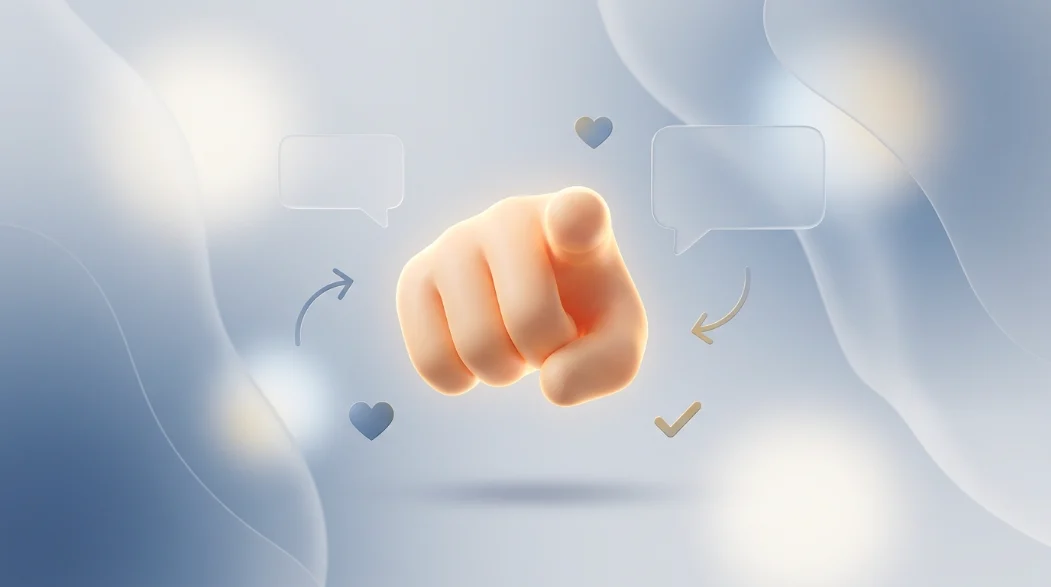
The pointing emoji 🫵 usually means “you,” “you specifically,” or “I’m pointing at you.” Its official Unicode name is Index Pointing at the Viewer, and the hand points directly toward the person viewing the emoji. In everyday texts, it can be used to call attention to someone, emphasize a statement, identify a person, or create a playful “you” reaction.
The tone of 🫵 depends heavily on the message around it. It can feel friendly, funny, teasing, direct, or slightly confrontational. For example, “That’s you 🫵” may be playful, while “I’m talking to you 🫵” can sound more serious. The emoji itself does not guarantee anger, flirting, or criticism, so the surrounding words and relationship matter.
Quick Answer
🫵 usually means “you,” “that’s you,” or “I’m pointing directly at you.”
It can feel playful, teasing, direct, or attention-grabbing depending on the message and context.
What Does the Pointing Emoji 🫵 Mean?
The 🫵 emoji is officially called Index Pointing at the Viewer. Unlike 👉, which points to the right, 🫵 points directly toward the person looking at the emoji. Emojipedia describes it as representing the concept of “you” or the second-person pronoun.
In ordinary messaging, this makes 🫵 especially useful when someone wants to single out another person.
For example:
“You did this 🫵😂”
The emoji visually reinforces the word “you.”
Another example:
“I’m looking at you 🫵”
Here, the pointing gesture adds emphasis and can make the message sound teasing or playful.
The emoji can therefore work like a visual substitute for pointing at someone during a face-to-face conversation.
🫵 Meaning in Text Messages
In texting, the pointing emoji can communicate several closely related ideas:
- You
- That person is you
- I mean you specifically
- Pay attention
- You are the one I’m talking about
- I’m calling you out
- That’s exactly you
- This applies to you
Its meaning can shift depending on whether the message is serious or humorous.
For example:
“Who keeps stealing the snacks? 🫵”
This can sound like playful blame.
But:
“I need you to listen 🫵”
sounds more direct and serious.
The emoji does not create the entire tone by itself. It mainly adds a strong visual emphasis to the idea of you.
The Emotional Tone of 🫵
The pointing emoji has no fixed emotional expression. Its tone comes from the words, punctuation, and situation around it.
Playful
“You are the problem 😂🫵”
The laughing emoji makes the pointing feel more like teasing.
Teasing
“Look who finally showed up 🫵”
The gesture can make the statement feel jokingly directed at someone.
Direct
“I need you to answer this 🫵”
Here, the emoji makes the message more pointed and attention-grabbing.
Supportive
“You can do this 🫵💪”
The pointing gesture can direct encouragement toward the recipient.
Confrontational
“You knew exactly what you were doing 🫵”
In this context, the emoji can make the message feel accusatory.
The same emoji can therefore feel very different in different conversations.
Does 🫵 Mean “You”?
Yes. “You” is one of the clearest contextual uses of 🫵.
Because the finger points toward the viewer, the emoji can visually represent the person receiving the message.
Examples include:
“This one’s for you 🫵”
“That’s you right there 🫵😂”
“You already know 🫵”
In each example, the emoji directs attention toward the recipient.
This is different from saying that 🫵 always literally translates to the word “you.” Emoji meanings are flexible, and people can use the same symbol for emphasis, humor, teasing, or attention.
What Does 🫵 Mean From Someone?
If someone sends you 🫵, they are often directing the message toward you specifically.
The exact meaning depends on what they write with it.
“That’s you 🫵”
Usually means they think something describes you.
“I’m talking to you 🫵”
Usually emphasizes that they want your attention.
“You better not 😂🫵”
Likely playful or teasing if the rest of the conversation is lighthearted.
“You did this 🫵”
Could be joking blame or genuine accusation depending on the situation.
The safest approach is to read the whole message rather than treating 🫵 as having one hidden meaning.
Is the Pointing Emoji Flirty?
It can appear in a flirty conversation, but 🫵 is not inherently a flirting emoji.
For example:
“You look good today 🫵😉”
The wink and wording can make the message feel flirtatious.
But:
“You forgot your keys again 🫵😂”
is clearly not romantic just because the same emoji appears.
If someone sends 🫵 in a romantic conversation, consider the full message, previous conversation, and their normal communication style. The emoji alone does not prove attraction or romantic interest.
Can 🫵 Be Rude?
It can feel rude in some situations because directly pointing at someone may seem confrontational.
For example:
“You are the one who did it 🫵”
could sound accusatory.
But:
“That’s totally you 😂🫵”
can be completely harmless and playful.
The difference comes from the wording and relationship between the people communicating.
If you’re talking to someone you do not know well, adding a friendly emoji such as 😂, 😆, or ❤️ may soften an otherwise very direct statement.
Does 🫵 Mean “I’m Calling You Out”?
It can.
When someone uses 🫵 alongside a statement about responsibility, behavior, or a recognizable habit, it may act like a visual version of “I’m calling you out.”
For example:
“You said you weren’t going to buy another one 🫵😂”
This is likely playful accountability.
A more serious example would be:
“You were the one who started this 🫵”
Here, the same gesture feels more confrontational.
So, 🫵 can highlight responsibility without automatically being aggressive.
🫵 in Friendly Conversations
Among friends, the pointing emoji is often used for jokes, teasing, and recognition.
For example:
“Who would stay up until 3 a.m.? 🫵😂”
The sender is playfully identifying the other person.
It can also be used when a friend says something that perfectly describes them:
“I don’t spend too much money.”
“You 🫵🤣”
The second message turns the emoji into a playful reaction meaning something like “You absolutely do.”
🫵 in Social Media Comments
In comments, 🫵 can direct attention toward a specific person or group without using their name.
For example:
“If you needed to hear this today 🫵❤️”
This can feel encouraging.
Another example:
“This is definitely you 🫵😂”
This can be a playful reaction to a relatable post.
Because comments are public, the same gesture can sometimes sound stronger than it would in a private conversation. Context still matters.
Pointing Emoji vs. Other Pointing Emojis
There are several pointing emojis, and they are easy to confuse. Their direction makes a meaningful difference.
Other Pointing Emojis and Their Meanings
| Emoji | Official Name | Common Meaning | Tone | Where or When It Is Used |
|---|---|---|---|---|
| 🫵 | Index Pointing at the Viewer | You, that’s you, I mean you | Direct, playful, teasing | Calling attention to the recipient |
| 👉 | Backhand Index Pointing Right | Look here, this one, pointing right | Neutral, playful | Pointing toward text or something to the right |
| 👈 | Backhand Index Pointing Left | Look here, pointing left | Neutral, playful | Pointing toward text or something to the left |
| 👆 | Backhand Index Pointing Up | Look above, this point, attention | Direct, casual | Highlighting something above or adding emphasis |
| 👇 | Backhand Index Pointing Down | Look below, see this, attention | Casual, emphatic | Directing attention downward |
| ☝️ | Index Pointing Up | One, important point, wait | Direct, instructive | Making a point or emphasizing an idea |
| 👉🏻 | Backhand Index Pointing Right: Light Skin Tone | Rightward pointing with a light skin tone | Casual, expressive | Pointing right while choosing a skin-tone variation |
| 👇🏽 | Backhand Index Pointing Down: Medium Skin Tone | Downward pointing with a medium skin tone | Casual, expressive | Directing attention downward |
Unicode lists 👉, 👈, 👆, and 👇 as backhand index pointing characters, while 🫵 has the distinct name Index Pointing at the Viewer. Skin-tone modifiers are also supported for these hand emojis.
The biggest difference is direction. 🫵 points toward the viewer, while 👉 and 👈 point sideways and 👆 and 👇 point vertically.
🫵 vs. 👉: What’s the Difference?
This is one of the most important distinctions.
🫵 points toward you.
👉 points toward the right.
Compare:
“That’s you 🫵”
The emoji directly identifies the recipient.
Now compare:
“Look at this 👉”
The emoji directs attention toward something to the right.
In many digital conversations, 👉 is also used to emphasize the next word or phrase:
“My favorite part 👉”
By contrast, 🫵 is much more naturally connected with the idea of “you.”
🫵 vs. ☝️: What’s the Difference?
☝️ is called Index Pointing Up. It points upward rather than toward the viewer.
It can suggest:
- One
- One important point
- Wait
- Listen
- An idea
- Emphasis
For example:
“One more thing ☝️”
The gesture works like raising one finger to make a point.
🫵 is more directly focused on another person:
“This applies to you 🫵”
So, ☝️ often emphasizes an idea or point, while 🫵 emphasizes the person being addressed.
🫵 vs. 👇: What’s the Difference?
👇 points downward and is often used to direct attention toward something below.
For example:
“The link is below 👇”
🫵 does something different:
“This is for you 🫵”
The first directs attention toward a location or content below. The second directs attention toward the recipient.
Can the Pointing Emoji Be Sarcastic?
Yes, but the emoji itself is not inherently sarcastic.
Sarcasm usually comes from the words.
For example:
“Oh, so you’re suddenly responsible now 🫵😂”
The words and laughing emoji create the sarcastic tone.
Without that context, 🫵 simply indicates a direct reference to the person receiving the message.
Text Message Examples
1. Playful teasing
“You really bought another pair? 🫵😂”
Likely meaning: The sender is jokingly calling attention to your habit.
2. Identifying someone
“That’s exactly you 🫵🤣”
Likely meaning: Something in the conversation strongly reminds the sender of you.
3. Encouragement
“You can handle this 🫵💪”
Likely meaning: The sender is directing encouragement toward you.
4. Getting attention
“I’m talking to you 🫵”
Likely meaning: The sender wants you to pay attention.
5. Playful accusation
“You ate the last slice 🫵😂”
Likely meaning: Lighthearted blame rather than a serious accusation.
6. Serious confrontation
“You knew this would happen 🫵”
Likely meaning: The sender is directly assigning responsibility.
Common Misunderstandings About 🫵
It does not always mean anger
A pointing gesture can be playful, supportive, humorous, or serious. The surrounding words determine the tone.
It does not automatically mean flirting
🫵 can appear in flirtatious messages, but it has no built-in romantic meaning.
It does not always mean “you are in trouble”
A message such as “That’s you 🫵😂” can be friendly teasing.
It is not the same as 👉
The direction is different. 🫵 points toward the viewer, while 👉 points right.
It does not have one guaranteed translation
Emoji meanings can change with context, and emoji interpretation can depend on common use, design, and surrounding communication. Emojipedia notes that its emoji definitions consider intended meaning, real-world use, alternative meanings, and cross-platform design.
How to Respond to 🫵
Your response should match the tone of the original message.
If they’re teasing you
“Okay, okay, you got me 😂”
If they’re jokingly calling you out
“I plead guilty 🤣”
If they’re encouraging you
“I’ll try my best! 💪”
If they’re being serious
“Yes, I’m listening.”
If you don’t understand the reference
“Me? What did I do? 😂”
You don’t need a special emoji in response. A natural reply based on the actual conversation works best.
Copy and Paste the Pointing Emoji
🫵
You can copy and paste it into texts, comments, captions, and social media posts.
Useful combinations include:
- 🫵😂 for playful teasing
- 🫵🤣 for jokingly calling someone out
- 🫵❤️ for directing affection toward someone
- 🫵💪 for encouragement
- 🫵👀 for telling someone to pay attention
- 🫵☝️ for emphasizing a point
- 🫵👉 for visually directing attention
The combination changes the tone, so choose the surrounding emoji based on what you actually want to communicate.
Official Name and Technical Details
The official Unicode name of 🫵 is INDEX POINTING AT THE VIEWER.
- Emoji: 🫵
- Unicode code point: U+1FAF5
- Official name: Index Pointing at the Viewer
- Unicode version: 14.0
- Emoji version: 14.0
- Basic concept: Pointing directly toward the viewer
The emoji was approved in Unicode 14.0 and added to Emoji 14.0 in 2021.
It also supports different skin-tone variations. Unicode’s emoji modifier data includes versions such as 🫵🏻, 🫵🏼, 🫵🏽, 🫵🏾, and 🫵🏿.
Its appearance may vary slightly between platforms because different emoji designs can represent the same underlying Unicode character.
Frequently Asked Questions
What does 🫵 mean?
🫵 usually means “you,” “that’s you,” or “I’m pointing at you.” It directs attention toward the person viewing the emoji.
What is the official name of 🫵?
The official Unicode name is Index Pointing at the Viewer.
Is 🫵 a pointing emoji?
Yes. It is a pointing hand emoji that points directly toward the viewer.
Is 🫵 rude?
It can feel rude or confrontational in a serious message, but it can also be completely playful. Context determines the tone.
Is 🫵 a flirting emoji?
Not by itself. It can appear in a flirtatious message, but the emoji alone does not indicate romantic interest.
What does 🫵 mean from a girl or guy?
The emoji itself does not have a different meaning based on the sender’s gender. The surrounding words, relationship, and conversation provide the useful context.
What is the difference between 🫵 and 👉?
🫵 points toward the viewer and commonly emphasizes “you.” 👉 points to the right and is often used to direct attention toward something beside it.
What does 🫵😂 mean?
🫵😂 often means something like “that’s you, haha” or playfully calling someone out.
What does 🫵❤️ mean?
It can direct affection or appreciation toward the recipient, similar to emphasizing “you ❤️.” The exact meaning depends on the conversation.
Conclusion
The pointing emoji 🫵 is mainly about directing attention toward someone, especially the person receiving the message. Its most common contextual meaning is “you,” “that’s you,” or “I’m talking to you.”
Its tone can be playful, supportive, teasing, direct, or confrontational. The key is to read the emoji together with the words around it. If you want to point toward a person, 🫵 is the clearest choice. If you want to direct attention left, right, up, or down, emojis such as 👈, 👉, 👆, and 👇 may communicate the idea more precisely.
Read More Related Articles:
- Embarrassed Emoji Meaning | Decode Awkward Moments …
- Warning Emoji Meaning | Hidden Messages, Real World Uses …
- ROFL Emoji Meaning | The Ultimate Guide to Laughing Out …