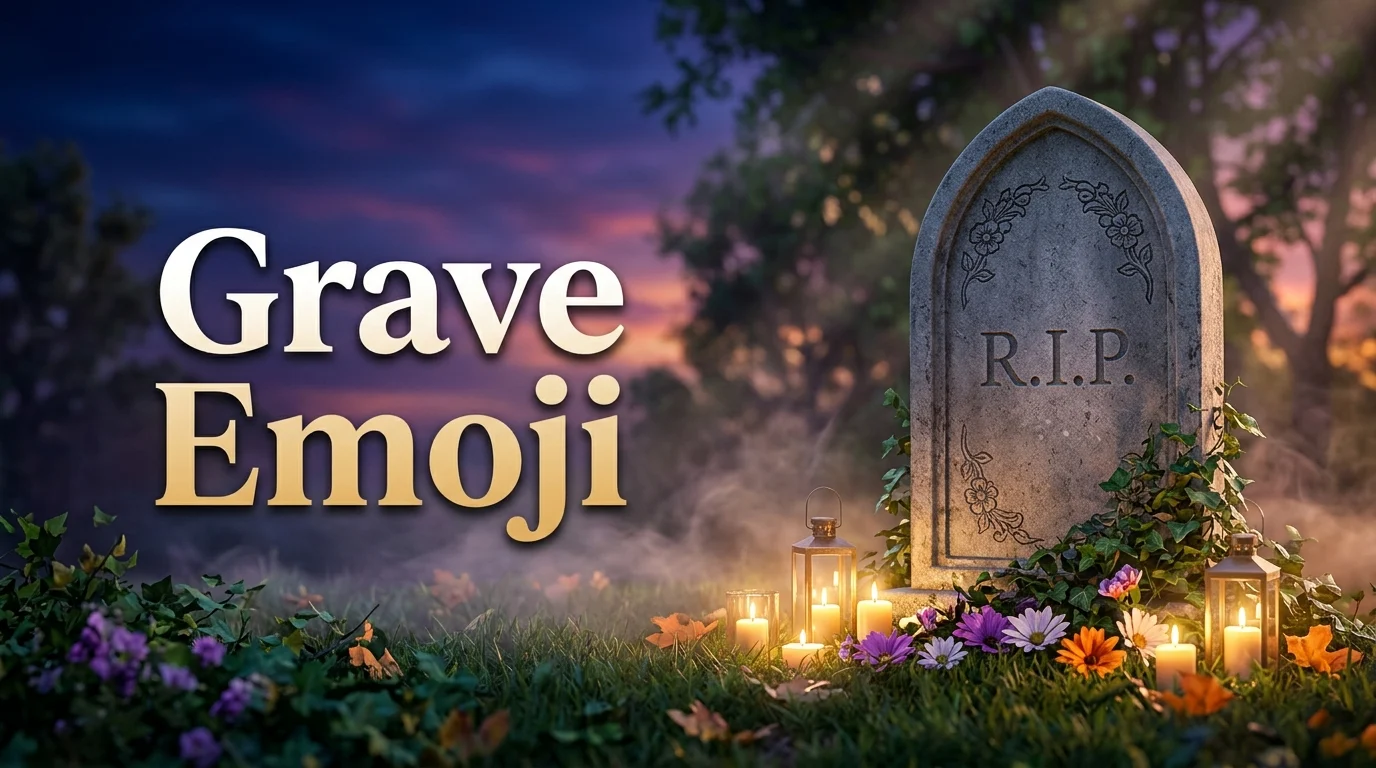
The grave emoji 🪦 represents a headstone or grave marker and is commonly associated with death, remembrance, cemeteries, and messages honoring someone who has passed away. It can express sympathy, mark a memorial, or communicate the idea of resting in peace. However, its meaning is not always serious. In casual texting and social media, people may also use it for dark humor, dramatic reactions, or jokes about something being completely finished.
Understanding the grave emoji depends on the conversation. In a memorial post, it may express grief and respect. In a funny message, it might exaggerate how exhausted someone feels or suggest that a situation is beyond saving. The words around it, the relationship between the people communicating, and the overall tone help determine what the sender means.
Quick Answer
The grave emoji 🪦 commonly represents a grave, remembrance, death, or RIP. It can also appear in jokes about exhaustion, embarrassment, or something being finished.
What Does the Grave Emoji 🪦 Mean?
The grave emoji 🪦 shows a headstone, the marker commonly placed at a burial site. Its main associations include graves, cemeteries, death, memorials, and remembering someone who has died.
People use it in several ways depending on the situation:
- Remembrance: Honoring someone who has passed away.
- Mourning: Expressing sadness or acknowledging a loss.
- RIP messages: Communicating a wish for someone to rest in peace.
- Cemetery references: Talking about graves, burial places, or memorial visits.
- Dark humor: Making an exaggerated joke about something being over.
- Dramatic reactions: Showing that a situation feels unbearable, embarrassing, or impossible to recover from.
The emoji does not always communicate sadness. For example, someone might include it in a message about a deceased relative as a sign of remembrance, while another person might use it after saying they stayed awake all night studying.
The difference comes from context. When the conversation involves a real loss, the grave emoji may carry a serious and respectful tone. When it appears beside an obvious joke, it may communicate exaggeration rather than literal death.
🪦 Grave Emoji Meaning in Text Messages
In text messages, the grave emoji can communicate death-related feelings without requiring a long explanation. It may appear in a conversation about a funeral, a memorial, a cemetery visit, or a person who has passed away.
For example, someone might write, “Thinking about Grandpa today 🪦.” In that context, the emoji supports a message of remembrance.
The same symbol can have a different meaning in an everyday conversation. Someone might say, “My sleep schedule is in the grave 🪦,” meaning that their sleeping habits have become a mess. The statement is figurative rather than literal.
Common texting uses include:
- “RIP, you will be missed 🪦” for a memorial message.
- “Visiting the cemetery today 🪦” when discussing a burial site.
- “That embarrassing moment put me in the grave 🪦” as an exaggerated joke.
- “My weekend is officially in the grave 🪦” to suggest that the weekend is over or ruined.
The grave emoji is therefore useful for both serious and informal communication. Before interpreting it, consider whether the sender is talking about a real person, a difficult experience, or a humorous situation.
What Does 🪦 Mean From Someone?
When someone sends you the grave emoji, its meaning depends on what you were discussing before they sent it.
If the conversation concerns a death, a funeral, or a memorial, the emoji may express sympathy, remembrance, or acknowledgment of a loss. In this setting, it is best to respond with care rather than assuming the sender is making a joke.
If the conversation is playful, the same emoji might communicate an exaggerated reaction. Someone could send it after hearing an embarrassing story, receiving an unexpectedly funny message, or describing an exhausting day.
Here are a few possible interpretations:
They are remembering someone. The emoji may refer to a loved one, friend, public figure, or another person who has died.
They are reacting dramatically. The sender might feel that a situation was so embarrassing or overwhelming that they jokingly describe themselves as finished.
They are making a dark joke. The emoji can add a death-related punchline to an otherwise playful conversation.
They are discussing a cemetery or grave. The meaning may be entirely literal, especially if the message mentions visiting a burial site.
The grave emoji alone cannot tell you exactly what someone feels. Read the full message and consider the circumstances before deciding how to respond.
Is the Grave Emoji Positive or Negative?
The grave emoji generally has serious associations because it represents a grave marker. It can suggest death, grief, remembrance, or the end of something. However, it is not automatically negative in every conversation.
In a memorial post, it can be a meaningful way to acknowledge a person who has passed away. Although the subject may be sad, the message itself can express love, respect, or gratitude.
In a humorous conversation, the emoji may create an exaggerated or playful tone. For example, someone who says, “I saw my exam results and my confidence is in the grave 🪦,” is probably describing disappointment through humor rather than referring to a literal death.
Its tone can be understood in three broad ways:
- Serious: Used when discussing death, funerals, or a personal loss.
- Respectful: Used in remembrance or memorial messages.
- Humorous: Used to exaggerate embarrassment, exhaustion, failure, or the end of a situation.
The surrounding words are especially important when the topic is sensitive. A joke that feels harmless among close friends may be inappropriate in a conversation about someone’s grief.
Can the Grave Emoji Be Sarcastic?
Yes. The grave emoji can contribute to sarcasm when someone uses it to exaggerate a reaction or describe a situation as hopeless.
For example, “Another meeting that could have been an email. Put me in the grave 🪦” expresses frustration through dramatic humor. The sender is not asking to be buried. They are making fun of an irritating situation.
It can also appear in playful responses to awkward moments. If a friend tells a story about accidentally waving at someone who was waving at another person, a grave emoji might communicate secondhand embarrassment.
However, the symbol itself does not guarantee sarcasm. A message about a real death or cemetery visit should not be interpreted as a joke without clear evidence.
When reading the grave emoji, consider the subject of the conversation, the sender’s usual communication style, and whether the wording suggests a literal or figurative meaning.
Does the Grave Emoji Mean RIP?
The grave emoji can communicate RIP, which stands for “rest in peace.” People may use it in memorial posts, messages about someone who has died, or online tributes.
For example, “RIP to a wonderful person 🪦” uses the emoji to reinforce a message of remembrance. The same symbol may appear when someone shares a memory of a loved one or acknowledges an anniversary of a death.
However, the grave emoji does not always mean RIP. In informal online conversations, it can represent the end of something or serve as an exaggerated reaction.
For example, “RIP to my free time 🪦” suggests that the sender expects to be busy. The message is figurative, and no actual death is involved.
To understand whether the emoji expresses genuine remembrance or humor, pay attention to the words around it.
Does the Grave Emoji Mean Someone Is Dead?
The grave emoji is associated with death, but its use does not always indicate that someone has died.
In a serious conversation, it may refer to a deceased person, a burial place, or a memorial. In an informal conversation, it can symbolize something that feels finished, ruined, or impossible to recover.
Consider these examples:
- “We visited the family grave today 🪦” refers to a real burial site.
- “RIP to our favorite old restaurant 🪦” may express sadness that a restaurant has closed.
- “My energy is in the grave after that workout 🪦” uses figurative language to describe exhaustion.
- “That joke sent me to the grave 🪦” may exaggerate how funny something was.
The emoji does not confirm that a person has died. The surrounding message determines whether the reference is literal or figurative.
Related Emojis and Their Meanings
Several emojis share associations with death, mourning, remembrance, or dramatic reactions. Although they can appear in similar conversations, each has a different visual meaning and common use.
| Emoji | Official Name | Common Meaning | Tone | Where or When It Is Used |
|---|---|---|---|---|
| 🪦 | Headstone | Grave, remembrance, memorial | Serious or playful | Memorial posts, cemetery references, and dark humor |
| ⚰️ | Coffin | Burial, death, funeral | Serious or dramatic | Funeral-related messages and figurative jokes |
| 💀 | Skull | Death, shock, or extreme amusement | Dark or humorous | Internet jokes and exaggerated reactions |
| ⚱️ | Funeral Urn | Cremation, ashes, remembrance | Respectful or solemn | Conversations about funerals and memorials |
| 🕯️ | Candle | Remembrance, hope, or reflection | Calm or respectful | Memorial messages and tributes |
| 😭 | Loudly Crying Face | Sadness or overwhelming emotion | Emotional or exaggerated | Grief, disappointment, and humorous reactions |
| 🖤 | Black Heart | Grief, affection, or a dark aesthetic | Somber or expressive | Condolences, memorial posts, and personal messages |
| 🕊️ | Dove | Peace, hope, or remembrance | Gentle or comforting | Sympathy messages and tributes |
🪦 vs. ⚰️: What’s the Difference?
The grave emoji 🪦 represents a headstone, the marker associated with a burial place. The coffin emoji ⚰️ represents a coffin used for a deceased person.
The two can appear in conversations about death or funerals, but they emphasize different things. The headstone is more directly associated with a grave, cemetery, or memorial. The coffin is more closely associated with burial and funeral arrangements.
In informal messages, either may be used figuratively. Still, the grave emoji may be a more natural choice when someone wants to refer specifically to a cemetery, headstone, or something metaphorically being “in the grave.”
🪦 vs. 💀: What’s the Difference?
The grave emoji 🪦 refers to a headstone or burial marker, while the skull emoji 💀 represents a skull.
The grave emoji often appears in memorial messages, cemetery references, and jokes about something being over. The skull emoji has a particularly common informal use online: expressing that something is extremely funny, shocking, or embarrassing.
For example, “RIP to my old laptop 🪦” suggests that the device has stopped working or is being treated as gone. By contrast, “That comment took me out 💀” commonly means the comment was hilarious.
Although both emojis can communicate death-related ideas, the skull emoji is often more closely associated with internet humor.
Is the Grave Emoji Flirty?
The grave emoji is not commonly understood as a direct sign of flirting. Its main associations involve graves, death, remembrance, and humor.
However, someone might use it in a playful conversation with a romantic interest to exaggerate a reaction. For example, “You look so good in that picture, I’m in the grave 🪦” could be a dramatic way to say that the person looks attractive.
In this case, the flirtatious meaning comes from the words, not from the grave emoji alone. Without the surrounding message, the symbol does not clearly communicate romantic interest.
If someone sends you the grave emoji in a conversation about dating or attraction, consider the full message and your existing relationship before interpreting it as flirting.
Is the Grave Emoji Rude?
The grave emoji is not inherently rude. It can be appropriate in a memorial post, a conversation about a cemetery, or a message expressing remembrance.
Its tone may become insensitive when someone uses it to mock a real person’s death or responds with it to someone who is grieving. Even if the sender intends humor, the recipient may interpret the message as disrespectful.
In casual conversations among friends, the emoji may be used for harmless exaggeration, such as describing a difficult exam or an exhausting workday. The same joke might not be suitable in a serious discussion.
A useful rule is to consider the subject and the audience. When someone is talking about an actual loss, choose words that show empathy. When the conversation is clearly playful, the grave emoji may fit the tone.
Grave Emoji on Social Media
On social media, the grave emoji can serve several purposes. Its meaning depends on the post, caption, comments, and the community using it.
Memorial posts: People may include the emoji when remembering a loved one or acknowledging a death anniversary.
Tributes: The symbol can accompany a message honoring a person who has passed away.
Dark humor: Some users employ it to exaggerate an embarrassing situation or describe something as finished.
Entertainment discussions: It may appear in comments about a fictional character’s death, a shocking plot twist, or a dramatic moment in a story.
Everyday frustrations: The emoji can add humor to posts about exhaustion, deadlines, disappointing results, or plans that have fallen apart.
Do not assume every grave emoji in a comment refers to a real death. At the same time, avoid assuming that every use is a joke. The content of the post and the conversation around it provide the best clues.
Text Message Examples
These examples show how the grave emoji can communicate different meanings in everyday conversations.
1. Remembering a loved one
- Person A: “Today marks five years since we lost Grandpa.”
- Person B: “Sending love to your family 🪦❤️”
Meaning: The emoji appears in a serious context involving remembrance and affection.
2. Describing exhaustion
- Person A: “How was your first day at the new job?”
- Person B: “Eight hours of meetings. My energy is in the grave 🪦”
Meaning: The sender is exaggerating how tired they feel.
3. Reacting to an embarrassing moment
- Person A: “I called my teacher Mom in front of the whole class.”
- Person B: “I’d never recover from that 🪦”
Meaning: The emoji represents embarrassment and a dramatic reaction.
4. Talking about something that has ended
- Person A: “The old café on our street closed.”
- Person B: “Nooo, our favorite place is gone 🪦”
Meaning: The symbol emphasizes disappointment about the café closing.
5. Making a joke about a deadline
- Person A: “The assignment is due in two hours.”
- Person B: “My weekend plans are in the grave 🪦”
Meaning: The sender is joking that the deadline has ruined their free time.
Common Misunderstandings About 🪦
1. Thinking It Always Means Someone Has Died
The grave emoji is associated with death, but it can also be used figuratively. A message about a ruined schedule or an embarrassing moment may use it for humor rather than to report a real death.
2. Confusing It With the Coffin Emoji
The grave emoji depicts a headstone, while the coffin emoji depicts a coffin. Both relate to death, but they represent different objects.
3. Assuming It Always Expresses Sadness
The emoji can appear in solemn messages, but it may also communicate sarcasm, exaggeration, or dark humor.
4. Treating It as a Sign of Disrespect
The symbol is not automatically rude. Its effect depends on how it is used and whether the conversation involves a sensitive subject.
5. Assuming Everyone Uses It the Same Way
Emoji meanings vary across people and online communities. A sender may use the grave emoji literally, while another may use it as a joke about something that has gone wrong.
How to Respond to the Grave Emoji
Your response should match the tone of the message.
- If it relates to a loss: Offer sympathy, such as “I’m sorry for your loss. Thinking of you.”
- If it refers to a cemetery visit: You can respond with a respectful acknowledgment or ask about the visit if appropriate.
- If it is a joke about exhaustion: Reply with something playful, such as “Sounds like you need a long nap.”
- If it describes an embarrassing moment: A lighthearted response may fit, such as “That’s a memory you’ll never forget.”
- If you cannot tell what it means: Ask, “What do you mean by the grave emoji here?”
Avoid assuming the sender is joking when the conversation may involve a real loss. A little attention to context can help you respond in a thoughtful and natural way.
Frequently Asked Questions
1. What does the grave emoji 🪦 mean?
The grave emoji 🪦 represents a headstone or grave marker. It is commonly associated with death, cemeteries, remembrance, memorials, and RIP messages. It can also appear in jokes about something being over.
2. Does the grave emoji mean RIP?
It can. People may use it to express remembrance or refer to someone who has passed away. In casual conversations, it can also be used figuratively to suggest that something has ended.
3. What does 🪦 mean in texting?
In texting, the grave emoji may refer to a real grave, express remembrance, or add dark humor to a message. The surrounding words help determine its intended meaning.
4. What is the difference between the grave emoji and the coffin emoji?
The grave emoji represents a headstone or burial marker, while the coffin emoji represents a coffin. Both relate to death, but they depict different objects.
5. Does the grave emoji mean something is dead?
It can refer to death literally, but people also use it figuratively. For example, saying that a schedule or weekend is in the grave can mean that plans have been ruined.
6. Is the grave emoji used for dark humor?
Yes. It may exaggerate feelings of embarrassment, exhaustion, or disappointment. However, its use in a conversation about an actual death may be serious rather than humorous.
7. Is the grave emoji disrespectful?
Not by itself. It can be appropriate for remembrance and memorial messages. It may seem insensitive if used to mock a death or make light of someone’s grief.
8. Can the grave emoji be used for a fictional character?
Yes. Someone discussing a movie, television show, book, or game may use it when a fictional character dies or when a dramatic event occurs in a story.
9. Is the grave emoji the same as the skull emoji?
No. The grave emoji depicts a headstone, while the skull emoji depicts a skull. The skull is often used in online humor to express extreme amusement or shock, whereas the grave emoji is more directly associated with burial and memorials.
Conclusion
The grave emoji 🪦 represents a headstone and is commonly associated with death, remembrance, cemeteries, and RIP messages. It can communicate respect for someone who has passed away, but it also appears in casual conversations as a symbol of dark humor or an exaggerated reaction to something that feels finished.
Its meaning depends on context. In a memorial message, it may be a solemn sign of remembrance. In a joke about exhaustion or embarrassment, it may simply add dramatic emphasis. Understanding the surrounding words helps you interpret the grave emoji accurately and respond in a way that fits the conversation.
Read More Related Articles:
- Sandwich Emoji Meaning | The Tasty Symbol for Food, Fun …
- Alarm Emoji Meaning | Wake-Up Alerts, Urgency & Hidden …
- Question Emoji Meaning | Decode Every ? Symbol and Its …