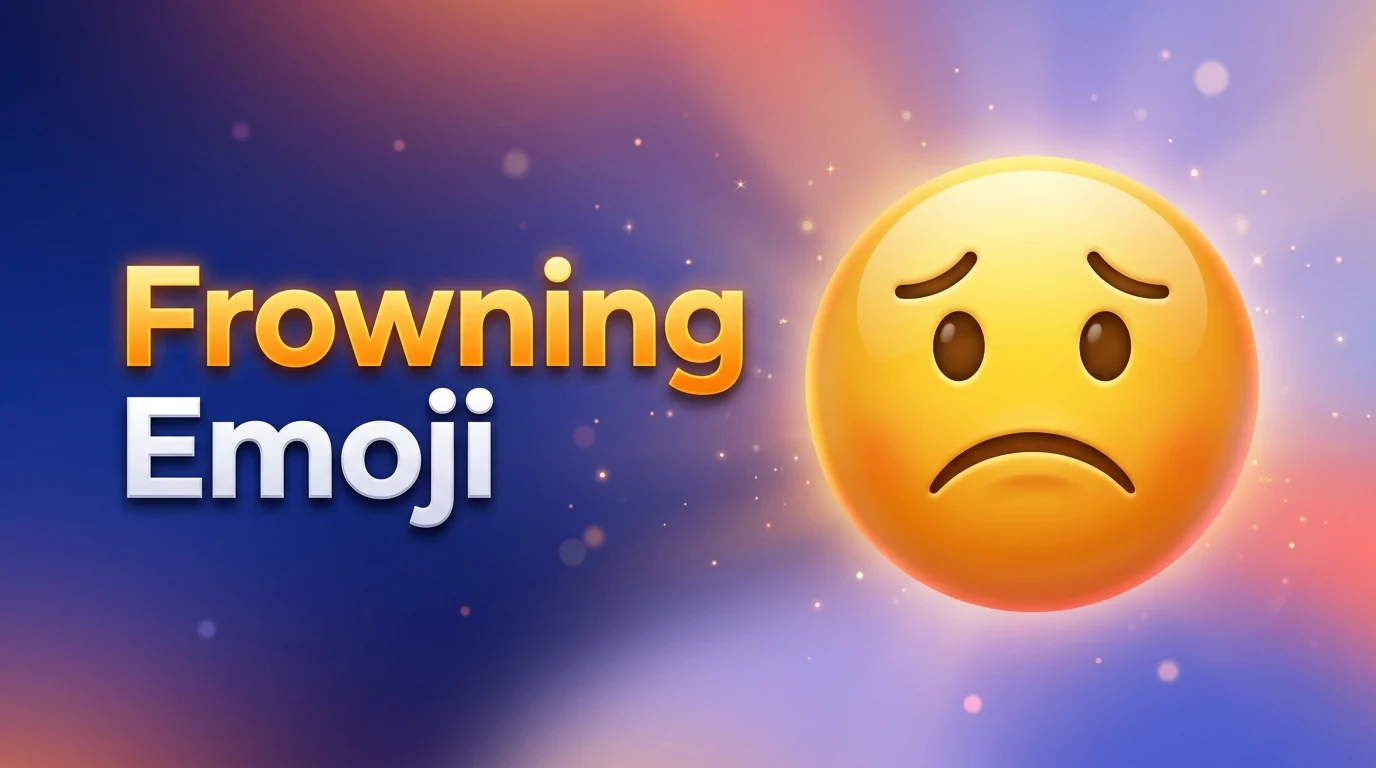
The frowning emoji ☹️ is a simple way to express sadness, disappointment, concern, or unhappiness without explaining every feeling in words. Its clearly downturned mouth gives it a more serious expression than a neutral face, making it useful when something goes wrong, plans fall apart, or a message carries an emotional tone. Depending on the conversation, it can communicate genuine sadness, sympathy for another person, or mild frustration about an everyday problem.
However, the frowning emoji does not always mean someone is deeply upset. A person might use it playfully after hearing disappointing news, such as a cancelled plan or an unfinished meal. In other situations, it may signal that they need comfort or understanding. The words around the emoji, the relationship between the people messaging, and the situation itself all help reveal what the sender intends.
Quick Answer
The frowning emoji ☹️ usually means sadness, disappointment, displeasure, or concern. It can also express sympathy or a playful reaction to something that did not go as expected.
Its exact tone depends on the message and context. A small disappointment may call for a lighthearted interpretation, while a serious conversation may make the same emoji feel sincere and emotional.
What Does the Frowning Emoji ☹️ Mean?
The frowning emoji shows a face with a noticeably downturned mouth and a subdued expression. Its main purpose in everyday communication is to show that something feels negative, disappointing, or emotionally difficult.
People commonly use it to express:
- Sadness: Feeling unhappy about a situation or outcome.
- Disappointment: Reacting to something that did not meet expectations.
- Concern: Showing that a situation feels troubling.
- Displeasure: Communicating that something is unwelcome or frustrating.
- Sympathy: Acknowledging someone else’s difficult experience.
- Playful unhappiness: Exaggerating a minor problem for humor.
For example, someone might write, “The weekend is over already ☹️” to show disappointment that their free time has ended. Another person might send it after hearing that a friend cannot attend an event.
The emoji is direct enough to communicate an unhappy feeling but does not necessarily suggest intense grief. Its meaning usually falls somewhere between mild disappointment and more noticeable sadness, depending on the context.
☹️ Frowning Emoji Meaning in Text Messages
In text messages, the frowning emoji adds emotional information that plain words may leave unclear. It can soften a complaint, show that someone feels let down, or make a short response sound more personal.
Consider these examples:
- “I didn’t get the job ☹️” communicates disappointment about an important outcome.
- “You can’t come tonight? ☹️” shows that the sender is unhappy about a change in plans.
- “It’s raining on our picnic day ☹️” expresses frustration about an inconvenient situation.
- “I miss everyone ☹️” adds a feeling of sadness or longing.
- “My favorite snack is sold out ☹️” can express a small, playful disappointment.
The emoji can also change how a sentence feels. Without it, “That’s disappointing” might sound factual or blunt. With ☹️, the sender makes the emotional reaction more visible.
Still, it is important not to assume that every frowning emoji signals a serious problem. Some people use it casually to make ordinary complaints sound more expressive or humorous.
What Does ☹️ Mean From Someone?
When someone sends you the frowning emoji, they may be communicating an emotion they do not want to explain in detail. The message surrounding it usually provides the best clue.
If they send it after bad news: They may genuinely feel sad or disappointed.
If they send it after you cancel plans: They may be disappointed that they will not see you, although it does not automatically mean they are angry.
If they send it while discussing a personal problem: They may be sharing their feelings or looking for sympathy.
If they send it after a minor inconvenience: They may be exaggerating their disappointment for fun.
If they send it alone: The meaning is less certain. They might be unhappy, reacting to something you said, or inviting you to ask what is wrong.
The frowning emoji by itself cannot tell you exactly what someone is thinking. If the conversation feels serious or their feelings are unclear, a gentle question is more reliable than guessing.
Is the Frowning Emoji Positive or Negative?
The frowning emoji generally has a negative emotional tone because its expression suggests unhappiness or dissatisfaction. However, a negative emotion does not always mean the message is hostile or unfriendly.
For example, a friend might send ☹️ after hearing that you are having a difficult day. In that situation, the emoji can communicate care and sympathy rather than negativity toward you.
It can also appear in lighthearted conversations. Someone might use it after learning that their favorite restaurant is closed, even though the situation is not particularly serious.
The key difference is between negative emotion and negative intention. The emoji may show sadness, but that does not necessarily mean the sender is criticizing you, blaming you, or trying to create conflict.
Can the Frowning Emoji Be Sarcastic?
Yes. The frowning emoji can be used sarcastically when someone pretends to be upset about something minor or responds dramatically to an unimportant inconvenience.
For example:
- “My favorite show only has ten seasons left to watch ☹️”
- “I have to eat the last slice of pizza myself ☹️”
- “Oh no, another day off work ☹️”
In these messages, the unhappy face may be intentionally exaggerated. The sender is probably joking rather than expressing genuine distress.
Sarcasm becomes more likely when the words describe something positive, trivial, or obviously not worth serious sadness. However, the same emoji can communicate real disappointment in another context.
If you are unsure whether someone is joking, consider the conversation’s overall tone and whether they commonly use exaggerated reactions.
The Quiet Disappointment Behind ☹️
One reason the frowning emoji is useful is that it can communicate disappointment without making a message sound overly dramatic.
Imagine that a friend tells you they cannot attend a gathering. You could respond with a long explanation of how disappointed you feel, or simply write, “Aw, okay ☹️.”
The emoji adds a small emotional signal. It tells your friend that you were looking forward to seeing them, while the wording keeps the conversation gentle.
It can also express disappointment with situations rather than people:
- A planned trip gets postponed.
- A package arrives later than expected.
- A long-awaited event is cancelled.
- A favorite item is no longer available.
- A personal goal takes longer to reach.
In these situations, ☹️ allows people to acknowledge disappointment without turning a minor setback into a major emotional statement.
Does ☹️ Mean “I’m Sorry”?
Not by itself. The frowning emoji can appear in an apology, but it does not automatically mean “I’m sorry.”
For example, “I forgot to call you ☹️” may communicate regret because the words describe a mistake and the emoji reinforces the unhappy feeling. In contrast, “The concert is cancelled ☹️” usually expresses disappointment about the news rather than an apology.
When someone uses the emoji after making a mistake, it may help soften the message or show remorse. But the emoji alone cannot establish whether the person accepts responsibility.
If you want to apologize clearly, use direct wording such as “I’m sorry I forgot” and add ☹️ only if it matches your usual communication style.
Does ☹️ Mean Sadness or Anger?
The frowning emoji most commonly suggests sadness, disappointment, or displeasure. It can sometimes accompany frustration, but it is not as direct an expression of anger as a red or scowling face.
For instance, “I didn’t get the results I expected ☹️” suggests disappointment. “You ignored my message again ☹️” could communicate hurt, frustration, or dissatisfaction, depending on the relationship and previous conversation.
The words matter because a downturned mouth alone cannot distinguish every emotional state. Someone who feels angry might use a different emoji, write a direct complaint, or send ☹️ to show that their anger is mild or mixed with sadness.
When interpreting a message, look at the full sentence instead of treating the facial expression as a complete explanation of the sender’s mood.
Related Sad and Concerned Emojis and Their Meanings
Several emojis can express sadness or discomfort, but each has a slightly different emotional tone. The following comparison can help you choose the one that best matches your message.
| Emoji | Official Name | Common Meaning | Tone | Where or When It Is Used |
|---|---|---|---|---|
| ☹️ | Frowning Face | Sadness, disappointment, displeasure | Direct, subdued | Bad news or an unhappy reaction |
| 🙁 | Slightly Frowning Face | Mild sadness or concern | Gentle, restrained | Small disappointments or sympathetic replies |
| 😔 | Pensive Face | Thoughtfulness, regret, sadness | Quiet, reflective | Serious conversations or personal setbacks |
| 😞 | Disappointed Face | Letdown or discouragement | Clearly disappointed | Unmet expectations or unwanted outcomes |
| 😢 | Crying Face | Sadness, hurt, sympathy | Emotional | Painful news or heartfelt reactions |
| 😭 | Loudly Crying Face | Intense sadness or exaggerated emotion | Dramatic | Strong feelings or humorous overreactions |
| 😟 | Worried Face | Anxiety, concern, uncertainty | Tense, uneasy | Difficult situations or worrying news |
| 😕 | Confused Face | Confusion, uncertainty, mild dissatisfaction | Uncertain | Unclear explanations or mixed reactions |
☹️ vs. 🙁: What’s the Difference?
The main difference is the strength of the frown. ☹️ generally communicates more noticeable sadness or disappointment, while 🙁 often feels milder and more restrained.
Use ☹️ when you want to make your disappointment clear. Choose 🙁 when the situation is unpleasant but your reaction is relatively gentle.
For example, “They cancelled the whole trip ☹️” sounds more disappointed than “Looks like it might rain 🙁,” although personal usage can vary.
☹️ vs. 😔: What’s the Difference?
The frowning emoji communicates visible unhappiness, while 😔 Pensive Face often suggests a more inward, thoughtful mood. It may express regret, reflection, or quiet sadness.
Use ☹️ for a direct reaction to bad news. Use 😔 when the message is more reflective, such as thinking about a mistake or feeling sad about something personal.
☹️ vs. 😢: What’s the Difference?
☹️ typically shows sadness or disappointment without suggesting tears. 😢 Crying Face makes the emotion more visibly intense by adding a tear.
If you are mildly disappointed about a cancelled plan, ☹️ may be enough. If you are hurt by serious news or want to show stronger sadness, 😢 may fit better.
Is the Frowning Emoji Flirty?
The frowning emoji is not inherently flirty. Its main meaning is unhappiness, disappointment, or displeasure, rather than romantic interest.
However, someone might use it playfully in a conversation with a person they like. For example, “You left before I could say goodbye ☹️” could communicate that they wanted to spend more time together.
In another conversation, the same emoji might simply show that a friend is disappointed about a missed opportunity. The emoji does not prove attraction, affection, or romantic intent on its own.
If you are trying to understand whether a message is flirtatious, look at the complete conversation, how the person usually communicates, and whether they express interest in other ways.
Is the Frowning Emoji Rude?
Usually, no. The frowning emoji is generally a straightforward way to express sadness or disappointment. However, it can feel passive-aggressive or dismissive if it appears in a tense conversation.
For example, replying only with ☹️ after someone explains a serious mistake might leave them unsure whether you are hurt, disappointed, or annoyed. A longer explanation would make your meaning clearer.
It can also sound judgmental when it is used in response to someone’s personal choice or achievement. The issue is not the emoji alone, but the way it fits into the message.
To avoid misunderstandings, pair the emoji with a few words when the subject is important. A short explanation can help the other person understand whether you are sad, concerned, or simply disappointed.
Frowning Emoji on Social Media
On social media, the frowning emoji often appears in comments, captions, and replies to show an emotional reaction. It can communicate disappointment about an announcement, sympathy for someone’s experience, or frustration with a situation.
For example, a person might use ☹️ when an event is postponed, a favorite product is discontinued, or a planned activity is cancelled. In a supportive comment, it can show that the writer recognizes someone else’s disappointment.
The emoji can also contribute to a playful or exaggerated tone. A caption about a minor inconvenience may use the frowning face to make the situation seem comically tragic.
Context is especially important in public comments because the sender and reader may not know each other well. A short emoji-only response can be interpreted differently by different audiences.
Text Message Examples
Here are realistic examples showing how the frowning emoji can change the tone of a conversation.
1. Disappointment about plans
- Person A: “Sorry, I can’t make it tonight.”
- Person B: “Aw, I was looking forward to seeing you ☹️”
Meaning: The sender is disappointed but communicates it gently.
2. Reacting to bad news
- Person A: “The trip has been postponed.”
- Person B: “That’s such a shame ☹️”
Meaning: The emoji reinforces the disappointment expressed in the words.
3. Showing sympathy
- Person A: “I didn’t get the position.”
- Person B: “I’m sorry. I know you worked hard for it ☹️”
Meaning: The sender expresses sympathy for the other person’s setback.
4. A small everyday problem
- Person A: “The bakery ran out of my favorite cake.”
- Person B: “Nooo, not the cake ☹️”
Meaning: The emoji expresses playful disappointment rather than serious sadness.
5. Feeling misunderstood
- Person A: “I thought you were coming to the meeting.”
- Person B: “I didn’t know it had changed ☹️”
Meaning: The emoji may communicate concern or discomfort while the sender explains the misunderstanding.
Common Misunderstandings About ☹️
1. Thinking It Always Means Deep Sadness
The frowning emoji can express mild disappointment, a small inconvenience, or playful unhappiness. Its presence does not automatically mean someone is deeply upset.
2. Assuming the Sender Is Angry
A frown can communicate displeasure, but it does not necessarily signal anger. The sender may be sad, concerned, sympathetic, or disappointed.
3. Reading It as an Apology
The emoji can accompany an apology, but it does not replace a clear statement of regret. Words and context help establish whether the sender is apologizing.
4. Treating It as a Sign of Romantic Interest
Someone may use ☹️ when they miss another person or feel disappointed about cancelled plans. That alone does not prove romantic attraction.
5. Ignoring the Message Around It
The same emoji can carry different meanings depending on the words it accompanies. Reading the entire message is more reliable than interpreting the face in isolation.
How to Respond to ☹️
The best response depends on what the sender appears to be feeling and what the conversation is about.
- If they seem disappointed: “Aw, that’s a shame. I hope things work out.”
- If they received bad news: “I’m sorry that happened. Are you okay?”
- If they are joking about a small problem: “Oh no, that’s tragic!”
- If they are disappointed about cancelled plans: “I’m disappointed too. Let’s find another time.”
- If you are unsure what they mean: “What’s wrong?” or “Are you okay?”
You do not have to match every emoji with another emoji. A thoughtful sentence may communicate support more clearly, especially when someone is dealing with a genuine problem.
If the frowning face appears in a casual exchange, a light response may be enough. If it appears alongside serious news or an emotional message, responding with empathy is usually more helpful.
Popular Frowning Emoji Combinations
The frowning emoji can appear with other symbols to add context or make the emotion more specific.
| Combination | Common Meaning |
|---|---|
| ☹️💔 | Sadness or emotional hurt |
| ☹️🌧️ | A gloomy mood or disappointing day |
| ☹️😔 | Quiet sadness or disappointment |
| ☹️🥺 | Sadness mixed with a pleading or tender feeling |
| ☹️❤️ | Sadness accompanied by care or affection |
| ☹️😢 | A stronger expression of sadness |
| ☹️🙄 | Frustration or displeasure, sometimes with sarcasm |
These combinations do not have fixed meanings. People use them creatively, and the surrounding message helps determine whether the emotion is sincere, playful, or exaggerated.
Frequently Asked Questions
1. What does the frowning emoji ☹️ mean?
The frowning emoji usually expresses sadness, disappointment, displeasure, or concern. It can also show sympathy or playful unhappiness about a minor problem.
2. What does ☹️ mean from a girl or a guy?
It can mean that the person feels sad, disappointed, concerned, or unhappy about something. The emoji alone does not reveal gender-specific intentions or prove romantic interest.
3. Is ☹️ stronger than 🙁?
Generally, yes. ☹️ Frowning Face usually communicates more noticeable sadness or disappointment, while 🙁 Slightly Frowning Face often conveys a milder reaction. The difference can vary by context and personal style.
4. Does the frowning emoji mean someone is mad at me?
Not necessarily. It usually expresses an unhappy feeling, but that feeling may be sadness, disappointment, concern, or frustration. Look at the words and situation before assuming the person is angry with you.
5. Can ☹️ be used sarcastically?
Yes. People sometimes use it to exaggerate disappointment about a small inconvenience, such as missing a snack or having to wake up early. The surrounding message helps reveal whether the reaction is playful.
6. Does ☹️ mean heartbreak?
It can express sadness related to heartbreak, but it does not specifically mean a romantic relationship has ended. The emoji has a broader meaning that includes disappointment and general unhappiness.
7. Is the frowning emoji appropriate for professional messages?
It can be appropriate in informal workplace chats when expressing disappointment or concern. In formal communication, clear wording is often better because the emoji may be interpreted differently by different readers.
8. What is the difference between ☹️ and 😭?
☹️ usually expresses sadness or disappointment without tears. 😭 Loudly Crying Face often suggests stronger emotion, although it is also widely used online for dramatic or humorous reactions.
9. Should I ask someone what’s wrong if they send ☹️?
If the conversation suggests genuine sadness or concern, a gentle question can be helpful. If the emoji appears in a playful exchange, a light response may be more natural.
Conclusion
The frowning emoji ☹️ is a simple but expressive way to communicate sadness, disappointment, concern, or displeasure. It can show a genuine emotional reaction, soften a complaint, express sympathy, or exaggerate a small inconvenience for humor.
Its meaning is not fixed in every conversation. The same face may communicate a serious letdown in one message and a playful pout in another. To understand it accurately, consider the words, the situation, and the relationship between the people communicating rather than assuming the emoji always means the same thing.
Read More Related Articles:
- Moan Emoji Meaning | What It Really Means in Texts, Chats …
- Troll Emoji Meaning | Decode the Mischief, Sarcasm, and …
- Rocket Emoji Meaning and Symbolism for Messages, Goals …