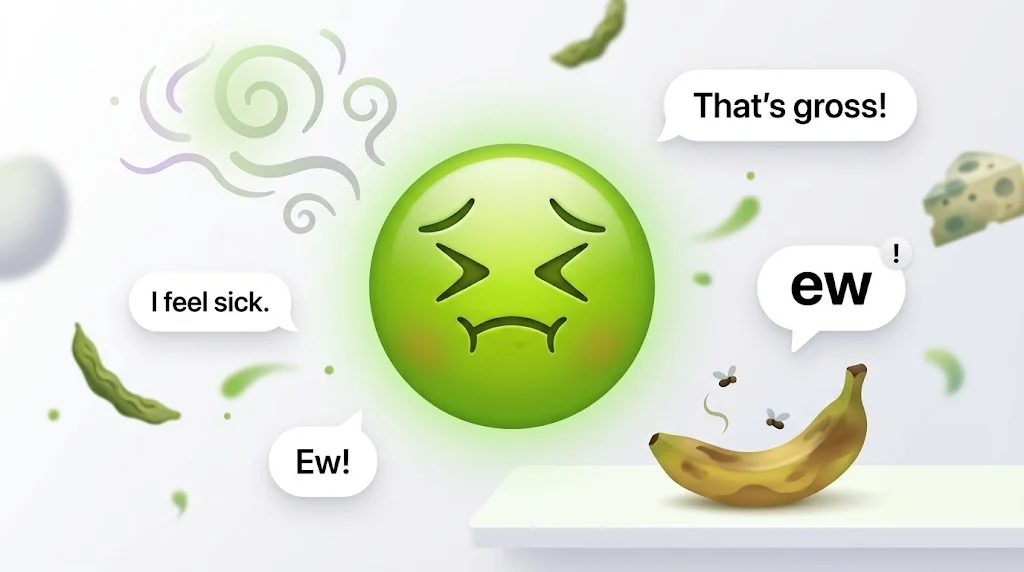
The disgusted emoji 🤢 usually expresses disgust, nausea, feeling sick, or a strong reaction to something unpleasant. Its official Unicode name is Nauseated Face, and the character is commonly shown with a sickly green face and puffed cheeks. It can describe a physical feeling, such as being nauseous, or an emotional reaction to something gross, disturbing, or unpleasant.
In casual texting, 🤢 can also be used dramatically or humorously. Someone might send it after hearing about disgusting food, seeing something gross, or reacting to an awkward idea. The exact meaning depends on the words around it, the situation, and the sender’s usual style. It is also worth separating 🤢 from 🤮: the first suggests nausea or disgust, while the second more directly depicts vomiting.
Quick Answer:
🤢 usually means “I feel sick,” “That’s disgusting,” or “That makes me nauseous.”
It can describe real nausea or be used as an exaggerated reaction to something gross, unpleasant, awkward, or offensive.
What Is the Disgusted Emoji 🤢?
The emoji 🤢 is officially called Nauseated Face by Unicode. Its code point is U+1F922, and it was approved in Unicode 9.0 in 2016. Emojipedia describes it as a sickly-green face that can represent physical illness or general disgust.
Although people often search for it as the “disgusted emoji,” Nauseated Face is the official name. Unicode also maintains keywords associated with the character, including terms such as “gross,” “nasty,” “nauseated,” “sick,” and “vomit.”
So 🤢 can communicate several closely related reactions:
- Feeling physically nauseous
- Finding something disgusting
- Reacting to a gross smell or taste
- Feeling sick after eating
- Being repulsed by an idea or situation
- Reacting dramatically to something unpleasant
- Making a joking or sarcastic “ew” reaction
The emoji does not automatically mean that someone is literally sick. Context tells you whether the reaction is physical, emotional, or playful.
What Does 🤢 Mean in Text Messages?
In texts, 🤢 is often a quick way to communicate a strong “ew” reaction.
For example:
“I opened the fridge and something smelled horrible 🤢”
Here, the emoji reinforces a genuine disgust reaction.
But:
“He said pineapple belongs on every pizza 🤢”
could be playful disagreement rather than actual nausea.
It can also be used after describing something unpleasant:
“I accidentally drank milk that had gone bad 🤢”
In this case, the emoji fits both the physical feeling and the unpleasant experience.
The words around 🤢 are what help you decide how seriously to interpret it.
Does 🤢 Mean Disgusted or Sick?
It can mean either one.
This is one of the most useful things to understand about the emoji. 🤢 sits between physical nausea and general disgust.
Physical sickness
“I feel so sick after that boat ride 🤢”
The sender is probably describing nausea.
Disgust
“That was the grossest thing I’ve ever seen 🤢”
Here, the sender is reacting to something unpleasant rather than reporting an illness.
Food reaction
“I think I ate something bad 🤢”
This may describe actual nausea.
Figurative disgust
“He treated his coworkers terribly 🤢”
In this context, 🤢 can express moral or emotional disgust rather than physical sickness.
What Does 🤢 Mean From Someone?
If someone sends you 🤢, the meaning depends heavily on what you were discussing.
If you sent them a photo of an unpleasant meal and they respond:
“🤢”
they are probably saying something like “That looks disgusting.”
If you told them:
“I’ve been sick all morning.”
and they respond:
“🤢”
they may be reacting to your description or saying they feel sick too.
If you were joking around and they send:
“Your cooking sounds dangerous 🤢”
the emoji may simply be playful teasing.
Because 🤢 is commonly used for both literal nausea and exaggerated disgust, you should not assume a deeper emotional meaning from the emoji alone.
Can 🤢 Mean “Ew”?
Yes. “Ew” is one of the most natural informal interpretations of 🤢.
For example:
“You actually ate that? 🤢”
can mean:
“Ew, that sounds gross.”
Similarly:
“I just saw what was under the couch 🤢”
can mean that the sender is disgusted by what they found.
The emoji works particularly well when the sender wants to make the reaction visually obvious without writing a full sentence.
Can 🤢 Be Used Sarcastically?
Yes. 🤢 can be sarcastic, especially when someone is exaggerating a minor annoyance or pretending to be disgusted.
For example:
“You put ketchup on your eggs? 🤢”
If the conversation is friendly, this may simply be playful teasing.
Another example:
“He said he doesn’t like chocolate 🤢”
The sender may not actually feel nauseous. They may be jokingly acting horrified because they strongly disagree.
Sarcasm depends on the relationship and surrounding conversation, so 🤢 alone does not prove that a message is sarcastic.
Is 🤢 a Rude Emoji?
Not inherently.
However, 🤢 can feel rude when it is directed at a person, appearance, opinion, food, or personal choice.
Compare:
“That smell is disgusting 🤢”
with:
“You look disgusting 🤢”
The first is a reaction to something unpleasant. The second directly targets another person and can be insulting.
Likewise, replying only with 🤢 to someone’s personal opinion may come across as dismissive or mocking.
The emoji itself is neutral in the sense that it represents nausea or disgust, but the target of the reaction can make the message friendly, humorous, or hurtful.
Is 🤢 a Flirting Emoji?
Usually, no.
🤢 generally communicates disgust, nausea, or an unpleasant reaction. It is not naturally associated with romantic attraction.
That said, people sometimes use almost any expressive emoji playfully within a flirtatious conversation. For example:
“Stop being so cheesy 🤢😂”
could be affectionate teasing between people who are flirting.
In that situation, the flirtatious tone comes from the broader conversation, not from 🤢 itself.
So if someone sends 🤢 during a romantic conversation, do not automatically interpret it as a sign of attraction or rejection. Read the complete message first.
What Does 🤢 Mean in a Relationship?
In a relationship, 🤢 can be used seriously or playfully.
For example:
“I think I ate something bad 🤢”
is simply a statement about feeling sick.
But:
“You really watched the whole season without me? 🤢”
could be playful fake disgust.
It can also be used between friends or partners to tease each other:
“You actually like that song? 🤢”
The meaning comes from the relationship and tone of the conversation. A single 🤢 cannot reliably tell you whether someone is angry, joking, teasing, or genuinely upset.
Can 🤢 Mean Something Is Gross?
Yes. This is probably one of the clearest everyday uses.
You might see:
“That bathroom was disgusting 🤢”
or:
“I found mold on the bread 🤢”
In both cases, the emoji visually reinforces the word “gross.”
Unicode’s emoji annotations include “gross” and “nasty” among the keywords associated with Nauseated Face, which supports this broader disgust-related use.
🤢 Meaning on Social Media
On social media, 🤢 can work as a short reaction to something users find unpleasant, gross, or hard to look at.
For example:
“That food combination 🤢”
could express disgust.
A comment such as:
“No way he actually did that 🤢”
might communicate strong disapproval.
However, the emoji does not have a special universal meaning on social media. Its interpretation still depends on the post and the surrounding text.
🤢 vs. 🤮: What’s the Difference?
This is one of the most important distinctions.
🤢 Nauseated Face generally represents feeling nauseous or disgusted. It can suggest that something makes you feel sick.
🤮 Face Vomiting depicts the act of vomiting more directly.
Compare:
“That smell makes me feel sick 🤢”
with:
“I actually threw up 🤮”
The first expresses nausea or disgust. The second gives a much stronger and more literal vomiting reaction.
Emojipedia specifically distinguishes Nauseated Face from Face Vomiting.
Related Emojis to 🤢
| Emoji | Official Name | Common Meaning | Tone | Where or When It Is Used |
|---|---|---|---|---|
| 🤢 | Nauseated Face | Nausea, sickness, or disgust | Gross, sick, dramatic | Bad food, unpleasant smells, disturbing sights, strong reactions |
| 🤮 | Face Vomiting | Vomiting or extreme nausea | Very strong, gross | Actual vomiting, severe disgust, exaggerated reactions |
| 😖 | Confounded Face | Distress, frustration, or discomfort | Uncomfortable, frustrated | Awkward situations, unpleasant experiences, emotional strain |
| 😒 | Unamused Face | Annoyance or disapproval | Dry, unimpressed | Bad jokes, irritating behavior, unwanted comments |
| 😬 | Grimacing Face | Awkwardness, tension, or discomfort | Nervous, uneasy | Awkward moments, uncomfortable reactions |
| 😷 | Face with Medical Mask | Illness or avoiding germs | Serious, health-related | Being sick, medical settings, illness-related messages |
| 🤧 | Sneezing Face | Sneezing, allergies, or feeling sick | Sick, uncomfortable | Colds, allergies, sneezing reactions |
| 🤒 | Face with Thermometer | Being ill or having a fever | Sick, concerned | Fever, illness, staying home |
| 😵 | Face with Crossed-Out Eyes | Overwhelmed, stunned, or disoriented | Dramatic, shocked | Confusing, intense, or overwhelming situations |
The most important distinction is between 🤢 and 🤮. 🤢 is more flexible because it can describe nausea, general disgust, or an exaggerated “ew” reaction. 🤮 is much more directly associated with vomiting.
The other emojis describe different forms of discomfort. 😒 is about being unimpressed, 😬 often signals awkwardness, and 🤧 or 🤒 are more clearly connected to being physically sick.
🤢 vs. 😖: What’s the Difference?
🤢 communicates nausea or disgust, while 😖 usually communicates distress, discomfort, frustration, or being emotionally troubled.
For example:
“That food smells terrible 🤢”
clearly suggests disgust.
“I have no idea how I’m going to finish this project 😖”
suggests stress or frustration.
They can overlap when a situation is unpleasant, but 🤢 has a much stronger connection to feeling sick or repulsed.
🤢 vs. 😒: What’s the Difference?
😒 Unamused Face is usually about annoyance, skepticism, or lack of enthusiasm.
🤢 is much stronger when the reaction is actual disgust or nausea.
For example:
“You forgot again 😒”
sounds annoyed.
“That smell is awful 🤢”
sounds disgusted.
Choosing between them depends on whether the main emotion is “I’m annoyed” or “That makes me feel sick.”
🤢 vs. 🤧: What’s the Difference?
🤧 Sneezing Face is mainly associated with sneezing, allergies, colds, or being sick.
🤢 Nauseated Face is associated with nausea and disgust.
Compare:
“My allergies are terrible today 🤧”
with:
“That food made me feel sick 🤢”
Both can appear in conversations about illness, but they describe different symptoms and reactions.
🤢 vs. 🤒: What’s the Difference?
🤒 Face with Thermometer is more directly associated with illness or fever.
🤢 is better when the focus is nausea or disgust.
For example:
“I have a fever and need to stay home 🤒”
versus:
“I feel nauseous after dinner 🤢”
This distinction makes the emojis easier to choose accurately.
Text Message Examples Using 🤢
“I just smelled the milk in the fridge 🤢”
Likely means the smell was extremely unpleasant.
“You actually eat that combination? 🤢”
Could be playful or genuine disgust.
“I feel so nauseous right now 🤢”
Likely describes physical sickness.
“That scene in the movie was disgusting 🤢”
Expresses a strong reaction to something unpleasant.
“He said he puts ketchup on ice cream 🤢😂”
Likely playful exaggeration rather than genuine nausea.
“That comment was seriously gross 🤢”
Expresses strong disapproval or disgust.
When Should You Use the Disgusted Emoji?
🤢 works well when you want to show:
- Something tastes or smells bad
- You feel nauseous
- Something looks gross
- A situation makes you uncomfortable in a disgusted way
- You strongly dislike an unpleasant idea
- You are jokingly pretending to be horrified
- You want a visual “ew” reaction
It is less suitable when you simply mean that you are sad, angry, tired, embarrassed, or confused. Another emoji will usually communicate those emotions more clearly.
How to Respond to 🤢
Your response should depend on why the sender used it.
- If they are feeling sick
“Oh no. Are you okay?”
- If they are reacting to something gross
“Right? It was so nasty.”
- If they are joking
“😂 I knew you’d hate it.”
- If they are teasing you
“Hey, leave my food choices alone 😂”
- If you are unsure
“Wait, are you actually feeling sick?”
A short clarification is better than assuming what the sender meant.
Can 🤢 Mean “I Hate This”?
Sometimes, but usually in an exaggerated sense.
For example:
“This song is everywhere now 🤢”
could mean:
“I really dislike this.”
However, 🤢 more strongly suggests disgust or repulsion than ordinary dislike.
If someone simply dislikes something, 😒 or 🙄 might be more natural depending on the situation.
Does 🤢 Always Mean Something Is Literally Disgusting?
No.
People frequently use emojis figuratively. Someone might write:
“My old alarm clock sound 🤢”
without meaning that the sound is physically disgusting. They may simply be expressing a very strong negative reaction.
Likewise, 🤢 can be used for awkward, embarrassing, or overly sentimental situations when the sender is jokingly pretending to feel disgusted.
Context remains the deciding factor.
Frequently Asked Questions
What is the official name of 🤢?
The official Unicode name is Nauseated Face. Its Unicode code point is U+1F922. It was approved in Unicode 9.0 in 2016.
What does 🤢 mean in texting?
🤢 commonly means “I’m nauseous,” “That’s disgusting,” “That’s gross,” or “Ew.” It can also be used as a humorous or exaggerated reaction.
Is 🤢 the disgusted emoji?
People commonly call 🤢 the disgusted emoji because it can express disgust. Its official Unicode name, however, is Nauseated Face.
What is the difference between 🤢 and 🤮?
🤢 represents nausea or disgust, while 🤮 more directly represents vomiting. 🤮 generally gives a stronger and more literal vomiting reaction.
Does 🤢 mean someone is sick?
It can. 🤢 may indicate nausea or feeling physically sick, but it can also simply express disgust toward something unpleasant.
Is 🤢 a rude emoji?
Not by itself. It can become rude if it is used to insult someone’s appearance, choices, food, or personal behavior.
Does 🤢 mean “ew”?
Yes. “Ew” is a natural informal interpretation when 🤢 is used to react to something gross or unpleasant.
Can 🤢 be used jokingly?
Yes. People may use 🤢 to exaggerate disgust for humor or playful teasing.
Is 🤢 a flirting emoji?
No. 🤢 does not inherently communicate flirting or romantic attraction. Any flirtatious meaning would come from the larger conversation rather than the emoji itself.
Can 🤢 mean “I don’t like it”?
Yes, especially when the dislike is strong or exaggerated. However, the emoji usually carries a stronger feeling of disgust than simple dislike.
Final Takeaway
The disgusted emoji 🤢, officially called Nauseated Face, usually communicates nausea, sickness, disgust, or a strong “ew” reaction. It can describe a physical feeling, such as being nauseous, or an emotional response to something gross, unpleasant, or disturbing.
In casual conversations, 🤢 can also be playful or sarcastic. The best way to understand it is to look at the complete message instead of treating the emoji as having one fixed meaning. And when choosing between 🤢 and 🤮, remember the simple difference: 🤢 suggests nausea or disgust, while 🤮 depicts vomiting more directly.
Read More Related Articles:
- Hot Emoji Meaning | What Really Says in Texts, Chats, and …
- Excited Emoji Meaning | A Complete Guide to Its Energy …
- Mewing Emoji Meaning | What It Really Represents, How It’s …