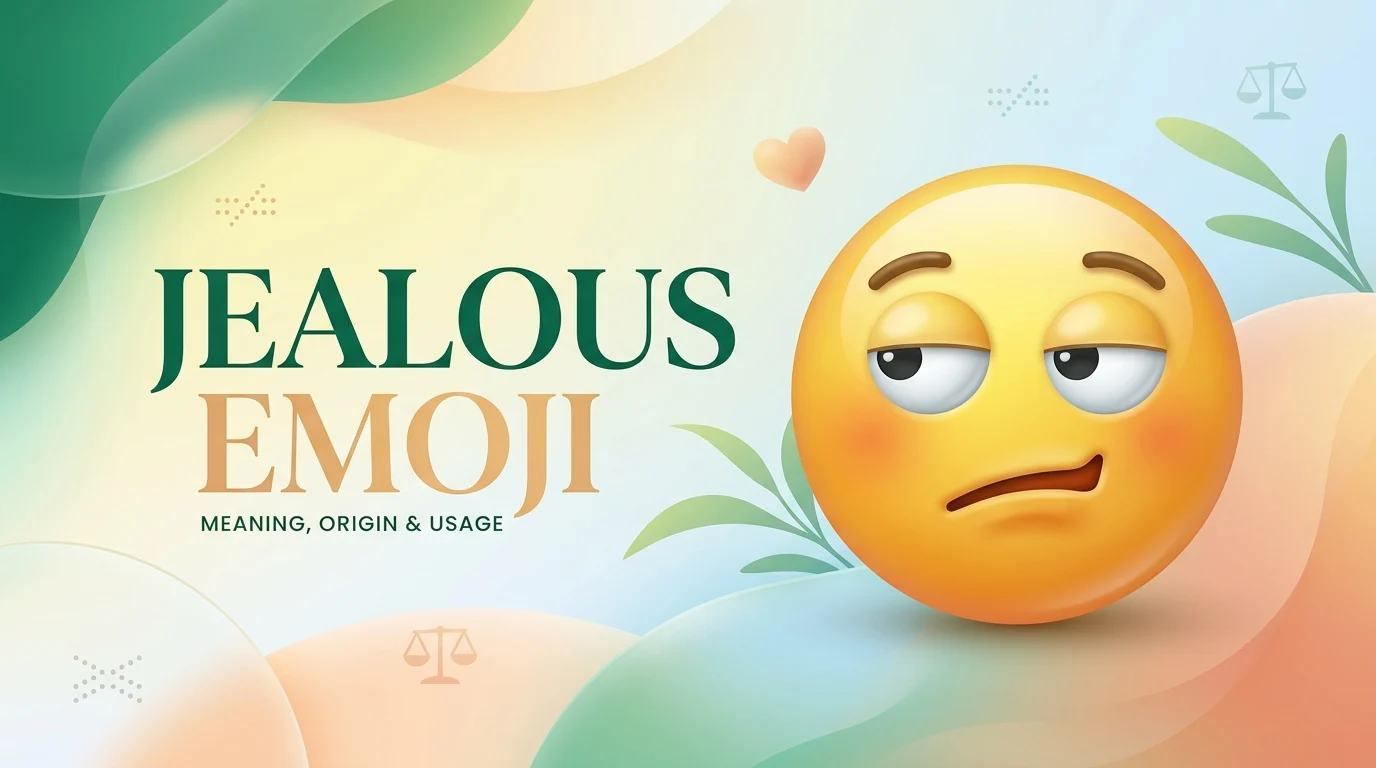
The jealous emoji 😒 is commonly used to show jealousy, envy, annoyance, dissatisfaction, or feeling unimpressed. Its official Unicode name is Unamused Face, so jealousy is a common contextual use rather than the emoji’s formal name. Unicode’s emoji annotations include “jealous” among the associated keywords for 😒.
In texts and chats, 😒 can communicate anything from a small feeling of envy to obvious irritation. A message such as “Must be nice 😒” may sound jealous or playfully envious, while “Seriously? 😒” can sound annoyed or unimpressed. The surrounding words, relationship between the people, and conversation history usually determine the exact meaning.
Quick Answer
😒 can mean jealousy, envy, annoyance, or being unimpressed.
Although officially called Unamused Face, it is also associated with jealousy and “jelly” in Unicode’s emoji keywords.
What Does the Jealous Emoji 😒 Mean?
The emoji 😒 is officially called Unamused Face. It shows a yellow face with a sideways-looking expression and a small, displeased mouth.
Despite its official name, many people use 😒 when they feel jealous, envious, irritated, left out, or unimpressed. Unicode’s current emoji data specifically includes keywords such as “jealous,” “jel,” and “jelly” for this emoji.
For example:
“You got front-row seats? 😒”
This could mean:
“I’m jealous.”
Another example:
“Oh, you’re going without me 😒”
Here, the emoji may express feeling left out or slightly annoyed.
The important point is that 😒 does not have one guaranteed meaning. It can signal jealousy in one conversation and simple annoyance in another.
😒 Meaning in Text Messages
In texting, the jealous emoji can express several related feelings:
- Jealousy
- Envy
- Feeling left out
- Mild annoyance
- Disappointment
- Being unimpressed
- “Must be nice”
- “I wish I had that”
- “Really?”
- “I’m not happy about this”
One common use is to react to something another person has that you would also like.
“I just booked a week in Hawaii 😒”
The emoji can communicate playful envy.
It may also be used when someone feels that another person is receiving attention they wanted.
“Everyone went to see you but nobody invited me 😒”
Here, 😒 can express both hurt feelings and jealousy.
When 😒 Means Jealousy
The jealous meaning becomes stronger when the message involves something desirable that another person has.
For example:
“You got the new phone already? 😒”
Possible meaning:
“I’m jealous that you got it before me.”
Another example:
“So you’re hanging out with them tonight? 😒”
Depending on the relationship, this could suggest:
“I’m feeling a little jealous about that.”
The emoji can make a statement sound less direct than saying “I’m jealous,” especially when the sender is trying to express the feeling playfully.
However, you should not automatically assume jealousy from 😒 alone. The surrounding message matters.
😒 Meaning in Relationships
In a relationship, 😒 may sometimes express jealousy, feeling neglected, annoyance, or wanting more attention.
For example:
“You had time to text everyone else but me 😒”
This sounds more like frustration mixed with hurt feelings.
Or:
“Oh, you’re going out with your friends again 😒”
Depending on the conversation, it could be playful teasing or genuine annoyance.
The emoji itself does not prove that someone is possessive or romantically jealous. Context is much more useful than the emoji alone.
If the sender normally uses 😒 jokingly, the message may be lighthearted. If the conversation has already become tense, the same emoji may feel much more serious.
Is 😒 a Jealous Emoji or an Annoyed Emoji?
It can be either.
The official name is Unamused Face, which fits uses involving dissatisfaction or lack of enthusiasm. Unicode’s emoji keywords also connect 😒 with jealousy and related expressions such as “jelly.”
A useful way to read it is:
Jealous context:
“You went without me? 😒”
Annoyed context:
“You forgot again 😒”
Unimpressed context:
“That’s your excuse? 😒”
Playful envy:
“Must be nice having unlimited vacation days 😒”
The same emoji can therefore communicate different shades of negative emotion.
What Does 😒 Mean From Someone?
If someone sends you 😒, look at the message before interpreting it.
It might mean:
- “I’m jealous.”
- “I’m annoyed.”
- “I’m not impressed.”
- “That wasn’t cool.”
- “I wish I had that.”
- “Why didn’t you include me?”
- “Seriously?”
- “I’m giving you side-eye.”
For example:
“You went to my favorite restaurant without me 😒”
This is likely playful jealousy or feeling left out.
But:
“You canceled again 😒”
This is more likely annoyance or disappointment.
The emoji alone cannot tell you which interpretation is correct.
Is 😒 Flirty?
Sometimes it can appear in a playful or flirty conversation, but 😒 is not inherently a flirting emoji.
Someone might use it teasingly:
“So you finally noticed me 😒😂”
Here, the combination of 😒 and 😂 makes the tone more playful.
In another conversation:
“You were flirting with them 😒”
That sounds more like genuine jealousy or annoyance.
If you’re trying to determine whether someone is flirting, consider the actual words and the broader conversation rather than treating 😒 as proof of romantic interest.
Can 😒 Be Sarcastic?
Yes.
The jealous emoji can work well with sarcasm because its unimpressed expression can make a statement sound deliberately dry.
For example:
“Wow, you remembered my birthday 😒”
This could jokingly mean:
“You remembered, but I’m pretending to be unimpressed.”
Another example:
“Must be nice to have free time 😒”
Depending on context, this could be playful sarcasm, genuine envy, or mild criticism.
The sarcasm comes from the combination of words and emoji, not from 😒 alone.
Emotional Tone of the Jealous Emoji
The emotional intensity of 😒 can range from very mild to fairly negative.
Playful
“You got dessert and didn’t save me any 😒😂”
This feels teasing.
Envious
“You got tickets already? 😒”
The sender may genuinely wish they had the same opportunity.
Annoyed
“You did that again 😒”
The emoji emphasizes irritation.
Disappointed
“I thought you were coming 😒”
The feeling may be more hurt than angry.
Sarcastic
“Wow, how generous of you 😒”
The emoji adds an unimpressed, dry tone.
This flexibility is one reason 😒 can be easy to misunderstand.
Emojis Similar to 😒 and Their Meanings
| Emoji | Official Name | Common Meaning | Tone | Where or When It Is Used |
|---|---|---|---|---|
| 😒 | Unamused Face | Jealousy, annoyance, dissatisfaction, unimpressed reaction | Annoyed, envious, dry | Texts, reactions, teasing |
| 😑 | Expressionless Face | Emotional flatness, frustration, “I’m over this” | Dry, tired, restrained | Annoying situations or awkward replies |
| 🙄 | Face with Rolling Eyes | Disbelief, irritation, sarcasm, “here we go again” | Sarcastic, dismissive | Reactions to frustrating or silly comments |
| 😏 | Smirking Face | Smugness, slyness, flirtation, suggestive confidence | Playful, sly | Teasing, flirting, suggestive comments |
| 😐 | Neutral Face | Neutrality, uncertainty, lack of reaction | Flat, neutral | Awkward or ordinary situations |
| 😞 | Disappointed Face | Sadness, disappointment, feeling let down | Sad, subdued | Disappointing news or situations |
| 😔 | Pensive Face | Sadness, reflection, regret | Quiet, thoughtful | Emotional or reflective messages |
| 🤨 | Face with Raised Eyebrow | Doubt, suspicion, disbelief | Skeptical, questioning | Questioning a claim or explanation |
| 😬 | Grimacing Face | Awkwardness, nervousness, discomfort | Uncomfortable, tense | Awkward moments or uncertain reactions |
The most commonly confused emojis are 😒, 😑, and 🙄. 😒 often carries a stronger sense of being unimpressed or annoyed, while 😑 feels more emotionally flat. 🙄 adds a clear eye-rolling reaction.
😏 is different from 😒 even though the two can look similar at a glance. 😏 has a smirk and is often associated with slyness or flirtation, while 😒 has a displeased, unamused expression. Unicode identifies them separately, with 😏 officially named Smirking Face and 😒 officially named Unamused Face.
😒 vs. 😑
These two can be difficult to distinguish in casual texting.
😒 Unamused Face tends to communicate dissatisfaction, annoyance, jealousy, or feeling unimpressed.
😑 Expressionless Face is more emotionally flat. It can communicate:
“I have no words.”
or
“I’m over this.”
If you want to express jealousy or mild irritation, 😒 is usually the clearer choice.
😒 vs. 🙄
Both can communicate annoyance, but they emphasize different reactions.
😒 often says:
“I’m not impressed.”
🙄 often says:
“Seriously? Here we go again.”
The rolling eyes in 🙄 make the dismissive or sarcastic reaction more obvious.
😒 vs. 😏
This distinction is especially important in relationship conversations.
😒 can suggest jealousy, annoyance, or dissatisfaction.
😏 can suggest a smirk, smugness, teasing, or flirtation. Unicode’s emoji keywords for 😏 include “flirt,” “sly,” “smirk,” and “suspicious.”
So if someone sends 😏, don’t automatically interpret it as jealousy. Its visual expression and common associations point in a different direction.
Realistic Text Message Examples
Example 1: Jealous reaction
Message:
“You got the concert tickets before me? 😒”
Likely meaning:
“I’m jealous. I wanted those too.”
The object of envy makes the jealous interpretation clear.
Example 2: Feeling left out
Message:
“You guys went out without me 😒”
Likely meaning:
“I feel left out, and I’m a little annoyed.”
Here, the emoji combines disappointment with mild irritation.
Example 3: Playful teasing
Message:
“So you had time to buy coffee but not text me? 😒😂”
Likely meaning:
A playful complaint rather than serious anger.
The 😂 helps soften the negative tone.
Example 4: Genuine annoyance
Message:
“You said you would call me 😒”
Likely meaning:
“I’m disappointed and annoyed that you didn’t.”
This does not necessarily involve jealousy.
Example 5: Sarcasm
Message:
“Wow, thanks for inviting me 😒”
Likely meaning:
The sender is sarcastically pointing out that they were not invited.
Common Misunderstandings About 😒
It does not always mean jealousy
Although 😒 is associated with jealousy in Unicode’s keyword data, it is officially the Unamused Face and can express several kinds of dissatisfaction.
It does not automatically mean anger
😒 is often milder than an explicitly angry reaction. It may simply communicate annoyance, disappointment, or being unimpressed.
It does not prove romantic jealousy
Someone using 😒 in a relationship conversation may be jealous, but they could also be joking, annoyed, or disappointed.
It is not the same as 😏
😒 and 😏 have different expressions and common uses. 😏 is more closely connected with smirking, slyness, and flirtation.
It does not have one fixed meaning
Unicode specifically explains that an emoji’s character name does not define every possible meaning or use. Emoji keywords and context help explain how characters are used.
How to Respond to 😒
Your best response depends on why the person used it.
If they seem jealous
“Haha, don’t be jealous 😂”
Use this only when the conversation is clearly playful.
If they feel left out
“Sorry, we should’ve invited you.”
This acknowledges the situation instead of dismissing it.
If they seem annoyed
“Okay, what did I do? 😅”
This gives them a chance to explain.
If the meaning is unclear
“Are you annoyed with me? 😂”
A direct question is often better than guessing.
If it’s clearly playful
“I know, I know 😭”
Match their light tone rather than turning the exchange into something serious.
Copy and Paste the Jealous Emoji
😒
You can copy and paste it into texts, captions, comments, or social posts.
Some combinations include:
- 😒💔 for feeling jealous or hurt
- 😒😂 for playful annoyance
- 😒🙄 for stronger irritation
- 😒👀 for suspicious or jealous side-eye
- 😒❤️ for playful relationship jealousy
- 😒🤨 for doubt or suspicion
The combination can change the tone, so use it based on the message you want to send.
Official Name and Technical Details
The emoji 😒 has the official Unicode name UNAMUSED FACE.
- Emoji: 😒
- Official Unicode name: Unamused Face
- Unicode code point: U+1F612
- Emoji category: Smileys & Emotion
- Emoji group: Smileys
- Common interpretations: Unamused, annoyed, dissatisfied, jealous, unimpressed
Unicode’s current character data identifies U+1F612 as 😒 UNAMUSED FACE.
Unicode’s CLDR emoji annotations also include terms such as jealous, jel, jelly, pissed, smh, ugh, unamused, unhappy, and whatever, showing why this emoji can appear in several related conversational situations.
The visual design can vary between platforms, but the underlying Unicode character remains U+1F612.
Frequently Asked Questions
What does the jealous emoji 😒 mean?
😒 can mean jealousy, envy, annoyance, dissatisfaction, or feeling unimpressed. Its official name is Unamused Face.
Is 😒 officially called the jealous emoji?
No. Its official Unicode name is Unamused Face. However, “jealous” is one of the associated Unicode emoji keywords.
What does 😒 mean from a girl?
It can mean jealousy, annoyance, disappointment, or playful teasing. The emoji itself does not have a different fixed meaning based on the sender’s gender.
What does 😒 mean from a guy?
It can express the same range of feelings, including jealousy, annoyance, envy, or being unimpressed. Context matters more than gender.
Does 😒 mean someone is jealous?
It can. Jealousy is one of the recognized associated keywords for 😒, but the emoji can also mean annoyance, dissatisfaction, or being unimpressed.
Is 😒 a flirting emoji?
Not by itself. It can appear in playful or romantic conversations, but 😒 is not inherently a flirting emoji.
What is the difference between 😒 and 😏?
😒 is Unamused Face and often suggests dissatisfaction, annoyance, or jealousy. 😏 is Smirking Face and is more associated with slyness, smugness, teasing, and flirtation.
What is the difference between 😒 and 🙄?
😒 usually communicates being unamused or unimpressed, while 🙄 more clearly communicates eye-rolling, disbelief, or irritation.
Can 😒 mean “I’m jealous”?
Yes. In the right context, 😒 can function as a short, playful way of saying “I’m jealous” or “I’m a little envious.”
Conclusion
The jealous emoji 😒 is one of those emojis whose meaning depends heavily on context. Its official name is Unamused Face, but it can also communicate jealousy, envy, annoyance, disappointment, sarcasm, or feeling left out.
If someone sends 😒, don’t assume they are automatically jealous or angry. Look at the words around it and the situation behind the message. In one conversation it may mean “I’m jealous,” while in another it may simply mean “I’m not impressed.”
Discover More Post:
- Butterfly Emoji Meaning | From Transformation to Beauty …
- OK Emoji Meaning Explained | Hidden Feelings, Uses …
- Dizzy Emoji Meaning | What It Really Says in Texts, Chats …