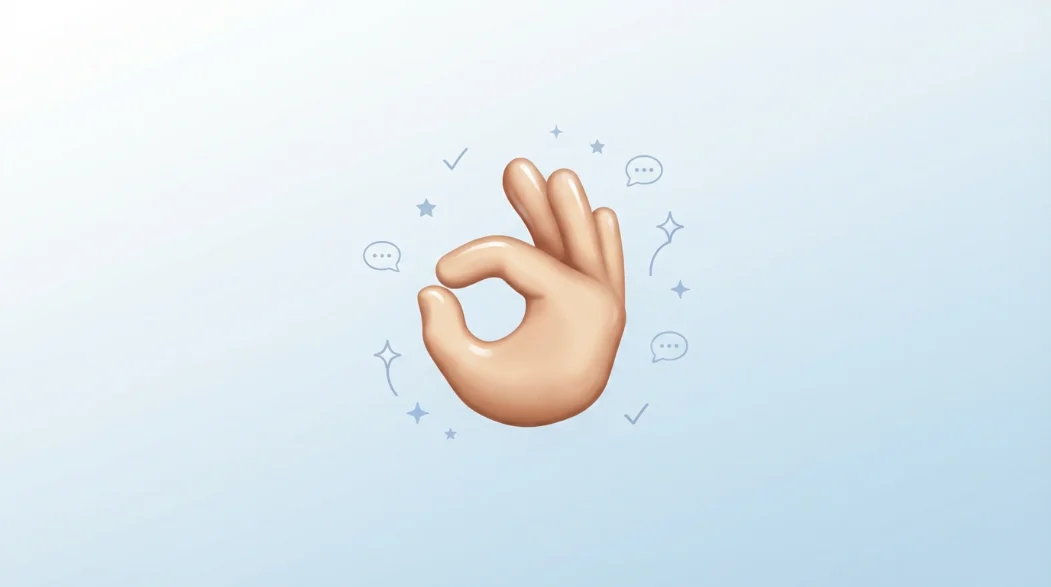
The OK emoji 👌 usually means okay, all good, approval, agreement, or perfect. It shows a hand making the familiar OK gesture, with the thumb and index finger forming a circle. In a text, someone may use it to confirm a plan, show satisfaction, accept something, or simply say that everything is fine. Unicode lists 👌 as OK hand, while Emojipedia explains that it can express ideas such as acceptance, agreement, approval, and satisfaction.
Context can change the feeling of the OK emoji. A simple “See you at 7 👌” sounds friendly and confirming, while “Fine 👌” could feel dismissive or sarcastic depending on the conversation. The emoji can also suggest that something is excellent or exactly right. Its meaning should be read together with the words, relationship, and tone surrounding it.
Quick Answer
👌 usually means “OK,” “all good,” “agreed,” or “perfect.”
In some conversations, it can also sound playful, sarcastic, dismissive, or highly approving depending on the surrounding words.
What Does the OK Emoji 👌 Mean?
The 👌 OK emoji represents the familiar OK hand gesture. Its official Unicode short name is OK hand, and its code point is U+1F44C. It is commonly used to communicate approval, agreement, acceptance, or that something is satisfactory.
In everyday texting, it can replace a short reply such as:
- “Okay.”
- “Sounds good.”
- “Sure.”
- “Got it.”
- “That’s fine.”
- “Perfect.”
- “All set.”
- “I agree.”
For example:
“Meet me at 6:30 👌”
This normally means the person agrees with the plan.
Another example:
“This looks perfect 👌”
Here, the emoji adds a stronger sense of approval.
The important point is that 👌 does not always carry exactly the same emotional weight. It can be warm and friendly in one message and brief or dismissive in another.
👌 Meaning in Text Messages
In texting, the OK emoji is often used as a quick confirmation.
Agreement
“Want to meet after work? 👌”
This usually means:
“Yes, that works for me.”
Confirmation
“I sent the file 👌”
Here, it can communicate that the task is handled or understood.
Approval
“Does this design look good? 👌”
Depending on who sends it, the emoji may mean that the design is acceptable or looks good.
Perfection
“That steak was 👌”
In this context, the emoji can suggest that something was excellent or just right.
Everything is fine
“Don’t worry, I’m okay 👌”
Here, it reassures the other person that everything is under control.
Is 👌 a Positive Emoji?
Usually, yes.
The most common uses of 👌 are positive or neutral. It can show agreement, approval, satisfaction, or acceptance. Emojipedia specifically describes the gesture as being used for meanings associated with “OK,” including acceptance, agreement, assent, likability, satisfaction, and wellness.
However, the exact tone depends on the message.
Compare:
“Sounds good! 👌”
with:
“Whatever you say 👌”
The first sounds like straightforward agreement.
The second could feel sarcastic or dismissive.
The emoji itself has not necessarily become negative. The surrounding language changes how it is interpreted.
What Does 👌 Mean From Someone?
When someone sends you 👌 by itself, the most natural interpretation is usually:
“Okay,” “got it,” “sure,” or “all good.”
For example:
You: “I’ll call you after dinner.”
Them: “👌”
That is normally a simple acknowledgment.
If the conversation has been tense, however, the same emoji can feel colder:
You: “I’m sorry about what happened.”
Them: “👌”
In that situation, you may wonder whether the person is genuinely accepting the apology or simply ending the conversation.
The best interpretation comes from the broader conversation rather than the emoji alone.
Can 👌 Mean “Perfect”?
Yes.
The OK hand gesture can communicate that something is excellent, correct, satisfactory, or exactly right.
For example:
“The timing was perfect 👌”
or:
“That outfit is 👌”
In these examples, 👌 is closer to “perfect” or “that looks great” than a simple “okay.”
This is one reason the emoji can work as a reaction to food, design, plans, photos, outfits, performances, or other things someone approves of.
Can 👌 Be Sarcastic?
Yes, but sarcasm comes from context, not from the emoji’s official meaning.
For example:
“You forgot my birthday again 👌”
That may communicate irritation or sarcasm because the words create that tone.
Another example:
“Great job breaking it 👌”
Here, the wording clearly changes the interpretation.
By contrast:
“Everything is ready 👌”
is normally straightforward.
So if you’re trying to understand a sarcastic 👌, pay attention to the sentence, previous messages, punctuation, and the relationship between the people chatting.
Can 👌 Sound Rude?
Sometimes.
A single 👌 can feel abrupt when a longer response would normally be expected.
For example:
“Okay 👌”
may sound perfectly normal in one conversation but dismissive in another.
This is especially true when the conversation involves disagreement, an apology, criticism, or an emotional topic.
That does not mean 👌 is inherently rude. It simply means a short emoji-only response can leave more room for interpretation.
If you want to sound warmer, you can combine it with words:
“Sounds good! 👌”
That generally provides more context than sending the emoji alone.
Is 👌 a Flirty Emoji?
Not by itself.
The OK emoji is primarily about agreement, approval, satisfaction, or being okay. It does not automatically communicate romantic interest.
It can appear in a flirtatious conversation, but the surrounding message is what creates that tone.
For example:
“You looked amazing tonight 👌”
may feel complimentary or flirtatious because of the words.
But:
“See you tomorrow 👌”
is normally just a confirmation.
So if someone sends 👌 during a romantic conversation, avoid treating the emoji alone as proof of attraction.
👌 Meaning in Relationships
In relationships, friends, or family conversations, 👌 can be used as a quick acknowledgment.
It may mean:
- “Okay, I understand.”
- “That works.”
- “I’m fine.”
- “I agree.”
- “Go ahead.”
- “Sounds good.”
- “Perfect.”
Its emotional meaning can change if the conversation is already tense.
For example:
“Are you okay?”
“👌”
could mean “I’m fine.”
But:
“Do whatever you want 👌”
could feel passive-aggressive depending on the relationship and previous conversation.
When a message feels ambiguous, the surrounding words usually provide more information than the emoji.
👌 Compared With Similar Emojis
| Emoji | Official Name | Common Meaning | Tone | Where or When It Is Used |
|---|---|---|---|---|
| 👌 | OK hand | Okay, agreement, approval, perfect | Neutral, positive, playful | Confirmations, approval, plans, reactions |
| 👍 | Thumbs up | Yes, good, approved, understood | Friendly, direct | Quick agreement, confirmation, reactions |
| 🆗 | OK button | Okay or approval | Clear, neutral | Direct confirmation and written “OK” |
| 🤝 | Handshake | Agreement, cooperation, partnership | Positive, professional | Deals, teamwork, mutual agreement |
| ✌️ | Victory hand | Peace, victory, positivity | Casual, upbeat | Greetings, photos, celebrations |
| 🤞 | Crossed fingers | Hope, luck, wishing for success | Hopeful, playful | Waiting for good news or outcomes |
| 🙆 | Person gesturing OK | Everything is okay or accepted | Positive, expressive | Reassurance and approval |
| 🤌 | Pinched fingers | Gesture with several contextual meanings | Expressive, playful, sometimes questioning | Emphasis, reactions, gestures |
| 🤏 | Pinching hand | Small amount or tiny size | Playful, descriptive | Talking about something small |
The closest comparison is usually 👍.
Both 👌 and 👍 can communicate approval, but they do not always feel identical. 👌 often has a more specific “OK,” “exactly right,” or “perfect” flavor, while 👍 is a broader thumbs-up approval.
🆗 is also easy to confuse with 👌 because both directly communicate “OK.” The difference is visual and stylistic: 🆗 literally displays the letters “OK,” while 👌 uses the hand gesture.
🤌 can be confused with 👌 because both use the fingers in a distinctive hand shape. However, 🤌 is officially called Pinched Fingers, and its intended visual concept is different from the OK gesture.
👌 vs. 👍: What’s the Difference?
Both can mean approval, but they can create slightly different impressions.
👌 OK hand
Often suggests:
“Okay.”
“Perfect.”
“That’s right.”
“All good.”
Example:
“The reservation is confirmed 👌”
👍 Thumbs up
Often suggests:
“Good.”
“Yes.”
“Sounds good.”
“I approve.”
Example:
“I’ll send it tonight 👍”
The distinction is subtle, and people often use them interchangeably.
👌 vs. 🆗: What’s the Difference?
These two are even more closely related.
👌 is a hand gesture.
🆗 is the OK Button emoji, which displays the letters “OK” inside a square. Emojipedia notes that the OK Button was approved in Unicode 6.0 and added to Emoji 1.0 in 2015.
Compare:
“Everything is ready 👌”
This feels like a casual hand gesture.
“Everything is ready 🆗”
This puts more direct visual emphasis on the word “OK.”
Does 👌 Have Other Meanings?
Yes. Like many gestures, 👌 can carry different meanings in different cultural or conversational settings.
In American Sign Language, the same hand shape can represent the number nine. The gesture can also have offensive interpretations in some regions and contexts.
There is also a documented history of the gesture being used in online trolling and, in some contexts, by white supremacists. Emojipedia notes that this association is context dependent and that the gesture is not intrinsically a hate symbol.
This is a good example of why an emoji should not be interpreted in isolation. A normal 👌 in a message such as “Sounds good 👌” is ordinarily an everyday OK gesture. A very different surrounding context can change what a symbol is intended to communicate.
Text Message Examples
1. Simple agreement
“Want to meet at 7? 👌”
Likely meaning: Yes, 7 works.
2. Confirming a task
“I finished the report 👌”
Likely meaning: The task is done and everything is okay.
3. Showing approval
“This photo looks good 👌”
Likely meaning: The sender likes or approves of the photo.
4. Saying something is excellent
“That burger was 👌”
Likely meaning: The food was especially good.
5. Possible sarcasm
“Sure, ignore my message again 👌”
Likely meaning: The emoji may add sarcastic or irritated emphasis.
6. Reassurance
“I’m home safe 👌”
Likely meaning: Everything is fine.
Common Misunderstandings About the OK Emoji
👌 does not always mean “perfect”
It can mean “okay,” “agreed,” “fine,” or “got it.” The stronger “perfect” interpretation usually comes from the context.
👌 is not automatically sarcastic
Some people use it sarcastically, but sarcasm depends on the wording and situation.
👌 does not automatically mean flirting
A romantic interpretation requires additional context. The emoji alone is not enough to establish romantic intent.
👌 is not always the same as 👍
They overlap, but 👌 can feel more specific to “OK,” “exactly,” or “perfect,” while 👍 is a general approval gesture.
👌 is not universally interpreted the same way
Hand gestures can carry different cultural meanings. In some regions, the gesture has offensive associations, so context and location can matter.
How to Respond to 👌
If someone sends 👌 as a normal acknowledgment, you often do not need to respond at all.
If you want to reply, match the context.
Casual
“Sounds good!”
Friendly
“Perfect, see you then!”
Confirming plans
“Great, it’s set.”
If you’re unsure what they mean
“All good?”
If the conversation feels tense
“Just checking, are we okay?”
The last option can help when the emoji seems unusually brief or ambiguous.
Copy and Paste the OK Emoji
👌
You can copy and paste it into texts, comments, captions, messages, and social posts.
Useful combinations include:
- 👌👍 = agreement or approval
- 👌✨ = approval with extra enthusiasm
- 👌😊 = friendly reassurance
- 👌😂 = playful approval
- 👌🔥 = strong approval or praise
- 👌❤️ = affectionate approval
- 👌💯 = strong agreement or approval
Official Name and Technical Details
The official Unicode name is OK hand.
- Emoji: 👌
- Unicode code point: U+1F44C
- Unicode name: OK hand
- Unicode version: 6.0
- Emoji version: 1.0
- Category: People & Body
Unicode’s current emoji charts list U+1F44C as OK hand.
The emoji was approved as part of Unicode 6.0 in 2010 and added to Emoji 1.0 in 2015.
Different platforms can draw the hand slightly differently. Skin tone modifiers are also available for the OK hand emoji, from light skin tone through dark skin tone.
OK Emoji vs. OK Button
There are two different emojis people may call the “OK emoji”:
👌 OK hand
A hand making the OK gesture.
🆗 OK button
The letters “OK” displayed inside a square.
They are related, but they are separate Unicode emoji characters.
Frequently Asked Questions
What does the OK emoji 👌 mean?
The OK emoji 👌 usually means okay, all good, agreement, approval, or perfect. Its exact tone depends on the message and context.
What does 👌 mean in texting?
In texting, 👌 commonly means “okay,” “sounds good,” “I agree,” “got it,” or “everything is fine.”
Does 👌 mean perfect?
It can. When reacting to food, work, appearance, quality, or a successful result, 👌 can suggest that something is excellent or just right.
Is 👌 a positive emoji?
Usually, yes. It is commonly used for approval, agreement, satisfaction, and reassurance.
Can 👌 be rude?
It can feel rude or dismissive in some conversations, especially when used as a very short response during a serious or tense exchange. The emoji itself is not inherently rude.
Is 👌 a flirty emoji?
Not inherently. 👌 is mainly an approval or OK gesture. A flirtatious meaning would come from the surrounding conversation rather than the emoji alone.
What does 👌 mean from a girl or guy?
The basic meaning does not depend on the sender’s gender. It usually means okay, agreement, approval, or satisfaction. Context and communication style matter more.
What is the difference between 👌 and 👍?
Both can show approval. 👌 often has a stronger “OK,” “perfect,” or “exactly right” feeling, while 👍 is a more general thumbs-up reaction.
What is the difference between 👌 and 🆗?
👌 is the OK hand gesture. 🆗 is the OK Button emoji, which literally displays the letters “OK.”
Can 👌 mean sarcasm?
Yes. It can be used sarcastically when the surrounding words or situation suggest irony, frustration, or dismissal. The emoji itself does not inherently mean sarcasm.
Conclusion
The OK emoji 👌 usually communicates okay, agreement, approval, satisfaction, or perfection. It is one of the most flexible hand emojis because the same gesture can work as a quick confirmation, a friendly reaction, or an enthusiastic sign of approval.
Its meaning can change when the surrounding message becomes sarcastic, tense, playful, or highly expressive. When choosing between similar emojis, remember that 👌 emphasizes the OK gesture, 👍 gives a broader thumbs-up, and 🆗 directly represents the word “OK.”
Discover More Post:
- Gasp Emoji | Meaning, Examples & What This Shocked …
- Rose Emoji Meaning | What It Really Says About Love …
- Praying Emoji Meaning | A Deeper Look at Faith, Hope …