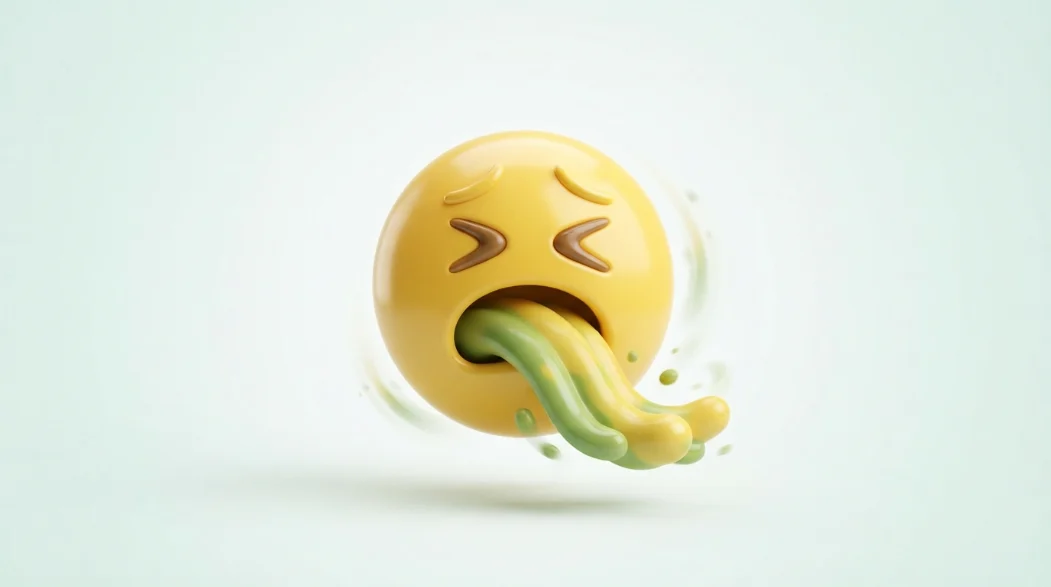
The throw up emoji 🤮 usually represents vomiting, nausea, physical sickness, or strong disgust. Its official Unicode name is Face with Open Mouth Vomiting, and it shows a yellow face with tightly closed, X-shaped eyes and bright green vomit. In everyday texting, people may use it literally when they feel sick, or figuratively when something is extremely gross, unpleasant, or revolting.
The meaning can change with context. A message such as “I feel so sick 🤮” usually refers to physical illness, while “That smell 🤮” expresses disgust. It can also be used jokingly or dramatically to show a strong negative reaction. Compared with 🤢 Nauseated Face, 🤮 generally communicates a more intense reaction.
Quick Answer
🤮 usually means vomiting, feeling physically sick, nausea, or intense disgust.
In texts, it can also exaggerate a reaction to something gross, unpleasant, or strongly disliked.
What Does the Throw Up Emoji 🤮 Mean?
The throw up emoji 🤮 is commonly called the throw up emoji, vomit emoji, or vomiting emoji, but its official Unicode name is Face with Open Mouth Vomiting.
It can communicate several closely related ideas:
- Feeling like you are going to vomit
- Actually being sick
- Nausea
- Something being disgusting
- Strong dislike
- A gross smell or taste
- An unpleasant experience
- A dramatic reaction to something
The emoji is visually much stronger than simply showing that someone feels slightly unwell. Its bright green vomit and tightly closed eyes create a clear image of a forceful reaction.
Emojipedia describes 🤮 as representing physical illness or disgust and notes that it generally conveys greater intensity than 🤢 Nauseated Face.
🤮 Meaning in Text Messages
In texting, the throw up emoji can have both a literal and figurative meaning.
Literal meaning
Someone may use 🤮 when they are physically sick:
“I ate something bad last night 🤮”
Here, the emoji most likely means actual vomiting or feeling extremely ill.
Disgust meaning
It can also express disgust:
“I opened the fridge and smelled that old food 🤮”
The sender may not be vomiting at all. They are using the emoji to say that something smells or looks disgusting.
Strong dislike
Someone may use it as an exaggerated reaction:
“You actually like that flavor? 🤮”
This does not necessarily mean the person is physically sick. It can simply mean, “I really dislike that.”
Is 🤮 Stronger Than 🤢?
Usually, yes.
Both emojis can communicate sickness and disgust, but they create different levels of intensity.
🤢 Nauseated Face often suggests nausea, queasiness, sickness, or general disgust.
🤮 Face with Open Mouth Vomiting shows the stronger visual reaction of actually vomiting.
For example:
“I feel a little nauseous 🤢”
sounds milder than:
“I think I’m going to throw up 🤮”
The distinction is not an absolute rule because people can use either emoji creatively, but the visual difference makes 🤮 the more intense choice.
Emojipedia specifically distinguishes the two by describing 🤮 as a stronger expression than 🤢.
🤮 Meaning When Someone Sends It to You
If someone sends 🤮 in a message, look at the words around it before deciding what they mean.
It could mean:
- “That is disgusting.”
- “I feel sick.”
- “I’m going to throw up.”
- “That smells terrible.”
- “That looks gross.”
- “I really don’t like that.”
- “That was an awful experience.”
- “I’m jokingly reacting with disgust.”
For example:
“You put ketchup on ice cream? 🤮”
This is probably playful disgust.
But:
“I’ve been sick all morning 🤮”
is much more likely to describe an actual physical illness.
The same emoji can therefore have very different meanings depending on the message.
Is the Throw Up Emoji Rude?
It can feel rude, but it is not automatically rude.
If someone sends 🤮 in response to your food, outfit, idea, or personal choice, it may come across as insulting because the emoji represents a very strong negative reaction.
For example:
“You bought that? 🤮”
could sound harsh.
However:
“That smell from the trash 🤮”
is simply a reaction to something unpleasant.
Tone, relationship, and context matter. A close friend may use 🤮 jokingly, while the same emoji from someone you barely know could feel more critical.
Is 🤮 a Flirting Emoji?
No. 🤮 is not normally a flirting emoji.
Its main meanings are sickness, vomiting, disgust, and strong dislike. If it appears during a playful conversation, the sender may be joking, but the emoji itself does not normally communicate romantic interest.
For example:
“You really think pineapple belongs on everything? 🤮😂”
This could be friendly teasing.
The 😂 changes the overall tone, but 🤮 still represents the exaggerated disgust reaction.
Avoid assuming that the emoji has a hidden romantic meaning simply because it appears in a personal conversation.
Can 🤮 Be Used Sarcastically?
Yes.
People sometimes use 🤮 for exaggerated or sarcastic reactions.
For example:
“Ugh, someone gave me free pizza again 🤮”
The sender probably is not actually disgusted by free pizza. The exaggerated emoji can make the sentence intentionally ironic.
Another example:
“My favorite dessert is back 🤮”
If the sender actually loves the dessert, the emoji creates a sarcastic contrast.
The important point is that sarcasm comes from the combination of words, context, and emoji, not from 🤮 having a built-in sarcastic meaning.
🤮 Meaning for Food
Food is one of the most obvious situations where 🤮 can appear.
It may express:
- A bad taste
- A terrible smell
- Spoiled food
- An unpleasant-looking meal
- Dislike of a particular ingredient
- A humorous reaction to an unusual food combination
For example:
“I accidentally drank expired milk 🤮”
This suggests a genuine unpleasant experience.
But:
“You put ranch on pancakes 🤮”
may simply be playful teasing.
The emoji does not prove whether the reaction is serious. The surrounding conversation does that.
🤮 Meaning for Something Gross
The emoji is also useful when reacting to something visually or emotionally unpleasant.
Examples include:
“That bathroom was disgusting 🤮”
“I stepped in something gross 🤮”
“That smell was horrible 🤮”
In these cases, the emoji works as a visual version of “ew”, “gross”, or “that’s disgusting.”
Related Sick and Disgust Emojis
| Emoji | Official Name | Common Meaning | Tone | Where or When It Is Used |
|---|---|---|---|---|
| 🤮 | Face with Open Mouth Vomiting | Vomiting, intense nausea, strong disgust | Very strong, gross | Sickness, disgusting things, dramatic reactions |
| 🤢 | Nauseated Face | Nausea, sickness, general disgust | Strong but milder | Feeling sick, queasiness, unpleasant things |
| 🤒 | Face with Thermometer | Being sick, fever, illness | Sick, subdued | Colds, fever, feeling unwell |
| 🤧 | Sneezing Face | Sneezing, allergies, illness | Sick, sometimes playful | Colds, allergies, sneezing |
| 🤕 | Face with Head-Bandage | Injury, pain, getting hurt | Concerned, uncomfortable | Accidents, injuries, physical pain |
| 😷 | Face with Medical Mask | Illness, germs, medical situations | Serious, cautious | Being sick, healthcare, avoiding germs |
| 😖 | Confounded Face | Distress, frustration, discomfort | Uncomfortable, tense | Bad situations, frustration, emotional discomfort |
| 😣 | Persevering Face | Struggling, stress, discomfort | Strained, determined | Difficult situations or unpleasant tasks |
| 😫 | Tired Face | Exhaustion, frustration, being overwhelmed | Intense, drained | Stress, fatigue, difficult experiences |
| 😵💫 | Face with Spiral Eyes | Confusion, dizziness, feeling overwhelmed | Dramatic, disoriented | Confusing or overwhelming situations |
The most important comparison is between 🤮 and 🤢. They are easily confused because both can represent nausea and disgust. 🤢 looks more like someone trying to hold back nausea, while 🤮 depicts the stronger act of vomiting.
The other useful distinction is between sickness emojis. 🤒 and 😷 are better when the focus is illness or medical symptoms, while 🤮 is much more specific to vomiting or intense disgust.
🤮 vs. 🤢: What’s the Difference?
This is the most common confusion.
🤢 Nauseated Face suggests:
“I feel sick.”
🤮 Face with Open Mouth Vomiting suggests:
“I’m throwing up.”
The same difference can apply figuratively.
“That movie was kind of gross 🤢”
has a milder feel.
“That scene was absolutely disgusting 🤮”
sounds much stronger.
Neither interpretation is guaranteed because emoji meaning depends on context, but the visual intensity makes 🤮 the stronger reaction.
🤮 vs. 😷: What’s the Difference?
😷 is about illness, germs, or wearing a medical mask.
🤮 is about vomiting or intense disgust.
Compare:
“I’ve got a bad cold 😷”
with:
“I ate something terrible 🤮”
The first focuses on illness. The second focuses on vomiting or a strong physical reaction.
🤮 vs. 🤒: What’s the Difference?
🤒 Face with Thermometer is commonly used to indicate being sick, especially with a fever or flu-like illness.
🤮 is more specific to vomiting or disgust.
For example:
“I’m home sick today 🤒”
suggests general illness.
“My stomach is killing me 🤮”
suggests nausea or vomiting.
Text Message Examples
1. Actual sickness
“I think that food made me sick 🤮”
Likely meaning: The sender feels physically ill and may be vomiting.
2. Disgust
“I found mold in the leftovers 🤮”
Likely meaning: The emoji expresses strong disgust.
3. Playful reaction
“You really put hot sauce on ice cream? 🤮😂”
Likely meaning: Exaggerated disgust used as humor.
4. Strong dislike
“I absolutely hate that smell 🤮”
Likely meaning: The sender finds the smell extremely unpleasant.
5. Sarcastic use
“Free concert tickets? Gross 🤮”
Likely meaning: The sender may be joking because the words and emoji contradict the likely attitude.
Common Misunderstandings About 🤮
It does not always mean actual vomiting
The emoji can represent disgust without anyone physically being sick.
It does not always mean the sender is insulting you
A friend might use it jokingly, especially with laughing or playful language.
It is not the same as 🤢
Both relate to nausea and disgust, but 🤮 visually represents vomiting and generally feels more intense.
It does not automatically mean anger
🤮 communicates disgust or sickness, not anger. A message can feel angry because of its wording, but the emoji itself is not an anger emoji.
It does not have one fixed meaning
Unicode notes that an official character name does not define every possible meaning of an emoji. Context and common usage also matter.
How to Respond to 🤮
Your response depends on why the person used it.
If they are actually sick
“Are you okay?”
or
“Hope you feel better soon.”
If they are reacting to something gross
“Right? That was disgusting.”
If they’re joking
“😂 I knew you were going to react like that.”
If they’re criticizing something you like
“Hey, don’t hate on my favorite food 😂”
If you’re unsure
“Wait, are you actually sick or are you just grossed out?”
That last option is useful when the context is unclear.
Copy and Paste the Throw Up Emoji
🤮
You can copy and paste the throw up emoji into texts, comments, captions, messages, or social media posts.
Some combinations include:
- 🤮🤢 = feeling extremely sick
- 🤮😂 = exaggerated disgust used jokingly
- 🤮🤢🤒 = feeling very unwell
- 🍔🤮 = food made you sick or looks disgusting
- 🤮🤦 = strong frustration or disgust
- 🤮💀 = extreme or humorous reaction
The surrounding emojis can change the tone, so combinations should still be interpreted in context.
Official Name and Technical Details
The emoji commonly called the throw up emoji has the official Unicode name FACE WITH OPEN MOUTH VOMITING.
- Emoji: 🤮
- Unicode code point: U+1F92E
- Official Unicode name: FACE WITH OPEN MOUTH VOMITING
- Unicode approval: Unicode 10.0
- Emoji addition: Emoji 5.0
- Year introduced: 2017
Unicode documentation identifies U+1F92E as FACE WITH OPEN MOUTH VOMITING.
Emojipedia reports that the emoji was approved in Unicode 10.0 in 2017 under the name “Face with Open Mouth Vomiting” and added to Emoji 5.0 that same year.
Different platforms can display the emoji somewhat differently. The basic concept remains the same, but details such as facial shape, color, and the appearance of the vomit may vary by vendor.
Frequently Asked Questions
What does the throw up emoji 🤮 mean?
🤮 usually means vomiting, feeling sick, nausea, or strong disgust. It can also be used figuratively for something extremely unpleasant or disliked.
What is the official name of 🤮?
The official Unicode name is FACE WITH OPEN MOUTH VOMITING. Emojipedia commonly labels it Face Vomiting.
What does 🤮 mean in texting?
In texting, 🤮 can mean “I’m going to throw up,” “I feel sick,” “that’s disgusting,” or “I really hate that.” The exact meaning depends on the surrounding message.
What is the difference between 🤮 and 🤢?
🤢 usually represents nausea or general disgust, while 🤮 depicts vomiting and generally conveys a stronger reaction.
Is 🤮 a bad emoji?
Not necessarily. It is a negative reaction emoji, but people can use it seriously, playfully, sarcastically, or dramatically.
Does 🤮 mean disgust?
Yes. Strong disgust is one of its common uses, alongside physical sickness and vomiting.
Is 🤮 rude in a text?
It can sound rude when directed at someone’s appearance, food, opinion, or personal choice. In a friendly conversation, however, it may simply be playful exaggeration.
Can 🤮 be sarcastic?
Yes. It can be paired with intentionally contradictory wording to create a sarcastic or humorous reaction.
Can I use 🤮 for bad food?
Yes. It can communicate that food tastes terrible, smells bad, looks unpleasant, or made you feel sick.
Conclusion
The throw up emoji 🤮 is one of the strongest emojis for expressing vomiting, nausea, disgust, or an intense negative reaction. It can describe genuine sickness, but it is also commonly used in a figurative or humorous way when something feels extremely gross.
When choosing between similar emojis, remember the basic distinction: 🤢 is more about nausea, while 🤮 represents the stronger visual idea of vomiting or intense disgust. The words around the emoji ultimately determine whether the message feels serious, playful, sarcastic, or simply grossed out.
Read More Related Articles:
- Embarrassed Emoji Meaning | Decode Awkward Moments …
- Warning Emoji Meaning | Hidden Messages, Real World Uses …
- ROFL Emoji Meaning | The Ultimate Guide to Laughing Out …