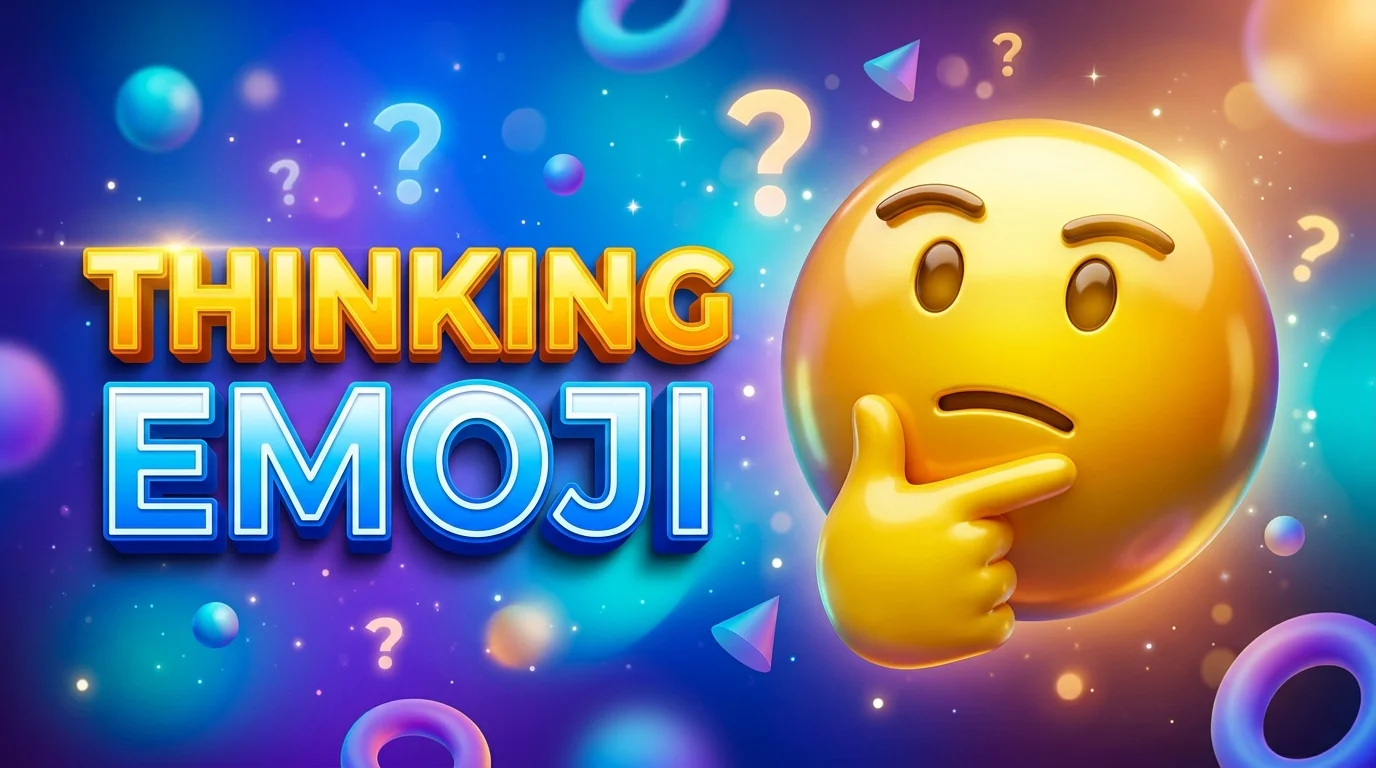
The thinking emoji 🤔 shows a yellow face with a slightly furrowed brow, a small frown, and one hand resting under its chin. It commonly represents thinking, curiosity, confusion, or careful consideration. People use it when they are trying to understand something, questioning an idea, or deciding what to say next.
However, this emoji does not always mean someone is seriously thinking. In casual conversations, it can also express doubt, disbelief, suspicion, or a playful reaction to something that sounds strange. Its meaning often depends on the message and the relationship between the people communicating.
Quick Answer
The thinking emoji 🤔 usually means someone is thinking, wondering, questioning, or trying to make sense of something.
It can also suggest doubt, curiosity, confusion, or playful suspicion, depending on the conversation.
What Does the Thinking Emoji 🤔 Mean?
The thinking emoji is commonly used to show that someone is considering an idea or trying to understand a situation. Its hand-on-chin expression resembles the familiar gesture people make when they are concentrating or weighing a decision.
The emoji can communicate several related feelings:
- Thinking: The sender is considering something before responding.
- Curiosity: They want to know more about a topic.
- Confusion: Something is unclear or difficult to understand.
- Doubt: They are not fully convinced by what someone said.
- Questioning: They want to examine an idea more closely.
- Suspicion: Something seems unusual or does not quite add up.
- Decision-making: They are weighing different choices.
The thinking emoji is useful because it can communicate a reaction without requiring a long explanation. A single 🤔 can show that a person has paused to consider what they just heard.
🤔 Meaning in Text Messages
In text messages, the thinking emoji often works as a reaction to a question, suggestion, statement, or unexpected piece of information. It can make a reply feel thoughtful rather than immediate.
For example, someone might send 🤔 after receiving an invitation because they are considering whether they can attend. Another person might use it after hearing an unusual explanation because they are unsure whether it makes sense.
Common texting uses include:
- When making a decision: “Should I go with the blue one? 🤔”
- When questioning information: “Are you sure that happened? 🤔”
- When feeling curious: “I wonder why they changed the plan 🤔”
- When expressing uncertainty: “I don’t know if that will work 🤔”
- When noticing something strange: “That sounds a little suspicious 🤔”
The emoji can also soften a question. Instead of sounding too direct or critical, it can make the sender appear curious and open to an explanation.
What Does 🤔 Mean From Someone?
When someone sends you the thinking emoji, they may be considering your message or reacting to something you said. It usually suggests that they have not reached a clear conclusion yet.
The exact meaning depends on what happened before the emoji appeared.
If they send it after your suggestion: They may be thinking about whether to agree.
If they send it after a surprising statement: They may be questioning whether your statement is true.
If they send it after you ask a question: They may be trying to work out an answer.
If they send it during a playful conversation: They may be teasing you or pretending to investigate something.
If they send it after a disagreement: They may be expressing doubt or asking you to explain your point.
It is best not to assume that someone is upset just because they use 🤔. The emoji often shows curiosity or consideration rather than anger.
Is the Thinking Emoji Positive?
Yes, the thinking emoji can have a positive or neutral meaning. It often shows interest, curiosity, and a willingness to consider another person’s idea.
For example, if you suggest a new restaurant and someone replies, “That could be interesting 🤔,” they may be genuinely considering your suggestion.
It can also show that someone is paying attention. Rather than ignoring a message or giving a quick response, they are indicating that they are thinking about it.
However, the emoji is not automatically positive. If it follows a questionable statement or an excuse that sounds unbelievable, it may communicate doubt.
The surrounding words usually make the intended tone clearer.
Can 🤔 Be Sarcastic?
Yes. The thinking emoji can be sarcastic when someone uses it to question something that seems obvious, ridiculous, or difficult to believe.
For example:
- “You forgot your keys again? 🤔”
- “That was supposed to be a five-minute job? 🤔”
- “Interesting explanation. 🤔”
In these situations, the emoji may suggest that the sender is not accepting the explanation at face value.
It can also be used playfully between friends. Someone might send 🤔 after a silly excuse to show that they are pretending to investigate the situation.
The difference between genuine curiosity and sarcasm depends on the wording, the conversation, and how well the people know each other.
Does the Thinking Emoji Mean Confusion?
Sometimes. The thinking emoji can express confusion when a person is trying to understand something that does not make sense to them.
For example, if a friend explains a complicated situation and you reply with 🤔, you may be showing that you are still processing the information.
However, confusion and thinking are not exactly the same. Confusion means something is unclear, while thinking can simply mean someone is considering an idea.
The emoji can communicate either feeling, which is why context matters.
Does 🤔 Mean Someone Is Doubting You?
It can. When the thinking emoji appears after a claim, promise, or explanation, it may suggest that the sender is questioning what they have heard.
For example:
- “I finished the entire project in ten minutes 🤔”
- “He said he was already home 🤔”
- “You really didn’t see my message? 🤔”
These messages may carry a doubtful or teasing tone.
Still, one emoji is not enough to prove that someone distrusts you. They may simply be curious or asking for more information. Look at the rest of the conversation before deciding what they mean.
Related Face Emojis and Their Meanings
Several face emojis can express thoughts, questions, confusion, or uncertainty. Although they may seem similar, each one communicates a slightly different reaction.
| Emoji | Official Name | Common Meaning | Tone | Where or When It Is Used |
|---|---|---|---|---|
| 🤔 | Thinking Face | Thinking, questioning, or considering | Thoughtful, curious | When weighing an idea or questioning information |
| 🤨 | Face with Raised Eyebrow | Doubt, suspicion, or disbelief | Skeptical | When something seems questionable |
| 🧐 | Face with Monocle | Careful examination or investigation | Observant, analytical | When looking closely at details |
| 😕 | Confused Face | Uncertainty or confusion | Unsure, puzzled | When something is difficult to understand |
| 😐 | Neutral Face | No strong emotional reaction | Neutral, reserved | When responding without showing much emotion |
| 🤯 | Exploding Head | Shock or an overwhelming realization | Surprised, amazed | When information is difficult to process |
| 😶 | Face Without Mouth | Speechlessness or having no words | Quiet, stunned | When a situation leaves someone unable to respond |
| 😬 | Grimacing Face | Awkwardness or nervous discomfort | Uneasy, embarrassed | When something feels uncomfortable |
🤔 vs. 🤨: What’s the Difference?
The thinking emoji 🤔 usually shows that someone is considering an idea or trying to understand something. The raised-eyebrow emoji 🤨 is more strongly associated with skepticism, suspicion, or disbelief.
For example:
- “Let me think about that 🤔” suggests careful consideration.
- “You expect me to believe that? 🤨” suggests doubt.
Both emojis can question information, but 🤔 often feels more thoughtful, while 🤨 can feel more challenging.
🤔 vs. 🧐: What’s the Difference?
The thinking emoji 🤔 suggests general thought or consideration. The monocle emoji 🧐 gives a stronger impression of careful inspection or close examination.
For example:
- “I’m not sure which option is better 🤔” shows someone weighing a decision.
- “Something about this report looks unusual 🧐” suggests closer investigation.
Use 🤔 for ordinary thinking and 🧐 when you want to emphasize examining details.
Is the Thinking Emoji Flirty?
The thinking emoji is not usually considered a romantic or flirty symbol. Its main purpose is to express thought, curiosity, or uncertainty.
However, it can become playful or slightly flirtatious when used in a conversation with romantic interest.
For example:
- “Should I tell you what I was thinking? 🤔”
- “Are you trying to impress me? 🤔”
- “I might have to think about that invitation 🤔”
In these messages, the emoji can create a teasing tone. It may suggest that the sender is playing along rather than giving a serious answer.
Still, 🤔 alone does not confirm romantic interest. The words and overall conversation provide more useful clues.
Is 🤔 Rude?
No, the thinking emoji is not inherently rude. It is generally a neutral way to show that someone is considering something or asking a question.
However, it can seem rude in certain situations. If someone shares personal news and receives only 🤔, they might feel that the response is cold or dismissive.
It may also sound judgmental when used after a statement that the sender clearly doubts.
For a more supportive response, combine the emoji with a few words:
- “Let me think about it 🤔”
- “I understand what you mean, but I’m not sure yet 🤔”
- “That’s an interesting point 🤔”
Adding a short explanation can prevent the emoji from being misunderstood.
Thinking Emoji on Social Media
On social media, 🤔 is often used to react to opinions, surprising information, unusual claims, and interesting questions.
Its meaning can change depending on the type of post.
On Instagram: People may use it in comments when a photo, caption, or statement makes them curious or raises questions.
On TikTok: It can express a doubtful reaction to a claim, a confusing moment, or an unexpected twist.
On Facebook: It may appear in discussions when someone is considering an opinion or questioning a statement.
On X: Users may add 🤔 to posts that invite debate, point out contradictions, or make readers question an idea.
The emoji is also useful when someone wants to respond without taking a clear position. It shows that they are thinking about the subject but have not necessarily agreed or disagreed.
Text Message Examples
Here are realistic examples of how people use the thinking emoji in everyday conversations.
1. Considering a suggestion
- Person A: “We could try the new café this weekend.”
- Person B: “That sounds interesting 🤔”
Meaning: Person B is considering the suggestion.
2. Questioning an explanation
- Person A: “He said he didn’t know anything about it.”
- Person B: “Really? 🤔”
Meaning: Person B is unsure whether the explanation is believable.
3. Making a difficult decision
- Person A: “Are you choosing the first apartment?”
- Person B: “Still comparing both options 🤔”
Meaning: Person B has not made a final decision.
4. Reacting to something unexpected
- Person A: “She finished the whole assignment in one hour.”
- Person B: “How did she manage that? 🤔”
Meaning: Person B is surprised and curious.
5. Playful teasing
- Person A: “I definitely didn’t eat the last slice of cake.”
- Person B: “Hmm, interesting 🤔”
Meaning: Person B is jokingly questioning the statement.
Common Misunderstandings About 🤔
1. Thinking It Always Means Confusion
The thinking emoji can show confusion, but it can also represent curiosity, careful consideration, or doubt. It does not always mean the sender is lost or does not understand something.
2. Assuming the Sender Is Angry
A thoughtful or questioning expression is not necessarily an angry reaction. Many people use 🤔 simply to show that they are processing information.
3. Treating It as Automatic Disbelief
The emoji can suggest skepticism, but it does not always mean someone thinks you are lying. They may just want more details.
4. Believing It Is a Romantic Emoji
Although it can appear in playful conversations, 🤔 is not primarily a symbol of attraction. Its common meaning is related to thought and curiosity.
5. Ignoring the Message Around It
The same emoji can communicate different feelings in different conversations. A friendly question, a sarcastic comment, and a serious decision can all use 🤔 for different reasons.
How to Respond to 🤔
If someone sends you the thinking emoji, respond according to the situation. They may need more information, time to decide, or a simple explanation.
Here are some natural responses:
- If they seem confused: “Let me explain what I mean.”
- If they are considering your suggestion: “Take your time. No rush.”
- If they are questioning something: “What part seems unclear?”
- If they are being playful: “I can tell you’re investigating this.”
- If they are deciding between options: “I can help you compare them.”
- If they seem doubtful: “I know it sounds unusual, but here’s what happened.”
A short and clear response usually works best. If the emoji follows a serious question, give the person enough information to understand your point instead of guessing what they are thinking.
Frequently Asked Questions
1. What does 🤔 mean from a girl?
When a girl sends 🤔, she may be thinking about your message, questioning something, or showing curiosity. It can also be playful or teasing, depending on the conversation. The emoji alone does not reveal romantic interest.
2. What does 🤔 mean from a guy?
A guy may use 🤔 to show that he is considering an idea, unsure about something, or questioning a statement. It can also be a casual reaction to something unexpected or funny.
3. Does the thinking emoji mean yes or no?
No. The thinking emoji does not give a definite yes or no answer. It usually means the sender is considering the question or has not made a decision.
4. Does 🤔 mean suspicious?
It can suggest suspicion when someone uses it after an unusual claim or explanation. However, it can also express ordinary curiosity or thoughtful consideration.
5. Is the thinking emoji sarcastic?
Sometimes. It can sound sarcastic when used to question an obvious statement or react to an unbelievable excuse. In other situations, it is completely genuine.
6. What is the difference between 🤔 and 🤨?
🤔 usually represents thinking or consideration, while 🤨 more directly communicates skepticism, doubt, or suspicion. The first is often thoughtful, and the second is more questioning.
7. Can I use 🤔 in a professional message?
Yes, but use it carefully. In a casual workplace chat, it can show that you are considering an idea. In formal communication, a written response such as “Let me consider this” may be clearer and more professional.
8. Does 🤔 mean someone is confused?
It can, especially when a person does not understand something. However, it also expresses curiosity, doubt, and decision-making, so confusion is only one possible meaning.
9. Is 🤔 a positive or negative emoji?
It is generally neutral. It can feel positive when showing curiosity and interest, or negative when expressing doubt or skepticism. The surrounding conversation determines its tone.
Conclusion
The thinking emoji 🤔 is a simple way to show that someone is considering an idea, asking questions, or trying to understand a situation. It can communicate curiosity, confusion, doubt, and even playful suspicion without needing a long reply.
Its meaning is not always the same. A thoughtful response, a doubtful reaction, and a teasing comment can all use this emoji differently. Pay attention to the words and situation around it to understand what the sender really means.
Discover More Post:
- OK Emoji Meaning Explained | Hidden Feelings, Uses & Texting …
- Windows Emoji Shortcut | Master Faster Typing and Hidden …
- Red Circle Emoji | Meaning, Uses & Hidden Messages You …