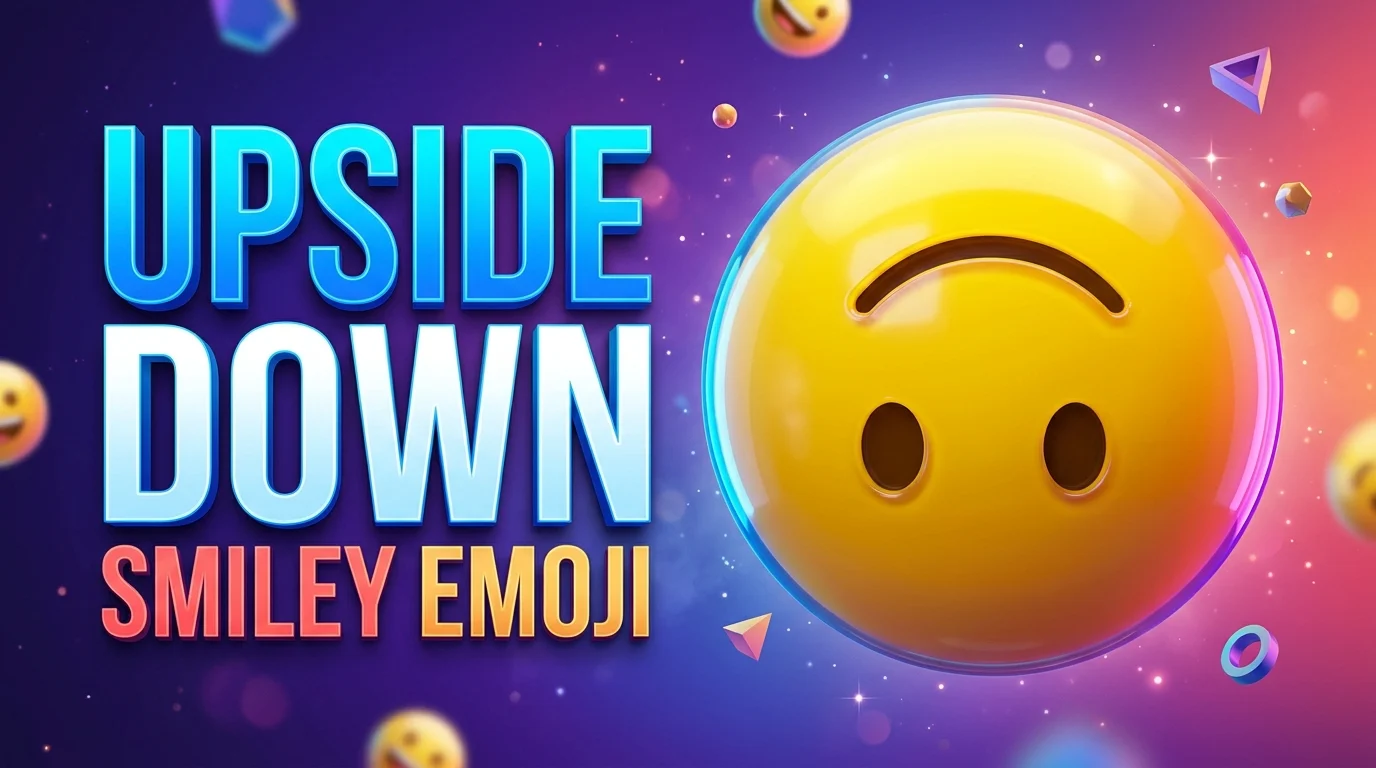
The upside down smiley emoji 🙃 is often used when a regular smile does not quite express what someone wants to say. It can suggest sarcasm, awkwardness, playful frustration, or a cheerful reaction to a situation that is actually uncomfortable. Its unusual upside-down expression gives messages a slightly unexpected tone, making it useful when words alone might sound too serious.
Unlike a straightforward smiling face, 🙃 can communicate two feelings at once. Someone might use it to joke about a mistake, respond to an awkward moment, or pretend to stay positive when things are not going as planned. The meaning depends on the conversation, the relationship between the people, and the words surrounding it. Sometimes it signals lighthearted humor, while other times it hints that something is not quite as fine as it appears.
Quick Answer
The upside down smiley emoji 🙃 commonly means sarcasm, awkwardness, playful irony, or pretending everything is fine when a situation feels frustrating.
Its meaning depends on context. It can be friendly and funny, but it may also express discomfort or hidden annoyance.
What Does the Upside Down Smiley Emoji 🙃 Mean?
The upside down smiley emoji can express several related feelings, but its most recognizable use is irony. It often appears when someone wants to make a comment sound playful, sarcastic, or less serious than the words might suggest.
Here are the most common meanings.
- Sarcasm: Making a comment that means something different from its literal wording.
- Awkwardness: Reacting to an embarrassing or uncomfortable situation.
- Playfulness: Showing that a comment is silly or not meant too seriously.
- Frustration: Joking about something annoying rather than openly complaining.
- Resignation: Accepting an inconvenient situation with a humorous or helpless attitude.
- Mixed feelings: Smiling outwardly while hinting that things are not entirely okay.
The emoji does not always mean the sender is upset. Sometimes it simply adds a quirky tone to a message. The words around it usually provide the best clue.
🙃 Upside Down Smiley Emoji Meaning in Text Messages
In text messages, 🙃 can change how a sentence feels. A statement that sounds cheerful on its own may become ironic when the emoji appears at the end.
For example, someone might write, “My alarm didn’t go off, and I missed the bus 🙃.” The emoji suggests that the situation is frustrating, but the sender is trying to laugh about it instead of making a serious complaint.
It can also soften an awkward admission. If someone says, “I just waved back at a person who wasn’t waving at me 🙃,” the emoji makes the embarrassment feel lighthearted.
Common texting uses include:
- Responding to an unexpected problem.
- Making fun of a small personal mistake.
- Showing that a situation feels awkward.
- Adding irony to an overly positive statement.
- Indicating that a person is trying to stay calm.
Because the emoji can carry more than one emotion, it is important not to interpret it in isolation.
What Does 🙃 Mean From Someone?
When someone sends you 🙃, the meaning depends on what they are responding to and how they usually communicate.
🙃
If they are joking
They may be teasing you, laughing at an unusual situation, or showing that their comment should not be taken too seriously.
🙃
If something went wrong
They may feel annoyed, embarrassed, or disappointed but prefer to express it humorously.
🙃
If the conversation feels tense
It might suggest sarcasm or hidden frustration, especially when the surrounding words sound unusually cheerful.
🙃
If they are being friendly
They may simply be adding a playful, silly, or slightly mischievous touch to the message.
One message is rarely enough to know exactly what another person feels. If the conversation matters, consider the full message rather than assuming the emoji reveals a hidden emotion.
Is the Upside Down Smiley Emoji Positive?
Yes, it can be positive, especially when used to express silliness, lighthearted humor, or a playful reaction.
For example, a friend might send “I somehow managed to burn instant noodles 🙃.” The emoji makes the mistake sound funny rather than serious.
However, 🙃 is not always a happy expression. It can also communicate frustration or discomfort beneath an outwardly cheerful tone.
The difference often comes from the wording:
- “Finally finished my project 🙃” may sound playful or relieved.
- “Another three-hour meeting 🙃” may suggest annoyance.
- “I said the wrong name in front of everyone 🙃” may express embarrassment.
The emoji is best understood as a flexible reaction rather than a clear sign of happiness or sadness.
Can 🙃 Be Sarcastic?
Yes. Sarcasm is one of the most common uses of the upside down smiley emoji.
Sarcasm happens when someone says something that should not be interpreted entirely at face value. The emoji can signal that the sender is joking, criticizing a situation indirectly, or pointing out an obvious contradiction.
Consider this message:
“Wonderful, my computer crashed right before the deadline 🙃.”
The word “wonderful” sounds positive, but the situation is clearly inconvenient. The upside down smile suggests that the sender does not genuinely consider the computer crash wonderful.
It can also be used in friendly teasing:
“You remembered everything except the one thing we needed 🙃.”
Depending on the relationship, this could be playful banter or genuine annoyance. If the message is sensitive, the emoji alone cannot tell you which interpretation is correct.
The Hidden Frustration Behind 🙃
One reason people use 🙃 is that it allows them to express frustration without sounding openly angry.
Someone might have a difficult day, make an embarrassing mistake, or deal with an inconvenience that is too small to justify a serious complaint. Instead of explaining every feeling, they add the emoji to show that they recognize the absurdity of the situation.
For example:
- “Spilled coffee on my clean shirt five minutes before leaving 🙃.”
- “Forgot my password again. Great 🙃.”
- “The package arrived one day after I left town 🙃.”
In these examples, the emoji creates a contrast between the smile and the disappointing event.
However, it does not always indicate that the person is secretly upset. Some people use it habitually as a playful punctuation mark. The surrounding message and their usual texting style matter more than the symbol alone.
Does 🙃 Mean “I’m Fine” When Someone Is Not Fine?
Sometimes. The upside down smiley can suggest that a person is trying to act cheerful even though a situation is stressful, awkward, or disappointing.
For example:
“Everything is going perfectly today 🙃.”
If the person has just described several problems, the sentence is probably ironic. The emoji reinforces the contrast between the positive wording and the actual circumstances.
But it would be a mistake to treat every use of 🙃 as a sign of emotional distress. A person might use it after a harmless joke, a silly accident, or an ordinary inconvenience.
A useful way to interpret it is to ask whether the emoji matches the literal meaning of the message. If the words sound positive but the situation sounds negative, irony may be the intended effect.
Related Smileys and Their Meanings
The upside down smiley is easy to confuse with other expressive faces. These emojis can all change the tone of a message, but each has a different visual expression and common use.
| Emoji | Common Name | Common Meaning | Tone | Where or When It Is Used |
|---|---|---|---|---|
| 🙃 | Upside-Down Face | Irony, awkwardness, silliness | Playful or sarcastic | Awkward situations and ironic comments |
| 🙂 | Slightly Smiling Face | Mild happiness or politeness | Calm, friendly, sometimes restrained | Everyday replies |
| 🙄 | Face with Rolling Eyes | Annoyance or disbelief | Dismissive, sarcastic | Frustrating or unbelievable situations |
| 😅 | Grinning Face with Sweat | Nervous laughter or relief | Awkward, relieved | Mistakes and close calls |
| 😬 | Grimacing Face | Discomfort or tension | Uneasy | Embarrassing moments |
| 😏 | Smirking Face | Mischief, confidence, or suggestiveness | Sly or teasing | Banter and suggestive comments |
| 😂 | Face with Tears of Joy | Strong laughter | Amused, cheerful | Funny stories and jokes |
| 🫠 | Melting Face | Overwhelm, embarrassment, or figurative exhaustion | Self-deprecating or overwhelmed | Stressful or uncomfortable moments |
🙃 vs. 🙂: What’s the Difference?
The main difference is the direction of the face and the tone it can suggest.
The slightly smiling face 🙂 usually communicates mild happiness, politeness, or a simple friendly reaction. It can occasionally feel restrained, depending on the conversation, but its expression is straightforward.
The upside down face 🙃 often introduces a twist. It may indicate that a comment is ironic, that a situation is awkward, or that the sender is laughing at something going wrong.
Compare these examples:
- “Thanks for helping me 🙂” sounds politely appreciative.
- “Thanks for reminding me after I already missed it 🙃” sounds more ironic.
Neither interpretation is guaranteed, but the upside down face is more likely to suggest that the message has a second layer.
🙃 vs. 🙄: What’s the Difference?
Both emojis can express sarcasm, but they usually communicate different attitudes.
The upside down face 🙃 often makes frustration look playful or absurd. It can suggest that the sender is trying to laugh at an awkward situation.
The eye-roll emoji 🙄 more directly signals annoyance, disbelief, or impatience. It can feel dismissive, particularly during a disagreement.
For example:
- “I forgot my keys again 🙃” suggests self-directed humor.
- “You forgot the keys again 🙄” may communicate frustration with another person.
The first is often lighter, while the second can sound more openly critical.
🙃 vs. 😅: What’s the Difference?
The grinning face with sweat 😅 commonly suggests nervous laughter, relief, or an awkward moment that has passed. Its sweat drop gives the expression a sense of tension or effort.
The upside down face 🙃 is more flexible and often leans toward irony or silliness.
For instance, “I almost sent that message to the wrong group 😅” suggests nervous relief. “I sent it to the wrong group 🙃” suggests that the sender is dealing with the mistake through humor.
The context can still change either interpretation.
Is the Upside Down Smiley Emoji Flirty?
It can be used flirtatiously, but it is not automatically a romantic or suggestive emoji.
In a playful conversation, 🙃 may soften teasing or make a cheeky comment seem less serious. Someone might use it after a lighthearted compliment or an awkward admission to keep the conversation relaxed.
For example:
“You caught me looking at your profile again 🙃.”
Depending on the relationship, this could sound shy, teasing, or flirtatious. In another context, the same emoji might simply express embarrassment.
If you want to understand whether someone is flirting, look at the overall conversation, the consistency of their behavior, and whether their messages contain other signs of romantic interest. The upside down smiley by itself is not enough to establish attraction.
Is 🙃 Rude or Passive-Aggressive?
The upside down smiley can sound passive-aggressive when it follows a complaint, a pointed remark, or a sentence that seems falsely cheerful.
For example:
“Thanks for telling me about the change after I arrived 🙃.”
The sender may be using the emoji to highlight frustration without stating it directly. The sentence is technically polite, but its context suggests irritation.
On the other hand, the emoji is not inherently rude. Friends may use it to laugh at their own mistakes or joke about a shared inconvenience.
To judge its tone, consider:
- Whether the words are friendly or critical.
- Whether the conversation was already tense.
- Whether the sender regularly uses the emoji.
- Whether the message targets a person or an unfortunate situation.
If you receive 🙃 in a tense conversation, avoid assuming the worst immediately. A calm question can clear up the intended meaning.
Upside Down Smiley Emoji on Social Media
On social media, 🙃 is often useful for short reactions that mix humor with irony. It can appear in captions, comments, replies, and posts about everyday inconveniences.
People may use it when describing an awkward experience, poking fun at themselves, or pointing out a situation that seems ridiculous.
For example:
- “Made a to-do list and spent the whole day avoiding it 🙃.”
- “Five minutes early, except I went to the wrong address 🙃.”
- “A relaxing weekend full of errands 🙃.”
In each example, the emoji adds a humorous contrast. The wording may sound positive or confident, but the situation tells a different story.
On social platforms, the same symbol may also be used without a full sentence as a reaction to a confusing or absurd post. Its interpretation still depends on the original post and the community using it.
Text Message Examples
Here are realistic examples showing how the upside down smiley emoji can change the tone of a conversation.
1. When something embarrassing happens
- Person A: “I called my teacher ‘Mom’ in class today.”
- Person B: “No way 🙃”
Meaning: The emoji adds playful disbelief or secondhand embarrassment.
2. When plans go wrong
- Person A: “It started raining the second I left home.”
- Person B: “Perfect timing 🙃”
Meaning: The reply is sarcastic because the timing is inconvenient.
3. When someone makes a small mistake
- Person A: “I made coffee and forgot to add the coffee.”
- Person B: “That’s impressive 🙃”
Meaning: The emoji suggests lighthearted teasing rather than a serious criticism.
4. When a day feels frustrating
- Person A: “My laptop froze, my phone died, and I missed my train.”
- Person B: “Sounds like a great day 🙃”
Meaning: The sender is using irony to acknowledge that the day has been difficult.
5. When a conversation becomes playful
- Person A: “You definitely owe me lunch now.”
- Person B: “I knew this was coming 🙃”
Meaning: The emoji keeps the exchange light and joking.
Common Misunderstandings About 🙃
1. Thinking It Always Means Sarcasm
Sarcasm is common, but the emoji can also mean silliness, embarrassment, or playful resignation. The message determines which interpretation fits best.
2. Assuming the Sender Is Secretly Upset
The emoji can suggest hidden frustration, but it does not prove that someone is unhappy. Some people use it as a casual part of their texting style.
3. Confusing It With a Regular Smile
A regular smile often communicates friendliness or mild happiness. The upside down face can add irony or make the emotion feel less straightforward.
4. Assuming It Is Always Passive-Aggressive
It may sound passive-aggressive in a tense exchange, but it is also common in harmless jokes and self-deprecating messages.
5. Reading Too Much Into a Single Emoji
One symbol cannot reliably reveal someone’s feelings or intentions. Read the full message, consider the conversation history, and ask for clarification if the meaning matters.
How to Respond to 🙃
The best response depends on the situation and the tone you want to maintain.
- If the person is joking: Respond with a playful comment or a laughing reaction.
- If they made an embarrassing mistake: Reassure them or share a similar experience.
- If they seem frustrated: Acknowledge the inconvenience instead of ignoring it.
- If the message sounds sarcastic: Respond calmly and avoid escalating the exchange.
- If you cannot tell what they mean: Ask, “Are you joking, or did that actually bother you?”
For example, if a friend writes, “I missed the bus again 🙃,” you could say, “That bus really has something against you.”
If someone writes, “Sure, change the plans at the last minute 🙃,” a better response might be, “Sorry, I know that was inconvenient. Can we work out a better plan?”
Respond to the words and situation, not just the emoji.
Popular Combinations With the Upside Down Smiley
The upside down smiley is often paired with another emoji to make the intended feeling clearer.
| Combination | Common Interpretation |
|---|---|
| 🙃😂 | Laughing at an awkward or ridiculous situation |
| 🙃😭 | Dramatic frustration or laughing through a difficult moment |
| 🙃😅 | Nervous humor or embarrassment |
| 🙃❤️ | Affectionate teasing or playful warmth |
| 🙃🙄 | Stronger sarcasm or annoyance |
| 🙃🫠 | Feeling overwhelmed while trying to stay lighthearted |
These combinations do not have fixed meanings. They are informal ways to add emotional context, and the accompanying words can change how a reader interprets them.
Frequently Asked Questions
1. What does the upside down smiley emoji 🙃 mean?
It commonly expresses irony, sarcasm, silliness, awkwardness, or playful frustration. Its precise meaning depends on the message and situation.
2. Does 🙃 mean sarcasm?
Often, yes. It can signal that the sender’s words should not be taken completely literally, especially when a positive statement describes a frustrating or inconvenient situation.
3. What does 🙃 mean from a girl or a guy?
The meaning is not determined by gender. Anyone may use it to express humor, embarrassment, sarcasm, or mixed feelings. The conversation provides better clues than the sender’s gender.
4. Does 🙃 mean someone is upset?
Not necessarily. It can soften frustration or suggest that someone is pretending everything is fine, but it can also be used for harmless jokes.
5. Is 🙃 a flirty emoji?
Sometimes. It can add a playful or teasing tone to a conversation, but it does not automatically indicate romantic interest.
6. Is 🙃 passive-aggressive?
It can be, particularly when paired with a pointed comment or false-sounding politeness. In friendly conversations, however, it may simply communicate silliness.
7. What is the difference between 🙃 and 🙂?
The regular smile 🙂 often expresses mild happiness or politeness. The upside down face 🙃 is more likely to suggest irony, awkwardness, or a playful twist.
8. Why do people use 🙃 when things go wrong?
It helps them acknowledge an inconvenience with humor. Rather than expressing frustration directly, they can use the emoji to make the situation seem less serious or more absurd.
9. How should I reply when someone sends 🙃?
Match the context. Joke back if the message is playful, offer support if something went wrong, or ask a direct question if the sender seems genuinely annoyed.
Conclusion
The upside down smiley emoji 🙃 is a flexible way to express sarcasm, irony, awkwardness, and playful frustration. Its unusual expression makes it useful when someone wants to show that a situation is funny, uncomfortable, or not quite as positive as their words suggest.
Still, it does not have one meaning in every conversation. It can be lighthearted, teasing, or slightly annoyed depending on the context. To interpret it accurately, pay attention to the message, the relationship between the people communicating, and the tone of the exchange.
Discover More Post:
- Choking Emoji Meaning | What It Really Says in Texts …
- Battery Emoji Meaning | Power, Low Energy & Life’s Daily …
- Frowning Emoji Meaning | Decode the Mood Behind the Face …