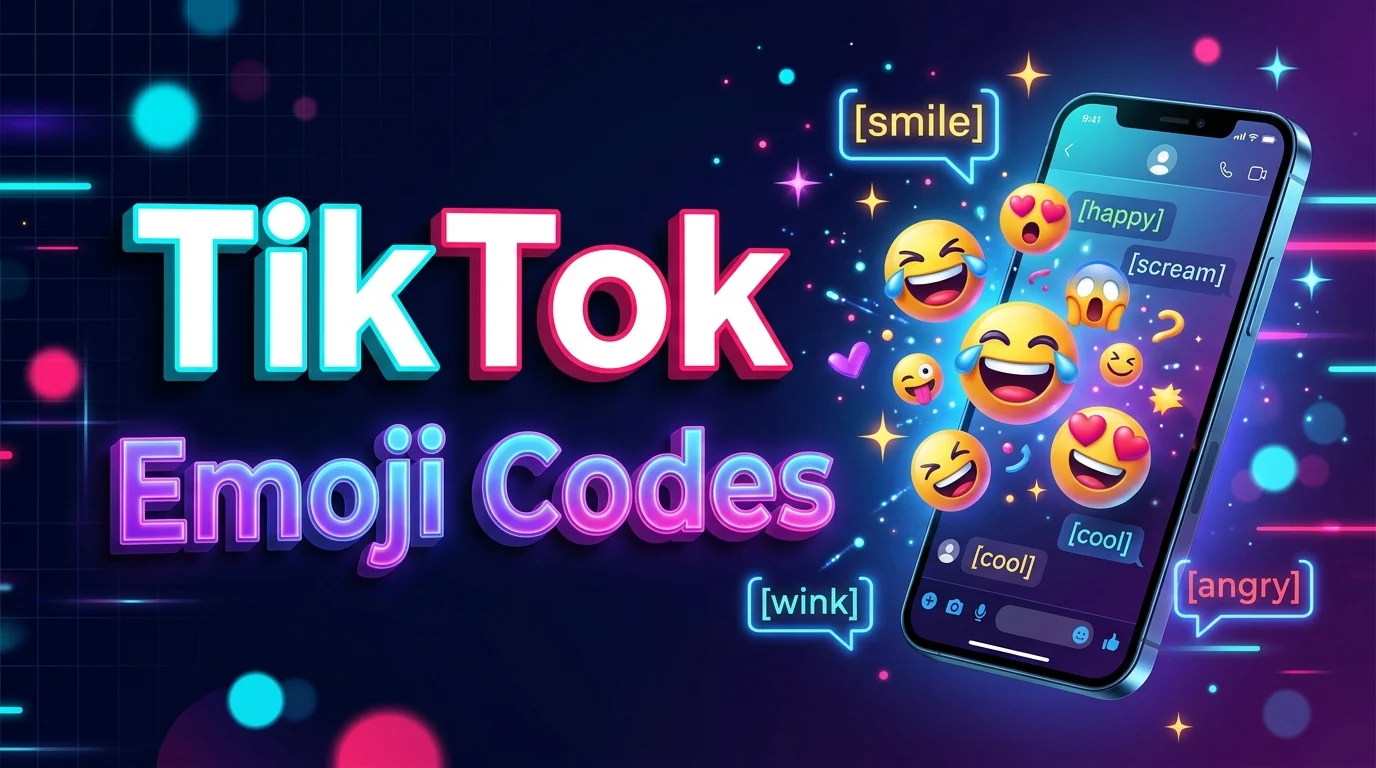
TikTok emoji codes are special words written inside square brackets that turn into small, custom-style emoji faces when TikTok recognizes them. Unlike the regular emojis on your phone keyboard, these hidden expressions have their own names, appearances, and uses within the platform. You may have seen someone comment [smile], [wronged], or [loveface] and wondered why a word suddenly appears as a little illustrated face. These shortcuts make TikTok conversations more expressive, playful, and sometimes confusing for people who do not know what the codes mean.
The interesting part is that the code’s name does not always explain the expression perfectly. Some represent familiar emotions, while others are used for teasing, embarrassment, affection, or dramatic reactions. Understanding the codes helps you recognize what people are communicating instead of guessing from the bracketed word alone.
Quick Answer
TikTok emoji codes are hidden text shortcuts, such as [smile] and [happy], that TikTok converts into custom emoji-style graphics when supported.
You enter the exact code inside square brackets in a supported TikTok comment or caption. The displayed expression can communicate happiness, sadness, affection, surprise, or other reactions.
What Are TikTok Emoji Codes?
TikTok emoji codes are hidden text shortcuts that activate custom illustrated expressions inside the TikTok app. Instead of selecting one of these faces from your phone’s normal emoji keyboard, you enter a specific word surrounded by square brackets.
For example, [smile] is a commonly documented TikTok code for a smiling expression. When TikTok recognizes a supported code in a compatible place, it displays the corresponding custom graphic.
These expressions are often called secret emojis, hidden emojis, TikTok emotes, or TikTok emoji shortcuts. They are popular because they give comments and captions a different visual style from ordinary text and standard phone emojis.
One important detail is that the word inside the brackets is not always a complete description of the face. A code may have a name that sounds simple, but its actual expression can communicate a more specific mood. That is why understanding both the code and its common use matters.
How to Use TikTok Emoji Codes
Using a hidden TikTok emoji is simple once you know the correct format. The important part is entering the code exactly as TikTok recognizes it.
- Open TikTok and go to a video where you want to leave a comment, or prepare a caption.
- Choose a supported emoji code.
- Type the code in lowercase letters with an opening and closing square bracket.
- Post the comment or publish the caption.
- Check whether TikTok has changed the text into its custom emoji.
For example, [happy] uses the code for a cheerful, open-mouthed expression. Writing happy without brackets will not activate the same shortcut.
The brackets are part of the code, not decoration. Avoid adding spaces inside them or changing the spelling. If TikTok does not recognize the entry, it may remain ordinary text instead of appearing as an illustrated face. These codes are commonly documented for TikTok comments and captions, although availability can vary with the app and where the text is entered. Social Media Dashboard+1
Full List of TikTok Emoji Codes and Their Meanings
TikTok’s commonly documented hidden emoji collection contains 46 codes. They cover a wide range of reactions, including happiness, embarrassment, affection, frustration, surprise, and humor. The following guide explains what each code generally represents and when it makes sense to use it. Social Media Dashboard+1
Happy and Positive TikTok Emoji Codes
| TikTok Code | Common Meaning | When to Use It |
|---|---|---|
[smile] | A gentle, friendly smile | To show happiness or appreciation |
[happy] | Big excitement and joy | When a video makes you genuinely happy |
[joyful] | Strong happiness | To celebrate something positive |
[lovely] | Love, affection, or a kiss | To react warmly to someone or something |
[angel] | Sweetness, innocence, or kindness | When something feels wholesome |
[pride] | Self-satisfaction or a confident attitude | When feeling pleased with yourself |
[complacent] | Relaxed, cool, or comfortable | To show a laid-back mood |
[yummy] | Enjoyment, approval, or hunger | For food videos or something appealing |
These codes are useful when you want a positive reaction without writing a full sentence. However, their tone is not identical. [smile] feels simple and friendly, while [happy] and [joyful] suggest stronger excitement. [angel] is more suitable for a sweet or innocent moment.
Sad, Crying, and Emotional TikTok Emoji Codes
| TikTok Code | Common Meaning | When to Use It |
|---|---|---|
[cry] | Crying or sadness | When something makes you emotional |
[weep] | Deep sadness or sympathy | For an upsetting or touching moment |
[tears] | Strong crying or emotional reaction | When a situation feels overwhelming |
[nap] | Sleepiness or low energy | When you feel tired or uninterested |
[wronged] | Shyness, bashfulness, or feeling awkward | When you feel nervous or shy |
The difference between these expressions is mainly the intensity and type of emotion. [cry] is a broad crying reaction, while [weep] often feels more serious or sad. [tears] can also be used for exaggerated emotional reactions, including moments that are so touching or funny that they make you emotional.
Funny and Playful TikTok Emoji Codes
| TikTok Code | Common Meaning | When to Use It |
|---|---|---|
[funnyface] | Being silly or playful | When joking with someone |
[laughwithtears] | Laughing very hard | When a video is extremely funny |
[hehe] | A quiet or mischievous giggle | For a small joke or cheeky reaction |
[laugh] | Strong laughter | When something makes you laugh out loud |
[excited] | Excitement or intense amusement | For an entertaining or surprising moment |
[cute] | Something adorable | For cute animals, people, or moments |
[blink] | A wink or cheeky expression | When teasing or being playful |
[loveface] | Strong affection or admiration | When you really love what you see |
These codes are especially useful in funny comment threads. For example, [hehe] can feel like a quiet laugh, while [laughwithtears] suggests that something is much funnier. [blink] can add a playful or slightly flirty tone, depending on the conversation.
Angry, Annoyed, and Sarcastic TikTok Emoji Codes
| TikTok Code | Common Meaning | When to Use It |
|---|---|---|
[angry] | Anger or frustration | When something genuinely annoys you |
[shout] | Strong frustration or an intense reaction | When you want to express an outburst |
[sulk] | Being upset or displeased | When you are unhappy about something |
[wicked] | Mischief or a naughty attitude | For a cheeky or troublemaking moment |
[facewithrollingeyes] | Disbelief or annoyance | When something seems ridiculous |
[disdain] | Being fed up or unimpressed | When you strongly dislike a situation |
[astonish] | An intense, angry, or shocked reaction | When something leaves you speechless |
[rage] | Extreme anger | When a situation feels infuriating |
[evil] | A mischievous or naughty mood | When joking about doing something bad |
[slap] | A sharp reaction to an insult or rude remark | For a dramatic response to someone’s comment |
Not all these codes communicate anger in the same way. [angry] is a direct expression of frustration, while [facewithrollingeyes] is more sarcastic or dismissive. [rage] is much stronger and works best when you want to exaggerate how annoyed you feel.
Surprised, Confused, and Awkward TikTok Emoji Codes
| TikTok Code | Common Meaning | When to Use It |
|---|---|---|
[surprised] | Surprise or amazement | When something unexpected happens |
[scream] | Fear or shock | When a video is frightening or startling |
[speechless] | Having no words or feeling annoyed | When a situation is hard to explain |
[thinking] | Thinking, doubt, or confusion | When considering something |
[wow] | Amazement or surprise | When something impresses you |
[stun] | Being stunned or shocked | When you cannot believe what happened |
[smileface] | A watchful or slightly suspicious smile | When something seems questionable |
[awkward] | Nervousness or discomfort | During an uncomfortable moment |
[shock] | A strong surprised reaction | When something catches you off guard |
[greedy] | Wanting money, rewards, or more of something | For jokes about money or wanting something |
A useful distinction is that [thinking] suggests you are considering something, while [speechless] suggests you do not know what to say. [surprised], [wow], [stun], and [shock] all involve surprise, but they can give a comment different levels of intensity.
What Does [wronged] Mean on TikTok?
[wronged] is one of the most recognizable hidden TikTok emoji codes. It is associated with a shy, bashful expression, often shown with sad-looking eyes and two fingers pointing toward each other.
People commonly use it when they feel embarrassed, nervous, timid, or playfully unsure about something. It can also make a comment sound softer or more vulnerable.
For example:
- “You actually noticed my new haircut? [wronged]”
- “I was too shy to say hello [wronged]”
- “That compliment made me nervous [wronged]”
The code does not always mean that someone has been treated unfairly, even though the word “wronged” might suggest that meaning. In TikTok usage, the expression is more closely associated with shyness and bashfulness. Emojipedia+1
What Is the Difference Between TikTok Hidden Emojis and Regular Emojis?
TikTok hidden emojis and regular phone emojis both help people express feelings, but they work differently.
| Feature | TikTok Hidden Emojis | Regular Phone Emojis |
|---|---|---|
| How they are entered | Through specific bracketed codes | Through the device’s emoji keyboard |
| Appearance | TikTok’s custom illustrated faces | Designs supplied by the device or platform |
| Where they work | In supported TikTok features | Across many apps and websites |
| How they are recognized | TikTok must recognize the shortcode | The app must support the character |
| Main purpose | Add TikTok-style expressions | Communicate general emotions and ideas |
A regular smiling emoji can be used in many messaging apps, while a TikTok hidden code depends on TikTok recognizing the exact shortcut. This difference explains why a bracketed code may not produce the same graphic on another social platform.
Do TikTok Emoji Codes Work in Comments and Captions?
TikTok emoji codes are commonly used in comments and captions. They allow users to add a custom expression while reacting to a video or writing a short message.
In comments, they can make a reaction feel more personal. Someone watching a funny clip might use a laughter code, while a viewer responding to an emotional story might choose a crying expression.
In captions, they can add personality to a post or support the mood of the text. For example, a cheerful caption may suit a happy expression, while a playful post may work better with a cheeky face.
However, do not assume that every TikTok text field supports every hidden code. If a shortcut remains visible as bracketed text, it may not be supported in that location or under the current app behavior.
Why Are TikTok Emoji Codes Not Working?
Sometimes a TikTok emoji code appears as ordinary text instead of turning into a custom face. This can happen for several reasons.
1. The Code Is Misspelled
A small spelling mistake can prevent TikTok from recognizing the shortcut. Check every letter against the supported code. For example, [smile] and [smiel] are not the same entry.
2. The Square Brackets Are Missing
The brackets are essential. Typing only the word happy does not use the same format as [happy].
3. There Are Extra Spaces
Keep the code together without spaces between the brackets and the word. An entry with spaces may not be recognized.
4. The Code Is Not Supported
Not every word that sounds like an emoji name is a valid TikTok shortcut. Use a documented code rather than guessing a new one.
5. The Feature Is Not Available in That Text Field
A code that works in one part of TikTok may not behave the same way everywhere. Try it in a standard comment or another commonly supported location.
6. The App Needs an Update
An older app version may not behave as expected. Check whether an update is available, then test the code again.
7. You Are Using TikTok Outside the App
Hidden emoji behavior is designed for TikTok’s own environment. When the same bracketed text is entered into another platform, it generally remains ordinary text rather than becoming TikTok’s custom graphic. Slangary+2
Can You Use TikTok Emoji Codes on Other Social Media Apps?
TikTok’s hidden emoji codes are not universal shortcuts. A code such as [smile] is associated with TikTok’s custom emoji system, so Instagram, Facebook, WhatsApp, and other platforms will generally display the bracketed word as text.
This is important when sharing comments or captions outside TikTok. A person who sees the code on another platform may not understand that it was intended to create a custom TikTok expression.
If you want the same reaction to be understood across different apps, use a familiar expression in your wording or choose a standard emoji supported by the platform. The TikTok-specific shortcut is best treated as an in-app feature.
TikTok Emoji Codes in Real Comment Examples
The following examples show how hidden codes can fit naturally into TikTok conversations. They are sample messages, not fixed meanings or official dialogue.
1. Reacting to a funny video
- Person A: “I can’t stop laughing at this.”
- Person B: “The ending got me [laughwithtears]”
Meaning: The second person is showing that the video was extremely funny.
2. Responding to a cute animal
- Person A: “Look at this tiny puppy!”
- Person B: “That face is too adorable [cute]”
Meaning: The code adds an affectionate reaction to something adorable.
3. Showing embarrassment
- Person A: “You waved at the wrong person.”
- Person B: “Please don’t remind me [embarrassed]”
Meaning: The person feels awkward about the situation.
4. Reacting to surprising news
- Person A: “She just announced that she’s moving abroad.”
- Person B: “Wait, seriously? [shock]”
Meaning: The sender is showing disbelief or surprise.
5. Showing affection
- Person A: “I made this little gift for you.”
- Person B: “You are so sweet [loveface]”
Meaning: The sender is responding with affection and appreciation.
Common Misunderstandings About TikTok Emoji Codes
1. Thinking Every Bracketed Word Is a TikTok Emoji
Only supported shortcuts activate the hidden graphics. Adding brackets around an ordinary word does not automatically turn it into an emoji.
2. Assuming the Code Name Explains the Whole Expression
Some names can be misleading. For example, [wronged] is commonly associated with shyness rather than simply feeling mistreated.
3. Believing All Hidden Emojis Have the Same Mood
The collection includes positive, negative, playful, emotional, and sarcastic expressions. Choosing a code that matches the situation helps prevent confusion.
4. Expecting the Codes to Work Everywhere
These shortcuts are tied to TikTok. Other apps generally do not recognize them as custom emoji commands.
5. Treating Every Use as Serious
People often use hidden emojis playfully or dramatically. A crying face may express sadness, but it can also exaggerate how funny or touching a video feels.
6. Assuming a Code Will Work in Every TikTok Field
Support can depend on where the text is entered and how the app handles it. A code that does not render in one place is not necessarily misspelled.
How to Choose the Right TikTok Emoji Code
The best code depends on the reaction you want to communicate. Instead of choosing one only because its name sounds interesting, consider the mood of the video and the message you are replying to.
- For happiness:
[smile],[happy], or[joyful] - For laughter:
[hehe],[laugh], or[laughwithtears] - For sadness:
[cry],[weep], or[tears] - For shyness:
[wronged]or[embarrassed] - For affection:
[lovely],[loveface], or[drool] - For surprise:
[wow],[stun], or[shock] - For annoyance:
[angry],[sulk], or[facewithrollingeyes] - For a playful mood:
[funnyface],[blink], or[wicked]
A good choice should support the meaning of your comment rather than distract from it. If a reaction could be misunderstood, adding a few words can make your intention clearer.
Frequently Asked Questions
1. What are TikTok emoji codes?
TikTok emoji codes are special bracketed words that activate custom illustrated expressions in supported areas of the TikTok app. Examples include [smile], [happy], and [wronged].
2. How many secret emoji codes does TikTok have?
A commonly documented collection contains 46 hidden TikTok emoji codes. These include expressions for happiness, sadness, laughter, embarrassment, anger, affection, and surprise. Social Media Dashboard+1
3. What is the most popular TikTok emoji code?
There is no reliable universal ranking of the most-used code. However, [smile], [happy], [wronged], and [loveface] are among the recognizable shortcuts frequently discussed in guides to TikTok’s hidden emojis.
4. What does [happy] mean on TikTok?
[happy] represents a cheerful expression with a wide, open smile. People use it to show excitement, happiness, or enjoyment when reacting to a post.
5. What does [wronged] mean on TikTok?
[wronged] is commonly used for a shy or bashful expression. It can communicate nervousness, embarrassment, or a playful feeling of being timid.
6. Why do TikTok emoji codes have brackets?
Square brackets are part of the shortcode format TikTok recognizes. The word alone is not enough to activate the hidden expression. The complete entry must use the supported spelling and bracket format.
7. Do TikTok emoji codes work on iPhone and Android?
The commonly documented hidden emoji set is supported on both iOS and Android versions of the TikTok app. However, individual results can depend on app behavior and where the code is entered. Emojipedia+1
8. Why does my TikTok emoji code show as text?
It may be misspelled, missing a bracket, or entered in a location that does not support the feature. Check the exact spelling and try a commonly recognized code in a standard TikTok comment.
9. Can I use TikTok emoji codes on Instagram or WhatsApp?
Generally, no. These are TikTok-specific shortcuts. Other platforms usually display the bracketed words as ordinary text instead of converting them into the custom TikTok graphics.
10. Are TikTok emoji codes the same as regular emojis?
No. Regular emojis are selected from a device keyboard and work across many platforms. TikTok hidden emojis use special text shortcuts and depend on TikTok recognizing those codes.
11. Can TikTok emoji codes have different meanings?
Yes. Their interpretation can depend on the conversation and the way someone uses them. A crying expression, for example, may communicate sadness, exaggerated emotion, or a reaction to something extremely funny.
12. Are new TikTok emoji codes added regularly?
The available collection can change as TikTok updates its features. Do not assume that a newly invented bracketed word is a working code. Check whether TikTok actually recognizes it before using it as a supported shortcut.
Conclusion
TikTok emoji codes make comments and captions more expressive through hidden bracket shortcuts that activate custom illustrated faces. From cheerful reactions like [happy] to shy expressions like [wronged] and dramatic responses like [shock], each code offers a different way to communicate a mood.
The key is understanding what the expression suggests, entering its spelling correctly, and using it in a supported part of TikTok. Once you know the difference between the codes, you can recognize these hidden reactions more easily and understand what people are trying to express in their comments.
Discover More Post:
- OK Emoji Meaning Explained | Hidden Feelings, Uses & Texting …
- Windows Emoji Shortcut | Master Faster Typing and Hidden …
- Red Circle Emoji | Meaning, Uses & Hidden Messages You …